Which way, Germany? Why German rearmament might end up dividing Europe
Which way, Germany? Why German rearmament might end up dividing Europe
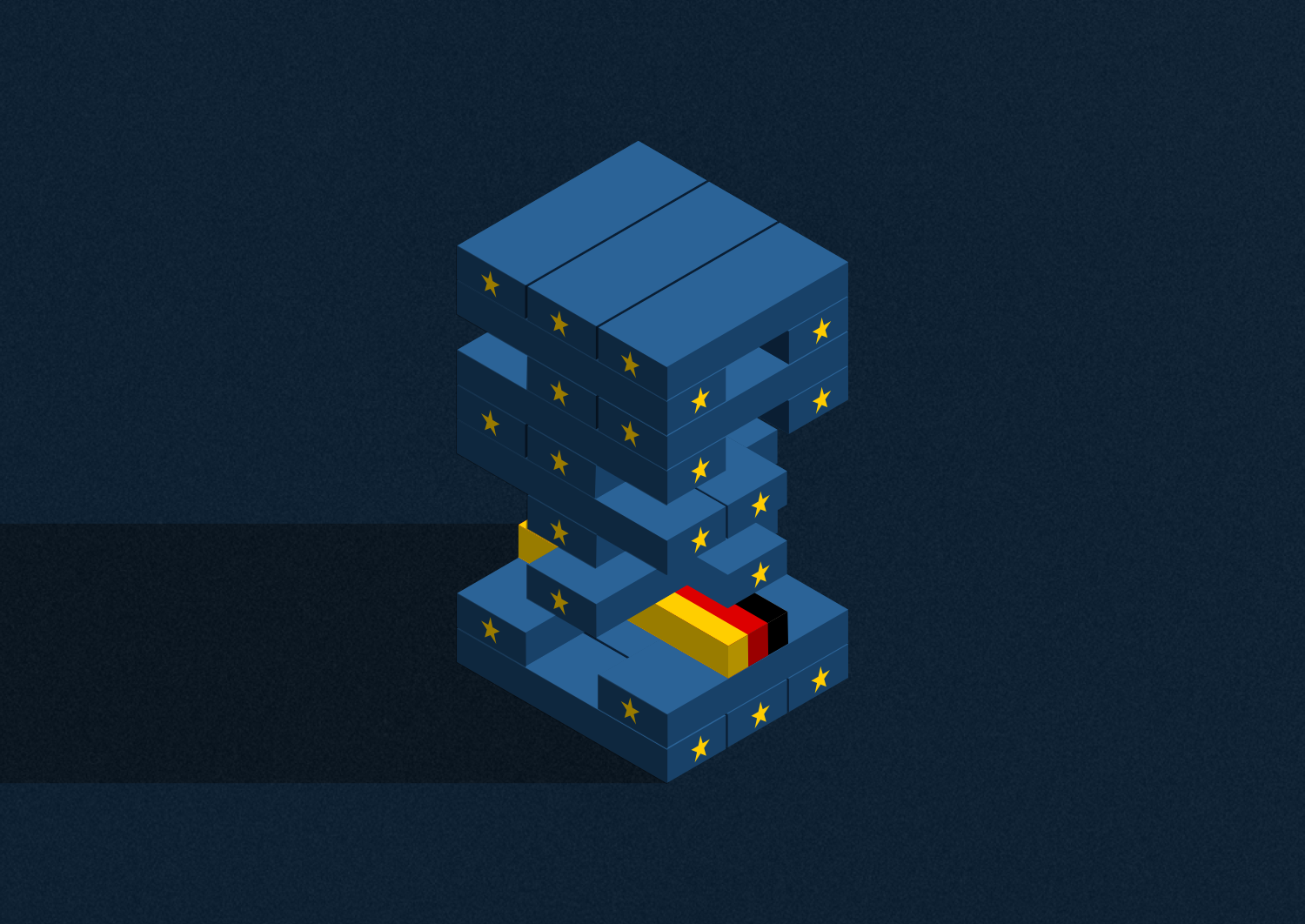
German rearmament is meant to unite Europe, but unless Berlin embeds it in European structures, it risks dividing it.
Image Credit: Euro Prospects
By Golo Vanden Eynde, Defence & Foreign Policy Correspondent
Edited by Brian Haughton, United States Correspondent
21 October 2026

We often like to pretend that all EU member states were created equal. In reality, however, some were clearly created a little ‘more equal’ than others. None more so than Germany. What happens in Germany has major reverberations across the continent and, indeed, the world. Which direction Germany decides to take over the coming years is therefore one of the most consequential ‘what if’ questions for the future of European unity and transatlantic cooperation, the two pillars on which the postwar order always used to rest.
Germany is indeed experiencing a Zeitenwende, a major transformation of its geopolitical stance. It is once again spending big on defence, scaling up its military, and even strengthening its secret service, the BND. This comes as good news in times of geopolitical competition and demands for greater European strategic sovereignty. At the same time, however, Germany is facing a stagnant economy, social tensions resulting from misguided migration policies, and a rapidly rising far-right movement in the form of the AfD, the Alternative für Deutschland, which might even win the next federal elections. Thus, German rearmament comes at a particularly precarious moment.
The AfD’s outspoken support for restoring political ties with Moscow is well-documented at this point. Members of the AfD have called for exiting the EU, abandoning the Euro, leaving the Schengen Area, a complete withdrawal of American NATO troops from German territory, and stronger relations with Russia.
In essence, German politics is caught between two competing visions of the country’s sense of self and its place in the world. On the one hand, there is the well-established view of Germany as the ‘motor’ behind European integration and transatlantic security. On the other hand, there is growing support for a very different vision of Germany, which sees it as a nation unto itself that should not share the burden of others but simply pursue its own interests. We could also refer to this as the dichotomy between the liberal postwar consensus on one side, established after 1945 and reaching its zenith in 1989, and the national-populist reaction against that consensus on the other.
Thus, Germany is trapped in a political interregnum, in which, as Gramsci described, “the old is dying and the new cannot yet be born.” Clearly, the old liberal model, based on globalisation, open borders and unfettered free trade, is in a deep, severe crisis; but the new, illiberal model that the AfD represents would not necessarily be better. It may indeed prove to be much, much worse.
In such a context, German rearmament could actually become a catalyst for political fragmentation, rather than greater unity. As Liana Fix has argued in an article for Foreign Affairs, aptly titled ‘Europe’s Next Hegemon: The Perils of German Power’: “People in Europe have largely been happy to see Berlin rebuild its military to defend against Russia. But they should be careful what they wish for. Today’s Germany has pledged to use its outsized armed power to help all of Europe. But left unchecked, German military dominance might eventually foster divisions within the continent. […] An AfD-controlled Germany might use its power to bully or coerce other countries, leading to tensions and conflict.”
Why the AfD’s foreign policy agenda is gradually gaining support
What explains the growing support for the AfD’s isolationist stance concerning foreign policy? To understand this, we have to look at the country’s complex relationship with Russia, especially with regard to Russian energy supplies, which are crucially important for German households, industry, and the economy in general.
With the benefit of hindsight, the closing down of Germany’s nuclear power plants in the wake of the Fukushima disaster in Japan, and the subsequent construction of the two Nord Stream pipelines in 2011 and 2021, may have been the biggest geopolitical blunder in Germany’s recent foreign policy history.
Firstly, because it effectively sidelined Ukraine, which already had pipelines running from Russia to Germany on its territory, giving Ukraine both a secure source of income and strategic leverage.
Secondly, because it made German industry dangerously dependent on continued energy supplies from Russia, a dependency which Russia shamelessly exploited by cutting Germany off from the gas supply following the invasion of Ukraine.
The result has been spiralling energy costs and deindustrialisation. Despite the best efforts of Chancellor Scholz (SPD) and his successor, Chancellor Merz (CDU), to replace Russian gas with American LNG and other energy sources, gas prices are still significantly higher than in China and the US.
The understandable public frustration that followed has contributed to the AfD achieving remarkable results in the recent elections in Saxony-Anhalt, where they received 44% of the vote, Mecklenburg-Vorpommern, where they received 38% of the vote, and even in the notoriously left-wing capital Berlin, where they still finished third with 16% of the vote.
What the AfD’s rise might mean for the future
If the AfD were to win the federal elections in 2029 and the so-called Brandmauer (the ‘firewall’ intended to keep the AfD out of power) were to fail, a number of different outcomes could be possible.
In the very best-case scenario, the AfD would moderate its position, abandon its soft-authoritarian and pro-Russian stance, and essentially become a party like any other. At present, this is highly unlikely, but it is not entirely unthinkable. In fact, the party has already backtracked on its idea to quit the Euro.
Under a worse scenario, the AfD would drag its coalition partners with it and convince them to adopt several of the party’s more problematic policies, while still remaining technically within the broadly accepted guardrails of the EU’s rule of law requirements. In Saxony-Anhalt, there are already signs of the party cooperating with left-wing populists to weaken support for Ukraine.
In the absolute worst-case scenario, an AfD-led government might decide to stop Germany’s support for Ukraine, re-engage with Russia, and leave the European Union and North Atlantic Treaty Organisation completely, thus endangering the security architecture of the entire continent. It must be said that this remains, for now, a distant prospect. Nevertheless, it is no longer an impossibility. This alone should be a serious cause for concern.
Thus, German rearmament might turn out to be a double-edged sword. On the one hand, it is a necessary step towards European self-sufficiency in defence. On the other hand, it could become a powerful dividing force, driving Germany further apart from its neighbours. For now, this may seem far-fetched. Yet, as far as the AfD are concerned, unconditional support for multilateral organisations like the EU or NATO is nothing less than an absurdity. What the AfD considers to be in Germany’s national interest should always come first. The defence of other nations, they argue, is none of Germany’s concern.
That is not to say that a full withdrawal from NATO or the EU is a likely scenario. However, similar to how Trump’s return to office damaged but did not spell the literal ‘end’ of the transatlantic relationship, an AfD-led government would not have to pull the plug completely out of NATO or the EU in order to render them essentially impotent.
Towards a solution: embedding German rearmament within pan-European structures
Averting the above will require systemic solutions to Germany’s social, political and economic crises. This in turn requires drastic reforms, both at the national and the European level, not only regarding defence, but also regarding competitiveness, migration management, and energy security.
Concerning defence, greater interoperability of military capabilities and deeper integration of the German Armed Forces within a single European framework (the so-called ‘European pillar’ within NATO) would go a long way in preventing any kind of adventurism from future German governments, and in reassuring Germany’s allies of its continued reliability. As Liana Fix has pointed out, however, successive governments have quietly yet decisively opposed such reforms. The current government is no exception. It has prioritised Germany’s domestic defence industry (think of giants like Rheinmetall and Thyssenkrupp) at the expense of a stronger European defence sector. In June 2026, it ended its cooperation with France on the new FCAS fighter jet program, and in October, it withdrew from the joint Franco-German MGCS tank project.
As Liana Fix described in Foreign Affairs, “Germany wants procurement to remain firmly in the hands of national governments and rejects a greater coordinating role for the European Commission. What the continent’s defense industry needs is Europeanization and a single market for weaponry, but Berlin’s policies are not pushing the sector in this direction. […] Germany recently loosened its debt brake to allow for almost unlimited defense expenditures, an option that most European countries — which have larger deficits — don’t have. The best solution to this conundrum would be for the European Commission to engage in large-scale joint borrowing for defense. […] Berlin, however, has refused to allow such a sweeping defense initiative.”
Berlin’s resistance also stemmed from its instinctive fiscal frugality and opposition to ‘wasteful’ EU spending. Opponents of industrial policies have long argued that such policies are a violation of free market principles and a waste of government money. There is certainly some validity to this line of criticism, but when it comes to defence spending, where the government is the sole customer, it no longer holds up. Moreover, it fails to take into account the growing great power competition in which Germany (and the EU in general) currently finds itself.
The question is not whether Europe needs a defence-industrial policy, but whether such a policy should be directed by the national capitals or by the European Commission. As the example of Germany clearly illustrates, leaving it entirely to the member states carries the risk of creating irreparable fault lines within the EU’s architecture. In order to prevent further fragmentation in defence down the line, it might therefore be prudent to give a greater coordinating role to the European Commission.
So far, the assumption has been that German rearmament is almost guaranteed to strengthen European strategic sovereignty, but what if this assumption turns out to be wrong? What if, instead of strengthening Europe, a more militant Germany actually helped to divide it? Taking this long-term possibility seriously, and enacting the reforms required to avoid it, would go a long way in preventing potential fragmentation in the future.
Conclusion
Germany’s troubles are not unique to Germany. They are the same set of challenges that almost all Western European governments currently face. Resolving them will therefore require closer coordination with Germany’s allies and a stronger, more capable European Commission. Withdrawing Germany’s membership from multilateral organisations like NATO and the EU would be highly counterproductive, as it would not only hurt Germany’s own interests, but effectively upset the entire established order in Europe, similar to how German unification reshaped Europe’s balance of power after 1871.
Transatlantic cooperation within NATO and European integration within the EEC/EU were intended, at least in part, to contain German power and prevent another major conflict on the continent. If Germany were to leave these institutions, it might potentially lead to some of the same geopolitical tensions that resulted in three great wars between 1870 and 1945. It would be wrong to pretend that Germany is anywhere near to returning to its imperialist past, or that the AfD is even vaguely comparable to Hitler’s murderous regime, but it would be equally dishonest to ignore the obvious warning signs, or to foster the illusion that there is nothing new under the sun.
Public frustration is understandable and national issues must indeed be addressed, but abandoning the EU or cutting ties with NATO will not solve Germany’s national issues, but only make them worse. Moreover, it would put an end to European unification and effectively hand victory to Russia and China, both of which would stand to benefit from Europe’s internal discord.
Finding a sustainable solution to Germany’s woes will require major reforms at both the national and the European level. We have known about the necessity of these reforms for ages; it is high time they are acted upon. This demands a willingness to take tough but necessary decisions. It requires what the former German Chancellor Gustav Stresemann once called “der Mut zur Verantwortlichkeit” – the courage of responsibility.
Will this powerful nation at the heart of Central Europe manage to find that courage? Will it face up to the crisis it is currently confronted with in a way that does not weaken its friends and allies? Or will it take the opposite approach and join the ranks of the autocratic forces of the world? Which way, Germany?
Disclaimer: While Euro Prospects encourages open and free discourse, the opinions expressed in this article are those of the author(s) and do not necessarily reflect the official policy or views of Euro Prospects or its editorial board.

Defence & Foreign Policy Correspondent
Prior to joining Euro Prospects, Golo Vanden Eynde studied History and European Studies at KU Leuven, and International Relations in Historical Perspective at Utrecht University. In addition, he pursued further education at the Clingendael Institute in The Hague, and worked as a journal editor at the Nexus Institute in Amsterdam, where he still remains active as a volunteer. His research interests include the history of pan-European federalism, the origins of neofunctionalist theory, the importance of crisis as a driving factor behind the European integration process, and the gradual transformation of the European Union from ‘Maastricht’ to the present. Above all, he feels passionate about improving the EU’s Common Foreign and Security Policy, reforming its decision-making procedures, and strengthening Europe’s strategic sovereignty.
Edited by Brian Haughton | Follow our European journalism