Horizon Europe’s Scientific Answer to a Bipolar World
Policy Brief
22 October 2026
Innovation Geopolitics
Horizon Europe’s Scientific Answer to a Bipolar World

It is hard to overstate the innovative capacity of the US and China. To compete on equal footing, the EU must leverage its strategic edge: the collaborative nature of its own flagship R&I programme, now the largest research coalition in the world.
Executive Summary
Research and innovation (R&I) is replacing traditional manufacturing capacity and resource wealth as the true determiner of global power, and the US-China contest over it is in full swing. The European Union (EU), while an innovation power in its own right, is losing ground, yet its case is not unique. Fellow middle powers Canada, Japan, and others simply cannot compete individually with the US’ public-private €1 trillion/year R&I expenditure. Yet while American and Chinese government R&I schemes remain fundamentally closed off, the EU’s strategic edge lies in the collaborative nature of its flagship R&I programme. For decades, but exponentially across the last three years, Horizon Europe has steadily built a functioning multilateral research network spanning 23 non-EU countries, including nearly all of non-EU Europe as well as Canada, Japan, Korea, Tunisia, Israel, New Zealand, Egypt, and soon Australia. With India and Singapore on the table, it is the world’s largest R&I coalition, mobilising a combined research expenditure that rivals the US’.
Yet that programme remains arguably underexploited, with its most pioneering R&I schemes, such as the European Research Council and European Innovation Council, not part of the association agreements of non-European members. With Horizon’s funding set to double and its framework overhauled for the EU’s 2028-2034 budget, the EU has a realistic opportunity to convert this underexploited network into a deliberate strategic architecture: an innovation bloc of like-minded middle powers.
Key Recommendations
1
Commit to a €175 billion Horizon budget for 2028-2034 and expand the ERC and EIC within it
Commit to doubling Horizon Europe’s funding under the next EU budget and disproportionately expand the Framework’s Pillars I and III, thereby prioritising innovative forms of R&I funding under the European Research Council (ERC) and the European Innovation Council (EIC). Safeguard both against trade-offs towards Pillar II or the European Competitiveness Fund (ECF).
2
Create a “Trusted Partner” criteria for third-country Horizon association
Codify a third-country association criteria within Horizon Europe’s regulation, including therein: a track record in Horizon, shared democratic values, strong safeguards on IP, research integrity, and no clash with EU security interests.
Thereafter, set clear roadmaps for moving Canada, South Korea, New Zealand, and Japan out of Pillar-II-only status and into ERC and EIC eligibility. Fast-track Australia and India onto the same track.
3
Open the EIC Fund to capital from trusted partners
Permit partners’ public investment banks and sovereign funds to invest alongside the EU in EIC-backed start-ups.
4
Embed Horizon association in the EU’s trade and economic security policy
Link trusted partner status to trade, investment and standards agreements.
Analysis
Competition over advances in biotech, AI, quantum tech, and semiconductors is not merely a tech race frenzy. Instead, next-generation technologies sit at the centre of who will patent the next pandemic’s vaccine, set the ethical standards for artificial genetic manipulation, access the military applications of quantum tech, or use those discoveries to self-accelerate their own R&I. It marks a fundamentally different technological revolution from those that preceded it. Through AI and mass computing, those who drive advances in today’s next-generation technologies will be those who exponentially accelerate the timeline for their own subsequent scientific breakthroughs.
The competition engendered by that fact is already in full display between the world’s two clearest superpowers of innovation, backed by unmatched public and private R&I budgets and an increasing willingness to weaponise supply chains. As Washington tightens export restrictions on the semiconductors needed to train the next generation of AI models, Beijing has weaponised its near-monopoly over rare earths by claiming extraterritorial jurisdiction over any chip with Chinese-origin inputs. And with no other power able to individually match either country’s innovative capacity, the rest of the world lags behind to varying degrees.
The EU, while an ‘innovation power’ in its own right, particularly in scientific output, has not adapted to shifts in the global order as easily. Multilateralism and liberalised trade, both of which have fuelled the EU’s self-conception since its creation, have been ravaged, not least by the US.
Worse, or perhaps partly because of it, the EU finds itself at an unprecedented convergence of economic crises. The peace dividend an American security umbrella had once offered the continent is in decay. The Union’s backbone manufacturing industries, from pharmaceuticals to the automotive sector, are losing their competitive edge to China and the US. And save some exceptions, breakthroughs in next-generation technology are overwhelmingly happening abroad. For its part, energy crises, fragmented capital markets, national economic egos, a rogue Russia, and a classically European risk-averse investment attitude have not made 21st-century competitiveness an easy goal.
Yet, the EU’s story of struggling to adapt is not a unique one. From Canada to Japan, advanced middle power economies worldwide are under competitive strain. Similar to the EU, Canada houses world-class research hubs such as the deep learning centres of Montréal’s Mila or Toronto’s Vector Institute. Yet it consistently faces brain drain to Silicon Valley and lags in commercialising its own research output. While Japan spends as much as the US in R&D as a percentage of GDP, challenges like rigidity in adapting to new tech have undercut its historic dominance over key industries like the global semiconductor market. Yet, if the strain is shared, so too might be the solution.
The R&I wake-up call
Advanced economies are fully aware of R&I’s importance in closing their innovation gap. With negotiations over the next 2028-2034 EU budget in full gear, an unlikely coalescence across European governments, industry, and academia is backing a doubling in funding to the EU’s flagship R&I programme, Horizon Europe. When combined with the proposed European Competitiveness Fund, funding covering the full technological roadmap from basic research to deployment and commercialisation is expected to reach over €400 billion.
Beyond Europe, advanced economies are following suit. Japan is similarly doubling its public R&I budget to over €300 billion within its 2026-2030 Basic Plan for Science, Technology and Innovation, targeting over $1 trillion when combining private capital. South Korea is committing nearly $130 billion to its equivalent 2026-2030 Basic Plan with a hyper-focus on next-generation technological sovereignty. Singapore, while traditionally not an R&I-intensive heavyweight like Israel or South Korea, will hit yet another record-high budget with its nearly $30 billion 2026-2030 Research, Innovation and Enterprise Plan. Israel, while decentralised administratively, is the most advanced innovative power for its size, consistently breaking its own record of >6% of R&D expenditure as a percentage of GDP, more than any other country worldwide. Canada, partly due to its highly decentralised system, lacks an equivalent national strategy, yet it too is fully aware of its competitive gap and R&I’s necessity, as illustrated by its government-commissioned Bouchard Report.
Figure 1: Research & development spending as a share of GDP
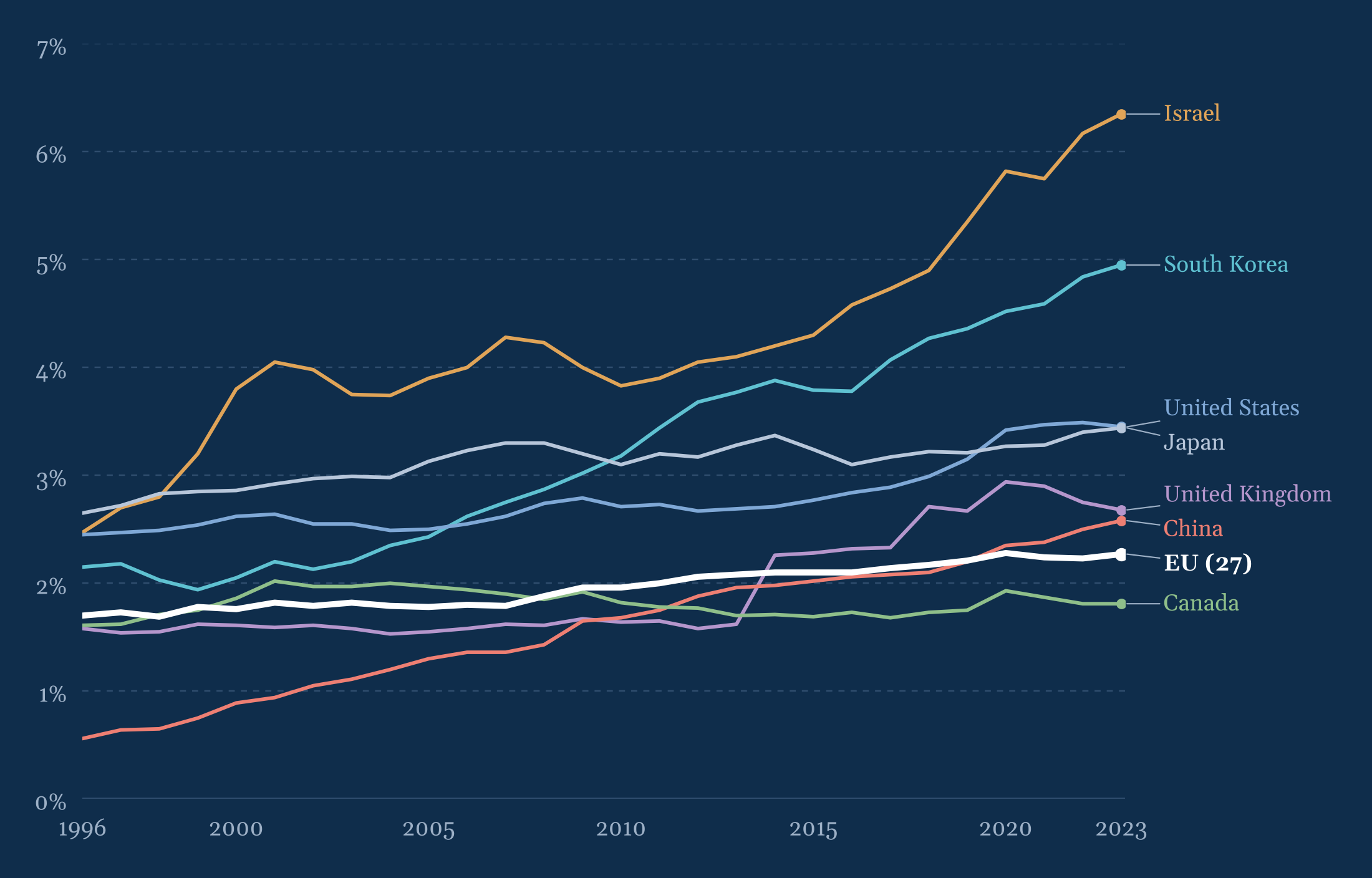
Source: UNESCO UIS Stat Bulk Data Download Service, via World Bank (2026) | Our World in Data
But despite these impressive figures, it’s hard to overstate the US’ lead. The American federal R&I budget musters approximately $200 billion a year across its various departments. Already monumental, that figure reaches a staggering $1 trillion when including state-level budgets, academic institutions, and more significantly, the US’ unparalleled pool of private capital dedicated to R&I. Europe’s equivalent gross domestic expenditure on R&D is just over €408 billion. Yet like China, moreover, the US’ schemes disproportionately prioritise late-stage development and commercialisation, particularly towards disruptive, next-generation technologies.
Beyond the numbers, the US excels in pioneering forms of R&I funding itself, innovating schemes well beyond the traditional one-off research grants. The Advanced Research Projects Agency (ARPA), to take just one example, has become a revolutionary funding model for frontier research too risky for commercial markets or traditional academia. Created in 1958 by the Department of Defense, it temporarily hires elite scientists to act as so-called ‘Program Managers’ (PMs), empowering each with near-total autonomy to pitch ideas, allocate multi-million-dollar budgets, and hand-pick teams across academia, private industry, and startups to reach pre-determined research goals. Among its thousands of projects, the ARPA model developed the internet’s processor under PM J. C. R. Licklider, the miniturised GPS under PM Sherman Karp, and even the AI that gave way to Apple’s Siri under PM David Gunning, to name a few examples. So successful, the model has been replicated across departments, from ARPA-E at the Dept. of Energy to ARPA-H at the Dept. of Health & Human Services. Now, Horizon Europe itself is seeking to replicate it with its own set of ‘Programme Managers’ at the European Innovation Council (EIC).
But even if only for the budget figures, the EU alone simply cannot compete at that level.
Horizon Europe’s multilateral edge
What Horizon Europe has that its US equivalents do not, however, is its internationally collaborative edge. Washington and Beijing’s R&I programmes are fundamentally closed off, often under the premise of national security. Conversely, Horizon Europe and its previous iterations have permitted third-country membership for decades, allowing foreign-registered researchers and organisations of associated members to compete for research grants and lead research consortia under the same conditions as EU entities. Today, all of non-EU Europe, save Russia, Belarus, and some micro-states, are associate members of Horizon. Beyond the continent, Tunisia and Israel have been members for years. And over the past three years, the EU has signed association agreements with Canada, Egypt, Korea, Japan, and New Zealand. Australia has just concluded its association negotiations, now awaiting formal sign-off, and India has started preliminary talks. Together, it represents the largest R&I coalition in the world, mustering more public R&D expenditure per year than either the US or China.
Moving forward
Admittedly, the latter non-European associated members have largely concluded partial agreements limited to Horizon’s Pillar II, which focuses on the most bureaucratic and traditional form of R&I schemes: top-down, consortium-based, and funded under conventional research grants. This excludes researchers from those countries from accessing Horizon’s most exciting and pioneering programmes from the European Research Council (ERC) or the aforementioned European Innovation Council (EIC). Unlike Pillar II, the ERC ignores commercial viability entirely and sets no predetermined thematic goals, financing high-risk, high-reward ideas pitched by scientists themselves, with the sole criteria being scientific excellence. Based on the US’ DARPA model, possibly the EIC’s most exciting factor aside from its aforementioned Project Manager model is its use of blended finance. Through the EIC Fund, the EU itself acts as a venture capitalist, offering direct equity investment and becoming a shareholder within pioneering start-ups specifically in deep-tech (ie., synthetic biology, quantum computing, advanced materials, etc…).
Fully integrated into such programmes, an EIC Programme Manager could leverage world-class AI research talent from Canada’s Mila or Vector Institute, South Korea’s advanced memory chips, Japan’s semiconductor renaissance through emerging advanced manufacturers like Rapidus, or New Zealand’s Dodd-Walls Centre on frontier quantum-sensing research. An EIC Programme Manager could, in principle, draw on all four for a single next-generation computing project.
Closing
Canadian Prime Minister Mark Carney’s ‘middle power coalition’ has understandably been met with criticisms of cliché. Supply chains, geography, monopolies over raw materials, historical grievances, and divergent security dependencies make an all-inclusive coalition far more messy than first imagined. Yet Horizon Europe’s associated membership already offers a working framework for that thesis, albeit within one policy domain.
Moreover, the competitiveness gap is not a uniquely European condition, nor is its remedy. Innovative capacity around next-generation technologies will likely become central to all advanced economies’ competitiveness. Yet no single economy, as large as that of the EU’s is, will be able to outspend either the US or China in the foreseeable future. Indeed, only by leveraging the collaborative edge and openness of its R&I schemes can the EU and like-minded middle powers muster the scale necessary to compete on equal footing.
More from the ESP Series
Explore the other ESP policy briefs, each offering actionable recommendations on a strategic challenge facing the EU.
View All ESP Policy Briefs →About Euro Prospects
Euro Prospects is an independent platform for in-depth analysis of European political affairs. We publish articles on the issues shaping Europe today, from the EU–Mercosur trade agreement and Europe’s semiconductor supply chains to the European Union’s strategic shift on Syria and Serbia’s global arms trade, to name a few.
But informing readers is only part of our Mission. Euro Prospects was founded to help cultivate a European public sphere — a transnational space of political curiosity and civic engagement among Europe’s citizens.
Visit Euro ProspectsAbout ESP
The European Strategic Policy Unit (ESP) is Euro Prospects’ dedicated think tank department. We produce forward-facing, policy-actionable analysis on European strategic sovereignty across defence, technology, trade, energy, industry, and digital infrastructure.
Partnerships
Interested in citing, discussing, or building on this research? ESP is actively building relationships with researchers, institutions, and publications working on European strategic policy.
Contact UsESP Members
Francesco Bernabeu FornaraHead of Unit; Editor-in-Chief, EP
Giulia ConvertiniDigital Systems Sovereignty
Finn Sands RobinsonTrade & Industrial Strategy
Rimsha ArifEnergy Market Resilience
Matilde MinettiEU-China Strategic Competition
Orla HarrisDigital Infrastructure Sovereignty
Jerfi WigleySupply Chain Resilience
Annika GerbigDefence Industrial Autonomy
Trinabh BanerjeeStrategic Digital Security
Luka OkropirashviliEastern Neighbourhood
Juan Carlos LeunissenTransport & Energy Connectivity
Antoine Cerqueira Da CostaFintech Sovereignty Analyst
Sofia CigoliniEU Fiscal & Monetary Sovereignty Analyst
Erik Giuliano WürthnerESP Outreach & Partnerships Coordinator