Can UK-French Nuclear Cooperation Substitute for US Extended Deterrence?
Can UK-French Nuclear Cooperation Substitute for US Extended Deterrence?
Washington’s 2026 National Defense Strategy rests conspicuously silent on the future of its nuclear umbrella over Europe. Growing Anglo-French cooperation is being framed as the continent’s most plausible fallback, though its doctrinal limits mean it still falls short of a genuine substitute.
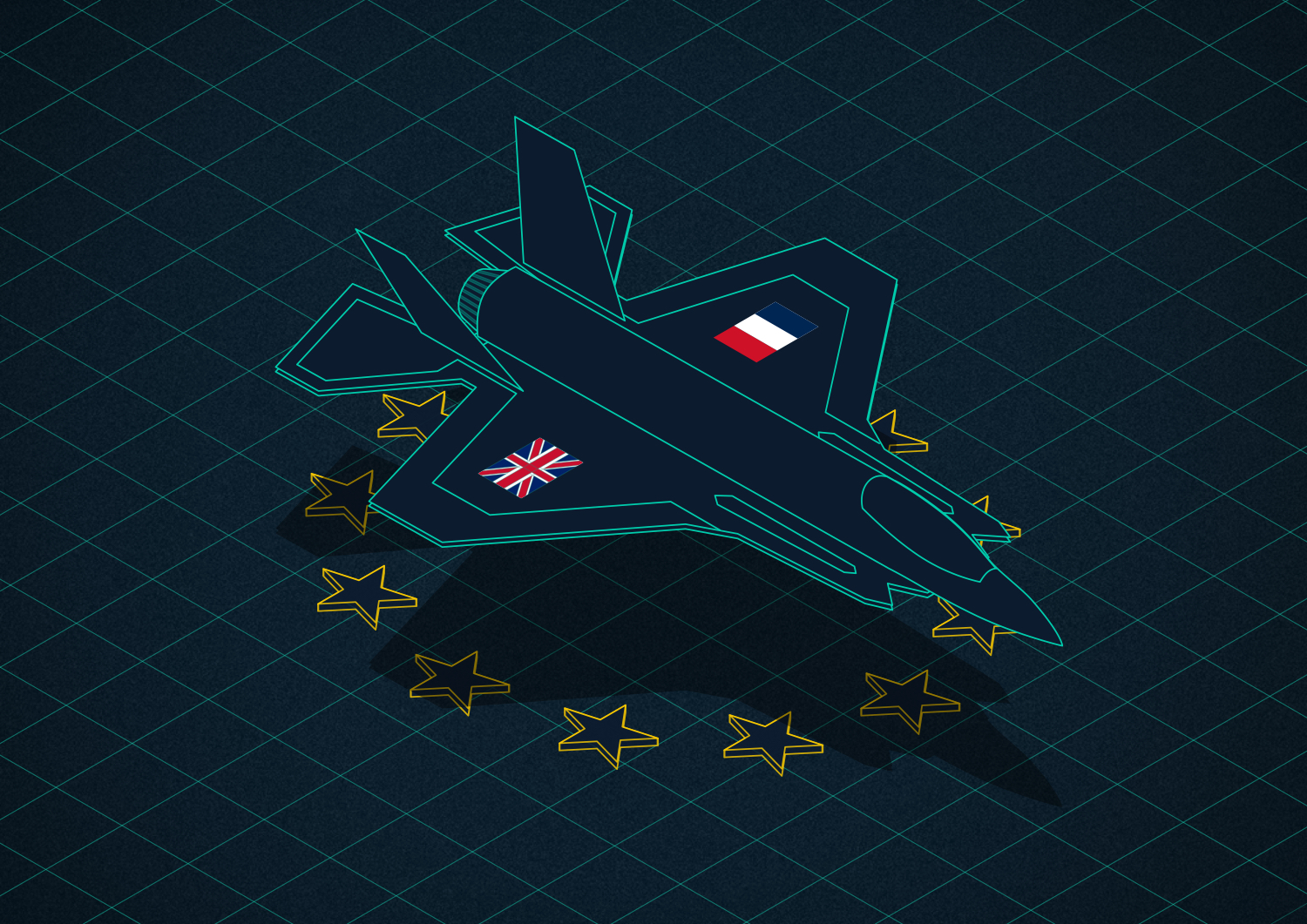
Image Credit: Euro Prospects
By Arthur Langley, UK & Nuclear Policy Analyst, Security & Defence Unit (S&D)
Arthur is an intern with the UK Nuclear Deterrence Network.
Edited by Mariona Fortuny Jané, Europe in the Indo Pacific Analyst, Security & Defence Unit (S&D), and Orla Harris, Digital Infrastructure Sovereignty Analyst, European Strategic Policy Unit
19 September 2026

The 2026 United States’ (US) National Defense Strategy is clear about its expectations from its European allies, positing that NATO allies are ‘strongly positioned to take primary responsibility for Europe’s conventional defense, with critical but more limited U.S. support’. Yet it is notably silent on the question of US extended deterrence. For Europe, a continent that has, for eight decades, treated the US nuclear commitment as a given for its own defence, that omission forces a recalibration of its deterrence posture for the first time in a generation.
This recalibration raises the question of what might replace the US nuclear umbrella, in the event that Washington’s nuclear guarantee were to recede. Anglo-French nuclear cooperation has begun filling in some of that space, and is increasingly presented as the most plausible European fallback should the United States withdraw entirely. However, the precise nature of this cooperation remains unclear, as does its adequacy with the lack of clarity likely due to the constitutional constraints on French nuclear command explored in the sections that follow. To address this uncertainty, this article outlines the requirements for genuine substitution and evaluates the Anglo-French relationship against that standard to conclude whether UK-France nuclear cooperation could feasibly substitute for U.S. extended deterrence.
Northwood and Lancaster House 2.0: the institutional base
Any assessment of whether Anglo-French cooperation could complement, or potentially mitigate a reduced US extended-deterrence role, should begin with the Northwood Declaration. Although it builds upon earlier bilateral nuclear cooperation, Northwood is the first Anglo-French framework explicitly to provide for the coordination of their independent nuclear forces across nuclear policy, capabilities and operations, rather than merely technical collaboration or wider conventional-force integration.
Signed on 10 July 2025, the Declaration confirms that UK and French nuclear forces remain independent, but can be coordinated, although it is deliberately limited in what it commits the two states to do. It does not specify how coordination would work in practice, nor does it establish shared targeting, joint command, or any form of pooled decision-making. What it does establish is a UK-France Nuclear Steering Group, co-chaired by the UK Cabinet Office and the French Presidency, tasked with political direction across nuclear policy, capabilities, and operations, significant because it remains closer to the understanding of the Gaullist logic of sovereign deterrence. Gaullist logic here signifies the principle, dating to de Gaulle’s presidency, that nuclear command must remain under sole national authority, unshared and undelegated even to close allies. This makes the declaration valuable, but still short of the level of integration, political commitment, and operational clarity that would be required for genuine substitution.
Despite the ambiguity, developments on the ground have moved further than the declaration itself lets on. The Nuclear Steering Group met for the first time in Paris on 10 December 2025, where UK representatives observed Operation Poker – France’s strategic nuclear airborne exercise – the first time any foreign officials had been granted that access.The nuclear track also sits within the wider Lancaster House 2.0 architecture, including the Combined Joint Force, the Entente Industrielle, and the Complex Weapons Portfolio Office, further evidence that this is not an isolated gesture but part of a broader institutional convergence. Even so, this amounts at most to trust-building beyond declaratory language, and still falls short of the integrated command, shared targeting, or doctrinal convergence that substitution for the U.S. guarantee would require.
Forward deterrence: dilution or expansion?
Macron’s speech at Île-Longue on 2 March 2026 announced the first increase in France’s nuclear warhead count since 1992, ending three decades of unilateral reductions that had run from Mitterrand through Chirac. The President also unveiled the concept of forward deterrence where selected non-nuclear allies may have access to French nuclear exercises, and potentially the temporary hosting of nuclear-capable aircraft for the first time. The initial group of eight European partners engaged in France’s emerging structured deterrence dialogue comprised the United Kingdom, Germany, Poland, the Netherlands, Belgium, Greece, Sweden and Denmark.
Two features of the French expansion bear directly on whether the wider Anglo-French relationship can meet the standard of genuine substitution set out at the start of this article.
The first, concerns integrated command, where Macron explicitly stated that France would not share decision-making under forward deterrence, since constitutional authority over the arsenal rests with the president alone. Therefore, exercises and hosting are on offer, but any degree of allied control over when or how the arsenal is used will be withheld. This is not a limit unique to the eight-state framework, but instead it is the same feature already present in Northwood, where British and French forces remain independent of one another by design. The cooperation now extended to the other eight states rests on the same non-negotiable term the UK itself accepted first. That consistency across eight different bilateral relationships suggests the absence of shared command is structural to how France cooperates with any partner, not a gap specific to the Anglo-French relationship that time or trust might eventually close.
The second issue is the coverage of the concept, whether a French-anchored arrangement could serve as a credible delivery chain for the allies who actually need it. The states most exposed to Russia – Finland and the Baltic three – are not among the current eight participants, since forward deterrence is opt-in and depends on a bilateral invitation from Paris rather than the automatic guarantee Article 5 of the Washington Treaty provides.
What an Anglo-French substitution requires
Genuine substitution, as this article has framed it, would require three things: integrated targeting and command, doctrinal convergence, and a credible delivery chain. As argued above, the Anglo-French relationship falls short – despite progress being made. What currently exists is closer to coordination than integration.
There is no evidence of fused targeting or joint decision-making between the UK’s national chain of command and its French counterpart. The Nuclear Steering Group provides political direction, and its co-chairs meet, discuss, and coordinate – but neither declaration nor practice has produced a body with authority over either country’s forces. Coordination remains something both chains do to one another, not something either is bound by.
Doctrinally, the two countries’ deterrents pull in different directions. Britain’s deterrent has been fully assigned to NATO since the 1962 Nassau Agreement, operating within the alliance’s nuclear planning structures. France’s has followed the opposite path, since de Gaulle withdrew France from NATO’s integrated military command in 1966, and the force de frappe was built specifically to answer to the French president only, on the reasoning that Washington could not be trusted to risk American cities over European ones. France’s continued non-membership of NATO’s Nuclear Planning Group, despite its 2009 return to NATO’s military command structures, underscores a fundamental asymmetry in any Anglo-French nuclear arrangement. The United Kingdom’s deterrent is assigned to NATO’s collective-deterrence architecture, whereas France’s force de frappe is deliberately maintained outside NATO’s nuclear-planning and nuclear-sharing arrangements under exclusive national authority. Cooperation must therefore reconcile deterrents embedded in materially different institutional and doctrinal settings.
A credible delivery chain is the third requirement, which remains underdeveloped in the British case. The UK’s continuous at-sea deterrent (CASD), based on Trident, has operated without interruption since 1969. Yet this sovereign, submarine-based capability is not integrated into the Anglo-French relationship and offers limited scope for the visible, flexible or geographically proximate signalling associated with an extended-deterrence role.The more pertinent issue is therefore the UK’s prospective air-delivered contribution to NATO.
The 2025 Strategic Defence Review recommended that the government explore enhanced British participation in NATO’s nuclear mission, after which the government announced the purchase of 12 F-35A aircraft and its intention to rejoin NATO’s dual-capable aircraft (DCA) mission. However, Air Vice-Marshal Jim Beck clarified in July 2026 that the initial 12 aircraft had been procured for the RAF’s operational conversion unit rather than as an operational DCA force. He further indicated that the size, composition and posture of any future nuclear-capable fleet remained subject to review, indicating that the air-delivered element of Britain’s deterrent contribution including the relevant aircraft numbers, basing and support arrangements, and enabling infrastructure has not yet been settled. Accordingly, it would be premature to treat a British air-delivered capability as a dependable component of an Anglo-French delivery architecture. At present, it is better understood as a prospective contribution whose operational credibility will depend upon subsequent decisions on force generation, sustainment and NATO integration.
The Verdict
Recent developments have moved Anglo-French nuclear cooperation beyond ad hoc consultation towards a more structured relationship. The establishment of the Nuclear Steering Group, British participation in Operation Poker and the incorporation of a nuclear track into Lancaster House 2.0 provide a basis for more sustained bilateral engagement. However, the relationship still lacks integrated targeting arrangements, as well as the UK’s prospective air-delivered contribution remaining undefined. These deficiencies are operational rather than constitutional, although they could be narrowed through capability investment, deeper planning and sustained political direction.
Doctrinal convergence is likely to be more resistant to change than the relationship’s operational limitations. French nuclear decision-making remains vested in the President of the Republic, reflecting Article 15 of the Constitution and the Gaullist principle that deterrence must remain under autonomous national control. Non-delegation is therefore integral to French nuclear doctrine rather than a technical limitation that can be overcome through further planning or investment. Current bilateral arrangements do not indicate any move towards shared employment authority: Northwood provides for coordination between independent forces, not joint control, while the Steering Group’s remit is limited to policy, capability and operational coordination. Macron’s Île-Longue speech similarly maintained exclusive French authority over the nuclear decision. On current evidence, Anglo-French cooperation has no plausible route towards shared nuclear command.
A relationship that fails one of its three necessary conditions, that of doctrine, is best seen not as a foundation to be built upon, but instead as a ceiling. Anglo-French cooperation can continue to deepen with more exercises, institutional access, and potentially firmer command coordination, but without narrowing the doctrinal gap, it cannot amount to a realistic substitute.
This does not mean that Anglo-French nuclear cooperation lacks strategic value. It is more institutionally developed than France’s newer forward-deterrence dialogues with other European partners and could provide a degree of reassurance in the event of reduced US engagement. However, reassurance is not equivalent to a guarantee, and at present the relationship does not offer the predictable, integrated and politically binding extended-deterrence commitment required for substitution.
Britain and France may yet develop some of the operational capabilities their cooperation currently lacks. Further investment, bilateral planning and joint activity could strengthen consultation, interoperability and the credibility of a common delivery architecture. The more fundamental constraint is doctrinal convergence. On current evidence, there is no plausible route through which Anglo-French cooperation could acquire the shared authority and political commitment required to stand fully in Washington’s place. Institutional deepening alone cannot alter the constitutional and strategic logic of French nuclear autonomy.
Disclaimer: While Euro Prospects encourages open and free discourse, the opinions expressed in this article are those of the author(s) and do not necessarily reflect the official policy or views of Euro Prospects or its editorial board.

UK & Nuclear Policy Analyst, Security & Defence Unit (S&D)
Arthur serves as a security and defence correspondent based in Buckinghamshire, England. His background includes research internship experience with the UK Nuclear Deterrence Network, an academic-policy collaborative involving RUSI, King’s College London, and the University of Leicester. He is currently pursuing an MA in National Security Studies at King’s College London, having earned a BA in History and International Relations from the University of Leicester. His scholarly focus centers on “the intersection of UK defence policy and nuclear deterrence, with a broader interest in national security strategy.” Beyond policy analysis, he maintains engagement with football and current affairs.
Edited by Mariona Fortuny Jané, Europe in the Indo Pacific Analyst, Security & Defence Unit (S&D), and Orla Harris, Digital Infrastructure Sovereignty Analyst, European Strategic Policy Unit | Follow our European journalism