Has Christmas Arrived Early? The Commission’s Busy To-Do List
Has Christmas Arrived Early? The Commission’s Busy To-Do List
This Wednesday, the President of the European Commission took the stage to launch a new and considerably ambitious path forward for the EU.
Image Credit: Euro Prospects
By Nuno Dias Pereira, Finance Correspondent
Edited by Francesco Bernabeu Fornara, Editor-in-Chief and Founder
18 September 2026

Laying the groundwork for such a multi-front approach is certainly not going to be easy, nor is it going to be easy herding cats – pardon – the EU’s Member States. The speech nonetheless clearly demonstrated the will to work on improving the EU economy across its sectors.
Simplicity at the Center
With the objective of delivering the “One Europe, One Market roadmap” by the end of next year, the EU will persist in its promise of a fully integrated Single Market. Fraught with political discussions and slow pacing, the Roadmap would allow a simplification of rules, with initiatives such as the EU INC (a single European harmonised legal regime) and combating national gold platting.
Though nationalistic desires might continue to impede the flow of such implementations and the pending approvals facing the Roadmap, multiple proposals are in their final steps awaiting adoption. They include all of the following made just this year: the Chips Act 2.0, Industrial Accelerator Act, EU Inc, and the Public Procurement Act.
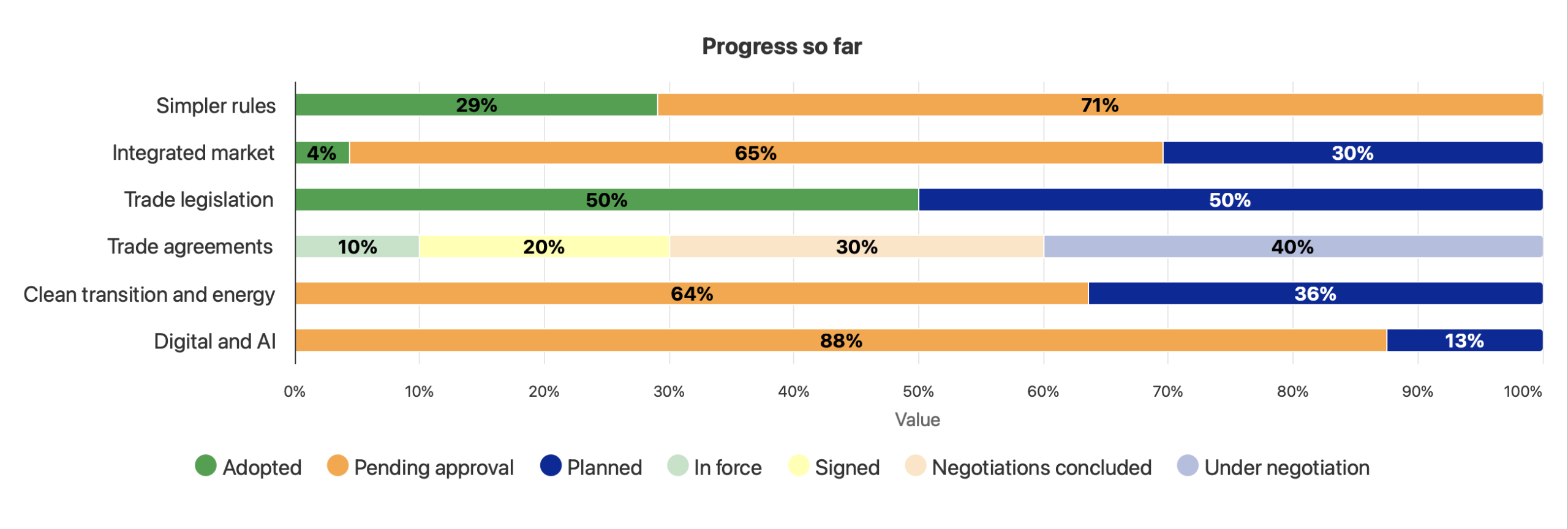
Image Credit: European Commission
To keep the economy churning along, however, it needs its fuel.
Savings and Investments Union: The Gift That Keeps on Compounding
With nearly €10 trillion in European household savings sitting largely idle in banks, the Commission has not been shy of its goal of encouraging Europeans to inject that fresh money back into their economy. While describing the work on the Savings and Investments Union as “so critical”, no clear dates have been offered for its delivery, with mere mentions of a new ‘Banking Package’ yet to be submitted. Still missing are also the incentives to Europeans who still see financial markets with more cautiousness than their American counterparts. And compliments were certainly reserved to the Scaleup Europe Fund.
It is worth noting a key point made during the speech regarding a modern budget’s need for “own resources”. This comes as the debate continues over the shortsighted wish by some Member States to cut the budget, even as the Irish PM, in parallel with the country’s EU presidency, raises the need to “generate significant own resources“.
But while money is already available in the EU, waiting to be invested, what could also be blocking the way?
All They Want for Christmas Is Cheaper Watts
As wars rage around the world, much of the energy distribution channels fueling Europe have either become sanctioned, blocked or literally destroyed. The EU’s energy security is at risk.
In the speech, though ambitious goals were mentioned, such as the doubling of the share of electricity in Europe by 2040, the European Grid initiative remains marred in its controversy, locking the potential of providing six times more electricity.
On the other hand, the economy craves for more than just fuel.
Critical Raw Materials in the Stocking
Most interestingly, and perhaps reminiscing from similar approaches to pharmaceuticals, a European Corporation on Critical Raw Materials was announced. Aimed at helping the block stockpile vital resources on which the EU still displays a concerning dependency on China, it could bring back similar benefits to when the EU jointly procured COVID vaccines and, then, other pharmaceuticals.
The availability of vital resources such as energy and raw materials serve as a boost to the industrial ambitions also laid out in the speech.
An Industrial Snowball Fight in the Making
Trade balance deficits acknowledged, the Commission seems to be preparing for a prolonged fight.
Having geared up trade agreements across the globe (with India, Mercosur, Mexico, Australia and Indonesia just this year), the EU seems to be raising a fist at China’s ever more aggressive trade policies. Though the actual trade toolkit at the EU’s disposal remained unmentioned, it shall hopefully contain more than requests, as was the case recently regarding car exports being voluntarily limited by China.
In contrast, the announcement of a new international connectivity to link the South Caucasus and Central Asia could prove vital in ensuring a foothold into new supply chains that circumvent China’s power in the region and counterpose its Belt and Road Initiative.
Trade fights aside, the Commission’s visionary perspective highlighted the immense value of quality EU data for industrial AI applications. The speech also emphasized the necessity of imposing guardrails, a demand increasingly echoed by industry stakeholders as of late.
It would be interesting to see what could be done, at the Commission level, to boost the computing power while also allowing for smooth, yet controlled, implementation of AI across EU industries, which have found themselves flailing, such as in the German automotive industry.
With trade agreements on one side and trade fights on the other, fighting climate change almost seems preferable to such a balancing act.
Hoping for a White Christmas, Not a Wildfire One
As the EU was ravaged by wildfires and storms throughout the year, the growing need for climate resilience was made clear to and by the Commission.
Several plans and initiatives were mentioned, from a European Heatwave Plan to a European Water Initiative, involving a European Firefighting fleet and a Climate Insurance Alliance.
Beyond continuing to work towards climate targets, climate prevention is key in reducing, not only the social, but also the economic impact that climate change has continued to bring to Europe.
Preparing for the continuance of wildfires by sharing the burden, while developing strategies to mitigate the health impacts of heatwaves, shows the type of common goals that the EU can work on together. However, the impact of the Climate Insurance Alliance in bridging the catastrophe-insurance gap (as only 25% to 35% of natural disaster losses are covered by insurance) can prove to be more difficult, hopefully more successful than, for example, the early iterations of what the Pan-European personal pension product aimed to be.
At the end of the day, strategies are needed to make sure people have a home to come back to, not only safe from climate change, but a home at all.
Home and Hired for the Holidays
To have a home (or even a job) to come to can, however, seem difficult to achieve for young Europeans, as youth unemployment remains high, in a year-to-date comparison, and housing prices continue to climb, faster than wages can.
At the same time that deregulation efforts are being made, the delivery of a Quality Jobs Act by the end of the year is also on the table. With known differences in worker protections across the EU, one can wonder how the different social partners will react to any of the measures to be found within it.
In parallel, the recently submitted Housing Act, also mentioned in the speech, could prove to be useful in the fight against the current affordability crisis. That is, only if it’s actually given the teeth needed to bite into the root of the problems at the local level, and not simply add another bureaucratic step before taking action.
Early Christmas Harvest
Though clearly referred to and made relevant in the speech, through the mentions of its recent woes, the support to the agricultural sector was only briefly highlighted. The importance of Europe’s food security, as prices for the chemicals needed in fertilizers go up due to wars, earned mentions to the farmers’ talents and promises of support, though no specific long term approach seemed to have been warranted.
As food security proves essential, so does the security in the more traditional sense.
Europe’s Naughty-or-Nice List Gets a Security Upgrade
In a step inching closer to the ever discussed European Army, the proposal of a European Security Council emerged, highlighting the need for all Member States to convene and act.
Such actions would be expanded to the increasingly diversified catalogue of hybrid threats that Europe faces: “Cyberattacks and sabotage, arson and drone incursions”. Needless to say that, in addition to more joint work on facing such threats, joint work would also apply to the fruits of the record defense spending itself, with larger orders for the European defense industry, allowing to expand on bigger economies of scale, all while supporting Ukraine.
Additionally, and on the backdrop of what occurred in Ceuta, the Pact on Migration and Asylum was mentioned, with ideas for coordination against weaponised mass immigration, accompanied by the previously existing target of increasing Frontex’s capacities.
Christmas Wishes, New Year’s Work
Celebrations for the State of the Union might seem constrained on the current backdrop.
A continuously antagonistic USA, contrasting with a blossoming relationship with Canada. War rages on all around, complemented by haunted trade squabbles with China.
However, despite adversity, the European Dream and its ambitions continue to spread through, as made evident by the latest State of the Union address.
It only remains to be seen whether such all-encompassing ambitions are able to come to deliver all its gifts.
Disclaimer: While Euro Prospects encourages open and free discourse, the opinions expressed in this article are those of the author(s) and do not necessarily reflect the official policy or views of Euro Prospects or its editorial board.
ND
Finance Correspondent
Nuno is portuguese and based in Porto. He has a background in Economics, Management and Financial Markets, as well as in IT. Areas of expertise: Financial Markets, Big Data, Privacy, Portugal, International Politics.
Edited by Francesco Bernabeu Fornara, Editor-in-Chief and Founder | Follow our European journalism