Made in Ukraine, Sold in Europe: A Test for the Continent’s Arms Producers
Made in Ukraine, Sold in Europe: A Test for the Continent’s Arms Producers
Eurosatory 2026, Europe’s largest defence exhibition, closed in Paris on 19 June after a record turnout of roughly 2,000 exhibitors and 43,000 visitors. Yet the real story was Ukraine, whose delegation grew from just 10 companies in 2024 to 80 this year. Its drone makers, still largely prohibited from exporting, upstaged Europe’s biggest manufacturers on their own turf — exposing a tension now reshaping the continent’s defence industrial base.
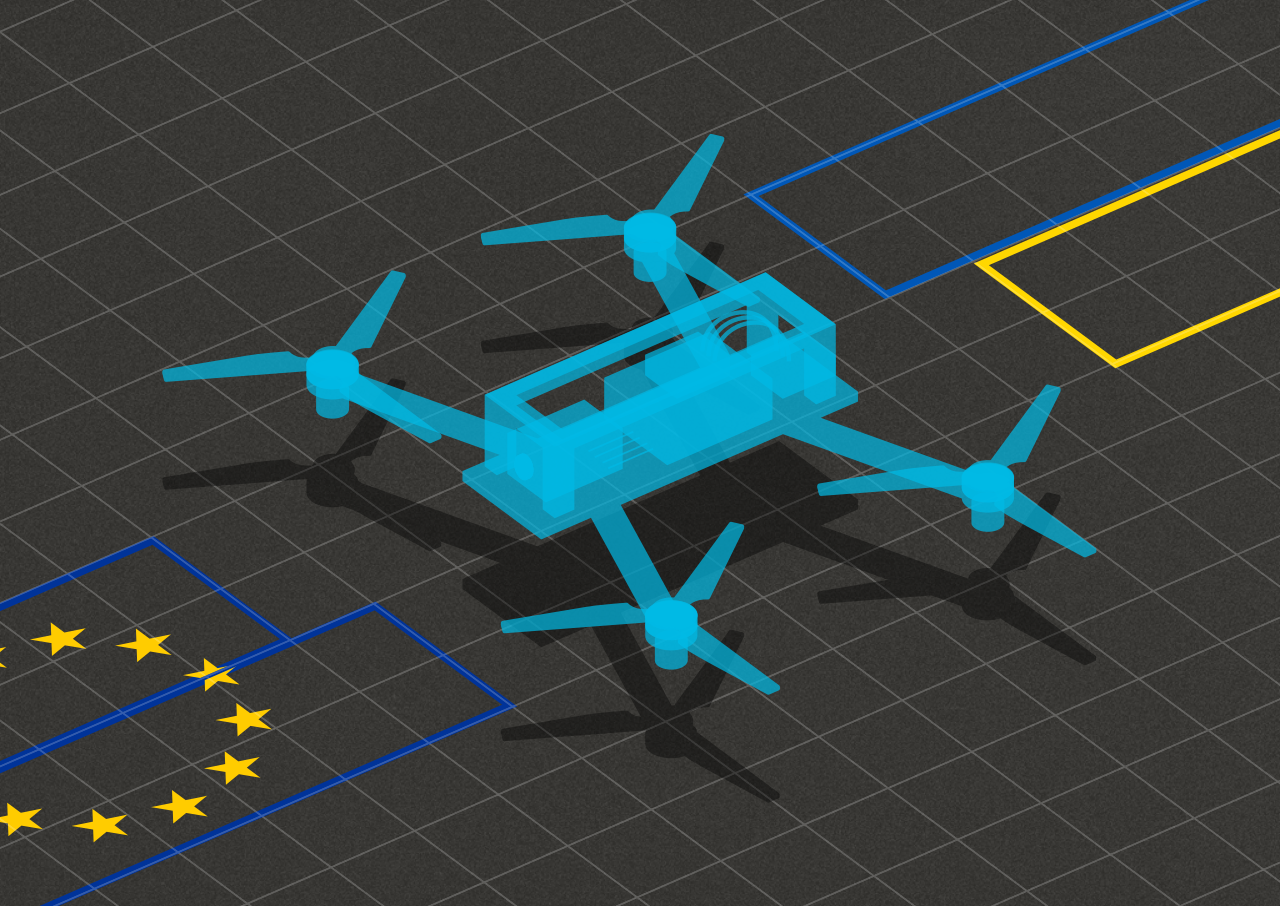
Image Credit: Euro Prospects

Different Approaches to Defence
Drones and counter-drone systems dominated the exhibition stands at Eurosatory. Thanks in large part to Ukraine’s shift toward long-range strike capabilities, a decision that has turned a once-nonexistent industry into a global conglomerate worth $13.2 billion (11.5 million EUR).
Whilst the country’s defence needs were previously based on the legacy of Soviet-era production and domestic procurement, its defence sector has since transformed into one of Europe’s most vibrant and innovative ecosystems. Output has ramped up at a pace no Western leaders would have thought possible: production capacity has increased by 35 times what it was before Russia’s invasion, representing value that went from $1 billion to $35 billion, although domestic contracts only accounted for about one-third of that last year. Government programs spearheaded by the MoD and the MDT, such as Brave1, were instrumental in creating competition amongst the domestic and international participants. Examples of this generated competition can be seen in the increasing funding for priority projects and the “e-points” system for battlefield performance.
Ukraine’s military financing has similarly been forced to adapt and improvise. Given its stretched state budget, Kyiv relies on private capital, philanthropy and direct investment from allies. Ukraine’s relationship with Denmark is illustrative: Denmark’s funding model has shifted from giving grants to manufacture weapons made in Ukraine for its army, to financing the production of weapons made in Denmark by Ukrainians to then be used in Ukraine. This blurs the line between aid and industrial policy, and it is precisely this model that Kyiv now wants to scale across the continent through ten export centres planned for 2026 in Germany, the Baltics, Scandinavia and the UK as its drone production exceeds its financing.
European countries have very different, more ‘traditional’ defence financing approaches. Procurement generally follows multi-year budget cycles, and typically gives preference to domestic industry, although EU-level frameworks such as the European Defence Fund try to encourage pan-European cooperation for procurement and product development. Spending remains concentrated in a handful of established “national champions,” with not even a third of orders reaching SMEs and start-ups. Innovation cycles are measured in product generations, not in weekly software updates pushed to the front. It is a structure built for national sovereignty for making choices, accountability and long-term industrial planning — not for the tempo of a war that changes its tactics every fortnight.
What Europe Stands to Gain
The argument for welcoming Ukrainian military products is straightforward: they are cheap, abundant, and tested under conditions European systems have never faced. The cost contrast is stark — a Ukrainian interceptor drone costs around $2,500 (EUR amount), whereas a single Patriot interceptor missile costs more than $3 million. Ukraine is also now producing about three million FPV (first-person-view) drones that only cost a few hundred dollars apiece. For European armies trying to affordably acquire in mass, that arithmetic is hard to ignore, particularly after the Middle East demonstrated how quickly even well-stocked, high-end air-defence systems can be depleted by repeated attacks.
Integration of Ukraine’s expertise and knowledge with the European defence industry is already starting to take root. Production lines based on Ukrainian technology are opening across the continent; Ukraine recently signed 12 joint production agreements with German partners, and Norway signed a cooperation agreement to mass-produce Ukraine’s mid-range strike drones in Norway. In April, five European countries — Finland, Italy, Norway, Sweden and the UK — signed the CORPUS Memorandum, which creates a procurement coalition to coordinate the purchase of weapons, signing of joint contracts, and the sharing of supply-chain intelligence with Ukraine. For Europe’s eastern and northern flank in particular, this offers something current national budgets alone cannot fathom: a European-produced combat-proven system designed to deter Russian attacks.
Not Everyone is Happy
Friction surfaced publicly in March when Rheinmetall’s chief executive dismissed Ukrainian drones as being made by “housewives” in their kitchens, prompting a fierce backlash and causing the hashtag #MadeByHousewives to go viral. The clash pointed to a genuine industrial anxiety. European procurement still focuses mostly on US-produced high-end platforms, even as the war has demonstrated a clear need for affordable, domestic mass-produced systems that undergo constant improvements. This shows more of a structural mismatch, not just a public-relations one.
But there are practical risks as well. Due to the necessity of operational security, Ukrainian firms operate under governance and transparency standards (partially because of being in a war context) that, despite reform efforts, still fall short of Western expectations. Institutional investors are also concerned about gaps in defence contracting, the protection of intellectual property and insurance. Nevertheless, interoperability with NATO’s operational apparatus remains a work in progress. Kyiv’s own export policy is politically constrained: weapons can only be sold to countries that have supported Ukraine since 2022, as there are fears of technology “falling into Russian hands”. There is also a longer-term sustainability question: a sector built to produce millions of drones a year for a war of an unknown duration could face a violent contraction once that war ends, leaving European partners holding joint ventures tied to demand that could simply vanish.
For Europe’s traditional major defence manufacturers, the more serious threat is budgetary. Procurement budgets are growing, but still limited; every euro spent on a Ukrainian drone fleet is therefore a euro not spent towards domestic production lines and jobs that European governments have spent decades promising that they would protect.
Complementarity, not Replacement
The more diplomatic perspectives on both sides increasingly frame this as a question of division of labour rather than a zero-sum contest. As Line Rindvig from the start-up accelerator Defence Builder in Ukrainska Pravda argues, “Ukraine has innovation, speed and combat experience. Rheinmetall has scale, capital and industrial clout. This sector should not be about competition, but about mutual complementarity.”
Practically speaking, that means treating Ukrainian firms as integration partners rather than rivals: co-development agreements that combine Europe’s certification, capital and scale of manufacturing with Ukrainian expertise in software, sensors and tactics. It also means new investment structures, similar to the Danish model, that fund production wherever it is most efficient rather than insisting it happen at home, and new procurement models that reward results as opposed to domestic loyalty.
Concerns about sovereignty, job protection and governance gaps will not disappear simply because an agreement is signed, but Eurosatory 2026 made one thing clear: the war in Ukraine has produced not just a battlefield laboratory, but a genuine industrial competitor and partner on Europe’s own doorstep. How Europe’s defence industry responds — by closing ranks or by incorporating what it has learned — will shape European security and its ability to respond to a Russian attack on its own soil.
Disclaimer: While Euro Prospects encourages open and free discourse, the opinions expressed in this article are those of the author(s) and do not necessarily reflect the official policy or views of Euro Prospects or its editorial board.
MV
Guest Author
Mark De Vries is a European public affairs professional specialising in EU security and defence policy. He works in the areas of defence cooperation, capability development and stakeholder engagement within the European political and economic landscape.
Edited by Jake Southerland | Follow our European journalism