Europe’s Opening in Africa’s Finance Race with China Lies in Local Value Creation
Policy Brief
3 October 2026
EU-China Strategic Competition
Europe’s Opening in Africa’s Finance Race with China Lies in Local Value Creation
As Europe and China converge on de-risking private capital in development finance, the real contest is shifting from mobilising finance to turning it into value-chain offers built around African priorities.
Executive Summary
The EU and China are converging on a new development-finance model in Africa, moving beyond traditional aid and sovereign lending towards public capital that de-risks private investment in value chains now central to competitiveness and economic security. Yet this convergence is increasingly contentious, as financing options and commercial actors multiply without equivalent gains in patient capital, local ownership or developmental depth.
The two also generate different strategic reach. Global Gateway’s €150bn target gives Europe a broad architecture of concessional, blended and risk-sharing finance, but fragmented execution across EU institutions and Member States weakens its coherence as a commercial partner. China’s leaner, less concessional envelope instead rests on government coordinated trade, contracting and corporate networks built over two decades, allowing it to preserve market access while reducing direct lending exposure.
This competition is strengthening African leverage. Control over strategic assets and a wider choice of partners allows governments to demand more processing, jobs and local value creation, as Zambia’s parallel pursuit of Lobito and TAZARA shows. Europe’s opportunity is to turn traditional safeguards, transparency and capacity-building from political conditionalities into commercial assets, embedding them in viable projects built around partner-defined industrial priorities.
Key Recommendations
1
Reduce Team Europe fragmentation through the Global Gateway Investment Hub
Use the Investment Hub as the single entry point for major Global Gateway projects, where proposals are screened, assigned a lead financing institution and assembled into a common Team Europe financing plan involving the Commission, EIB, national DFIs and export-credit agencies. This would give partner governments one interface and one coordinated offer instead of separate national financing tracks.
2
Open partner-country project origination and connect it directly to EFSD+ support
Allow viable partner-country firms to submit projects through EU Delegations without first securing an EU partner, with the Hub matching them to European investors and financiers. Prioritise eligible proposals for EFSD+ guarantees, local-currency instruments and project-preparation grants, so that access to de-risking follows partner-defined industrial priorities rather than only the easiest projects to finance.
3
Strengthen European positioning in African value chains through CRMA and RESourceEU
Prioritise African processing and value-addition projects for CRMA Strategic Project status and connect them through RESourceEU’s financing coordination and Raw Materials Mechanism to European buyers, processors and long-term offtake. This would give European firms a diversified commercial route into downstream African value chains while increasing local control over higher-value stages.
Analysis
Europe Takes De-Risking to Africa
The EU’s position as a global economic actor has come under growing strain in recent years. Russia’s weaponisation of energy forced a rapid reorientation of European supply, instability around the Strait of Hormuz has highlighted continuing import exposure, and a more transactional US trade policy under Trump 2.0 has hindered Europe’s largest economic partnership. At the same time, China’s industrial dominance and overcapacity have reshaped clean technologies and other strategic markets, challenging future European competitiveness. The EU has responded by placing de-risking at the centre of its external positioning. Its 2023 Economic Security Strategy combines stronger domestic capacity with diversification abroad, with the Commission explicitly framing partnerships with developing economies as a means to support their industrialisation while reducing excessive European dependencies and strengthening resilience—a direction reinforced by the 2025 Competitiveness Compass’ emphasis on new external investment ties.
Africa sits at the centre of this turn. Alongside its longstanding development relationship with Europe, the continent is increasingly important to the minerals, energy and connectivity infrastructure underpinning Europe’s twin transition. Global Gateway, launched in 2021, provided a new investment framework for this partnership, with its Africa–Europe package targeting 138 of its 264 flagship projects. Many now support processing capacity and access to strategic inputs, and increasingly complement domestic instruments such as the Critical Raw Materials Act and the Net-Zero Industry Act, reflecting a clearer geoeconomic approach. Yet Europe is expanding where Chinese banks, contractors and firms are already deeply embedded. Since the early 2000s, China’s South–South infrastructure-led model has built extensive commercial and political networks across Africa that now shape the markets Europe is seeking to diversify into. This is the landscape in which its new development-finance agenda must now compete.
China’s Head Start in the Finance Race
For decades, Africa’s development-cooperation landscape was Western-dominated. European support grew out of Member States’ post-colonial ties and was progressively institutionalised, culminating in the 2000 Cotonou Agreement, which made human rights, democracy and the rule of law “essential elements” of development performance. That same year, China launched FOCAC from a deliberately different premise: partnership among developing countries, centred on sovereignty, non-interference and mutual benefit. Spending reflected the divide. Between 2000 and 2017, EU Official Development Assistance channelled around $90bn to social infrastructure and $59bn to economic infrastructure, compared with China’s $10bn and $37bn respectively. Moreover, around 76% of Beijing’s offer lay outside ODA through non-concessional financing, including the megaproject sovereign loans that came to define the Belt and Road Initiative era. This model also enjoyed widespread public appeal, as 63% across 36 African countries viewed China’s influence positively in 2015, with commercial investment and business activity emerging as main drivers of favourable perceptions.
Yet China recalibrated its model well before Europe did. The 2015 FOCAC Johannesburg Action Plan already called for “new financing models”, while mounting debt and repayment risks pushed Beijing away from Eximbank and CDB maxiloans towards state-owned commercial banks, co-financing and tighter risk safeguards. At the same time, Chinese firms expanded through investment and contracting in strategically important sectors such as energy, mining and communications. African public-sector loan commitments fell from $28.8bn in 2016 to about $2.1bn in 2024, while FDI and trade assumed a larger role. China also broadened its social offer, with FOCAC 2024 pledging 1,000 “小而美” (xiǎo ér měi) “small and beautiful” livelihood projects across health, skills and agriculture, amid longstanding criticism of labour practices in Chinese-operated mining and construction projects in the region.
This is where the traditional EU–China divide becomes apparent. Europe is making development finance more investment-led and geostrategic, just as China becomes more risk-conscious and socially diversified. The field is also more crowded. The US is tying investment more directly to critical-mineral supply chains under its 2025 strategic partnership with the DRC, while UAE-backed International Resources Holding has taken a 51% stake in Zambia’s Mopani Copper Mines. Nevertheless, the convergence is increasingly ‘miserly’: strategic self-interest is rising faster than patient finance, despite a decades-long African agenda for external finance to serve locally defined priorities, build productive capacity and advance greater self-reliance. Competition is therefore shifting from aid provision towards leveraging public capital for commercial reach and private investment, rather than maximising developmental gain.
“Competition is therefore shifting from aid provision towards leveraging public capital for commercial reach and private investment, rather than maximising developmental gain.”
Converging Tools, Different Strategic Reach
Europe enters this race with considerable development-finance weight. NDICI–Global Europe earmarks at least €29bn for Sub-Saharan Africa through 2027, while around $7.5bn in annual ODA preserves a substantial concessional pillar. Global Gateway adds an ambitious investment layer targeting €150bn by 2027. Its main arm, EFSD+, uses guarantees and blended finance to absorb project risk, enabling the EIB, national DFIs and MDBs to lend on better terms and crowd in private investors. Mobilisation is also becoming more selective: under the CRMA, third-country projects that strengthen EU security of supply can receive Strategic Project status and dedicated coordination, while recognition in developing economies is conditional on local value creation. Yet translating these instruments into a coherent European offer remains difficult. Commission and EEAS priorities, private-sector return requirements and Member State strategies remain separately governed and differ over objectives such as migration and security. Team Europe coordinates these actors without eliminating their autonomy, leaving scope for overlap and competition for influence, as recent French and Italian energy initiatives in Kenya illustrate.
“Europe enters this race with considerable development-finance weight.”
China has committed RMB360bn by 2027, roughly €46bn, including 210bn in credit lines, 80bn in assistance and at least 70bn in investment by Chinese companies, amounting to a smaller and less aid-centred headline envelope than Europe’s. Yet it operates through a far more politically coherent ecosystem. Strategic direction is set at leadership level and carried through the main foreign-policy and commercial institutions: CHEXIM and CDB provide finance, Sinosure absorbs risk, and SOEs translate policy into project delivery. Recent loan-level evidence finds identifiable presidential-level backing behind 64.8% of market-rate lending by value, while 74.85% also employed risk-mitigation instruments, reflecting commercial finance deeply “braided” to state strategy.
The smaller figures also reflect China’s substitution of lending with contracting and trade. In renewables, over 70% of Chinese engagement in Africa in 2022–25 took the form of EPC contracts, while low-carbon technology exports reached $9.8bn in 2024. This reduces corporate exposure while preserving demand for Chinese engineering and equipment even when projects are financed elsewhere. Two decades of infrastructure investment, mining assets and commercial networks have created strong path dependence, allowing Chinese firms to retain influence with less direct financing. Meanwhile, African borrowers now repay more to Chinese creditors than they receive in new disbursements, turning net debt transfers negative.
African perceptions reveal both the appeal and limits of the two models. In AidData’s survey of 861 African leaders, Chinese finance was valued for fewer conditions (48%), closer alignment with national priorities (43%) and better terms (39%), but criticised for weak transparency and limited capacity-building. A comparative survey found the EU slower and more intrusive, yet stronger on delivery quality (93.5% versus 67.9%), local job creation and environmental standards. Evidence across 141 developing countries similarly shows that elites value labour and environmental safeguards, anti-corruption provisions and untied procurement. Europe’s opening is therefore to combine these strengths with a stronger economic offer, using ODA and grants where market-based investment remains weakest, especially as nearly 70% of mobilised private finance still flows to middle-income countries rather than LDCs.
Zambia as a Case of Competitive Leverage
Long a centre of foreign mining, Zambia’s Copperbelt has acquired renewed geoeconomic importance since 2021, as Lusaka’s push into battery processing and industrial upgrading drew new European, US, Chinese and Gulf development-finance packages. Competition now extends beyond access to copper and cobalt to the infrastructure, processing capacity and trade routes that determine where value is captured. Europe is central to the Western-backed Lobito Corridor, linking Zambia and southern DRC to Angola’s Atlantic coast. Team Europe, bringing together the EU, EIB and nine Member States, reports more than €2bn in investment across the corridor. Its ‘360° approach’ combines commercial mobilisation with local capacity-building: Germany is deploying around €1bn in export-credit support for electrification through a German contractor; France combines AFD lending and EU blending with vocational training; and Italy’s €250m CDP facility to the Africa Finance Corporation supports infrastructure while opening opportunities for Italian suppliers. These investments complement the EU–Zambia Critical Raw Materials Partnership on local processing and skills. Yet projects remain organised through separate national mandates and financing channels, leaving Zambia to navigate multiple European offers rather than a single package aligned with its objectives.
The US operates alongside this architecture, anchoring Lobito’s hard infrastructure through DFC’s $553m railway and mineral-port financing. Its role builds on the 2022 US–Zambia–DRC battery partnership, which sought a regional “mine-to-assembly” value chain less dependent on China. A Western-financed railway can, however, still carry minerals extracted by Chinese-owned companies. National champion CNMC controls Zambia’s Chambishi mine and holds an 80% stake in Luanshya Copper Mines, while copper from neighbouring DRC remains heavily tied to Chinese ownership and downstream manufacturing. Lobito’s strategic success therefore lies in turning route diversification into value-chain diversification, promoting a single Team Europe industrial offer that pools EU and national finance behind Zambian processing capacity and links it to European technology and specialised services.
“Lobito’s strategic success therefore lies in turning route diversification into value-chain diversification.”
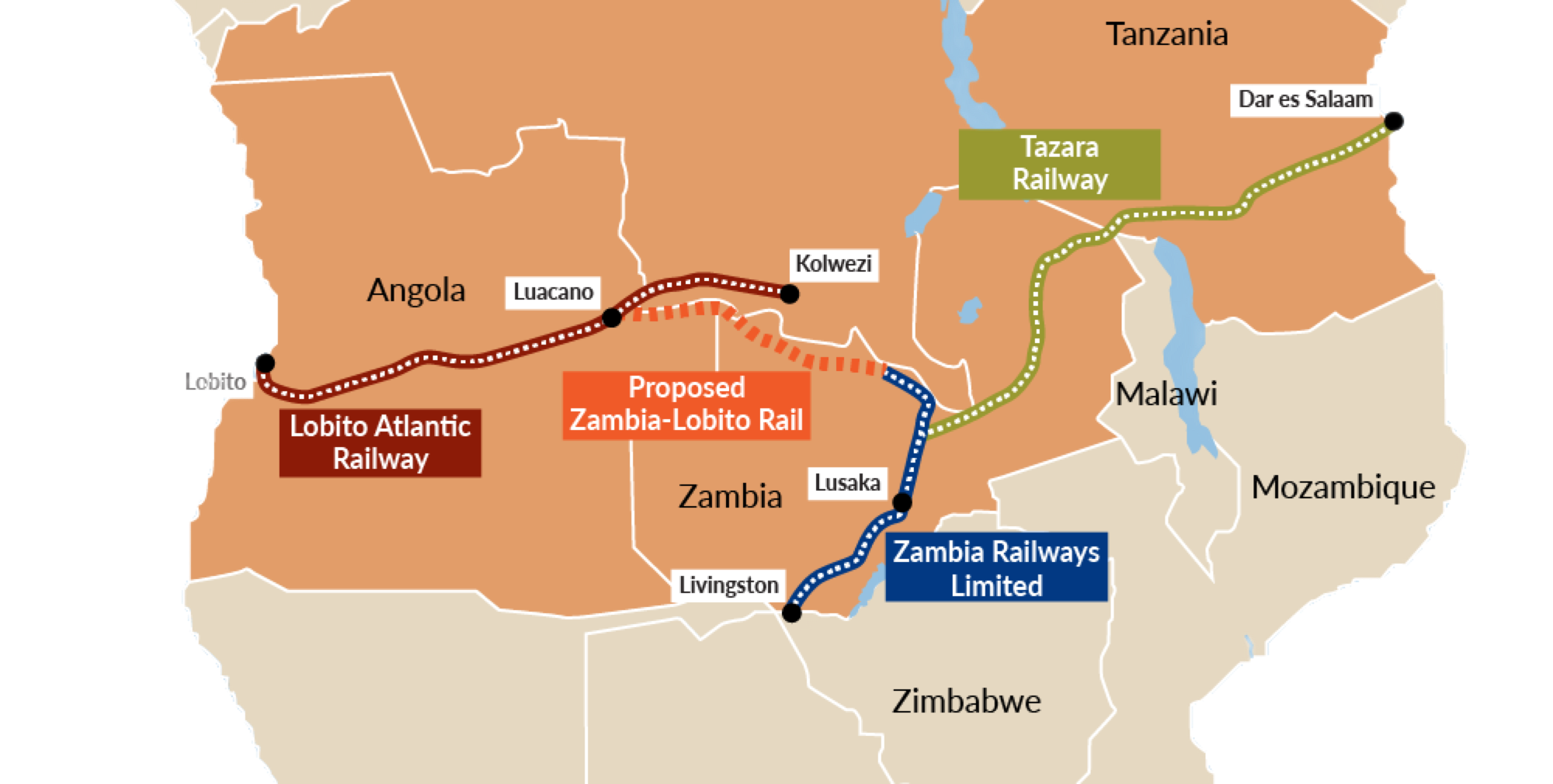
China nevertheless retains a substantial head start. It remains Zambia’s largest creditor, with roughly $6bn invested over two decades, and still enjoys a stronger local standing than Europe: 51% of Zambians viewed Chinese influence positively in 2025, against 33% for the EU, although support has fallen sharply from a decade earlier. In 2023, Lusaka itself requested Chinese support to rehabilitate TAZARA. The resulting $1.4bn, 31-year concession is now framed as a “Prosperity Belt” that couples rail rehabilitation with local processing, industrial parks and access to Chinese markets, signalling a reshaping of Beijing’s traditionally commercial offer. This closely tracks Zambia’s own agenda. President Hichilema links both corridors to exports, jobs and private-sector growth, while this year’s Budget Speech presents them as the basis for an east–west transport hub. That ambition is now taking shape through the Zambia–Lobito Railway, an Africa-led project under development by AFC targeting financial close in 2027. Its integration at Chingola with the state-owned Zambia Railways would connect the two corridors into an Atlantic–Indian Ocean rail system, making them less mutually exclusive as Western- and Chinese-backed access routes and shifting competitive advantage towards the partners best able to develop the industrial ecosystems surrounding them.
Figure 1. Planned integration of the Lobito and TAZARA rail corridors
The Copperbelt exposes both Europe’s opportunity and China’s constraint. Lobito’s emerging pipeline extends beyond transport into a wider corridor economy spanning trade facilitation, skills, agriculture and mineral processing, with the $100m Kobaloni project combining Africa’s first battery-grade cobalt refinery with 87% local ownership, contrasting with the 15–20% Zambian stakes in major Chinese-controlled Copperbelt mines. China can respond from a far deeper commercial base, but African demands for local production and value retention may require more patient finance and deeper local investment than its increasingly contract- and trade-led model provides. The DRC’s 2026 ban on copper and cobalt concentrate exports reflects a wider regional claim. Europe’s opening is therefore to fuse its emerging de-risking architecture with long-standing strengths in capacity-building, transparency and social and environmental safeguards that increasingly carry value for partner countries.
“Europe’s opening is therefore to fuse its emerging de-risking architecture with long-standing strengths in capacity-building, transparency and social and environmental safeguards that increasingly carry value for partner countries.”
More from the ESP Series
View All ESP Policy Briefs →About Euro Prospects
Euro Prospects is an independent platform for in-depth analysis of European political affairs. We publish articles on the issues shaping Europe today, from the EU–Mercosur trade agreement and Europe’s semiconductor supply chains to the European Union’s strategic shift on Syria and Serbia’s global arms trade, to name a few.
But informing readers is only part of our Mission. Euro Prospects was founded to help cultivate a European public sphere — a transnational space of political curiosity and civic engagement among Europe’s citizens.
Visit Euro ProspectsAbout ESP
The European Strategic Policy Unit (ESP) is Euro Prospects’ dedicated think tank department. We produce forward-facing, policy-actionable analysis on European strategic sovereignty across defence, technology, trade, energy, industry, and digital infrastructure.
Partnerships
Interested in citing, discussing, or building on this research? ESP is actively building relationships with researchers, institutions, and publications working on European strategic policy.
Contact UsESP Members
Francesco Bernabeu FornaraHead of Unit; Editor-in-Chief, EP
Giulia ConvertiniDigital Systems Sovereignty
Finn Sands RobinsonTrade & Industrial Strategy
Rimsha ArifEnergy Market Resilience
Matilde MinettiEU-China Strategic Competition
Orla HarrisDigital Infrastructure Sovereignty
Jerfi WigleySupply Chain Resilience
Annika GerbigDefence Industrial Autonomy
Trinabh BanerjeeStrategic Digital Security
Luka OkropirashviliEastern Neighbourhood
Juan Carlos LeunissenTransport & Energy Connectivity
Antoine Cerqueira Da CostaFintech Sovereignty Analyst
Sofia CigoliniEU Fiscal & Monetary Sovereignty Analyst
Erik Giuliano WürthnerESP Outreach & Partnerships Coordinator