Beyond Trade Defence: Europe Needs a Strategy Against Chinese Overcapacity
Policy Brief
24 June 2026
EU–China Strategic Competition
Beyond Trade Defence: Europe Needs a Strategy Against Chinese Overcapacity
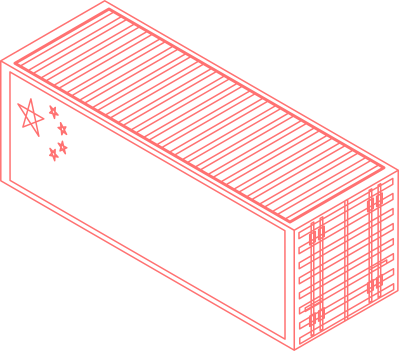
China’s industrial overcapacity is creating a competitiveness trap for the EU. Cheap supply lowers costs today, but weakens the industrial capacity and political room Europe needs to de-risk tomorrow.
Executive Summary
China has become the world’s dominant manufacturing producer, accounting for 36% of global output and 20% of exports in 2022. Yet industrial capacity has increasingly outpaced domestic demand, producing destructive price competition sustained by state-directed investment and limited market exit. The issue now extends beyond China’s domestic imbalance. For the EU, whose goods trade deficit with China reached €359.8 billion in 2025, overcapacity is reaching sectors central to competitiveness and the green transition.
This briefing analyses how overcapacity affects the Union through a transmission cycle. Excess Chinese production lowers prices and exports disinflation into the Single Market, strengthening Chinese competitiveness. While cheaper imports reduce costs in the short term, persistent price pressure weakens the profitability and investment expectations EU firms need to scale.
As domestic capacity erodes, dependence shifts to Chinese technologies, inputs and localised production inside Europe, reducing European control over strategic value chains. Economic dependence then becomes a political constraint, as de-risking measures can be framed as threatening costs, jobs and production continuity.
The EU should integrate existing trade defensive tools with a broader strategy to make European production commercially viable. This requires pragmatic engagement with China where interests overlap, stronger domestic capacity-building, and diversified supply through trusted partners.

Key Recommendations
The Commission’s warning that “openness without security becomes vulnerability” captures the logic of EU de-risking. Current defensive tools contain specific distortions, but fail to solve the structural effects of Chinese overcapacity. The EU’s response should follow the 2023 Economic Security Strategy’s promote, protect and partner logic, combining market defence with pragmatic engagement with China, domestic capacity building and supply-chain diversification.
Selective Protection Against Overcapacity Spillovers
Use Trade Defence Instruments (TDIs), including anti-subsidy and anti-dumping measures, where border distortions are proven, but combine them with the Foreign Subsidies Regulation (FSR), FDI screening and the International Procurement Instrument (IPI) to capture spillovers inside the Single Market, including subsidised Chinese procurement bids and localised production.
Pragmatic Engagement with China
Keep EU-China channels open where interests overlap. Price undertakings and sectoral dialogue on anti-involution, subsidies and capacity transparency can help curb destructive price competition that damages both European capacity and Chinese profitability, while preserving space for negotiated solutions where they are enforceable.
Promotion of EU Domestic Capacity
Use the Chips Act, NZIA and Clean Industrial Deal to make European production commercially viable where Chinese low prices deter private investment. Procurement criteria, clean-tech auctions and demand guarantees should help EU firms survive the scale-up phase while ensuring that localisation strengthens European sourcing, know-how and supplier integration.
Diversification Through Trusted Partnerships
Finance China+1 supply chains with trusted industrial and resource partners, including Japan, South Korea, Canada, Australia, India and ASEAN. Global Gateway and EIB support should prioritise alternative input and processing capacity, while coordination with partners should prevent trade diversion from rerouting Chinese overcapacity through third markets.
Analysis
China’s Overcapacity Problem
Over the past decade, China has become the world’s dominant industrial producer and exporter. Its share of global manufacturing output rose from 27% in 2011 to 36% in 2022, while its share of manufacturing exports increased from 15% to 20%, with near-monopoly positions emerging in green-technology supply chains. Since the mid-2010s, however, productive capacity has outpaced domestic demand across most Chinese manufacturing sectors, pointing to industrial overcapacity. This is not a simple cyclical imbalance, but a result of China’s investment-led growth model, which channelled high savings and local-government incentives into infrastructure, real estate and manufacturing capacity. While this model delivered scale and productivity gains, it has become harder to sustain since the 2021 property downturn weakened demand, reduced investment returns and left consumption unable to absorb China’s expanded output.
Rather than allowing unprofitable firms to exit, Chinese industrial policy has often sustained production through subsidies, tax incentives, R&D grants, preferential credit and below-market lending. This is especially relevant for SOEs, which retain large positions in sectors such as automobiles and ferrous metals while benefiting from lower financing costs linked to state support. This policy-shaped overcapacity has produced what Chinese policymakers call neijuan (内卷), or “involution”. The concern is that low-price competition compresses profitability and obstructs technological upgrading, as OECD projections already expect China’s growth to slow from 5.0% in 2024 to 4.3% in 2026. Under its anti-involution campaign, linked to 15th Five-Year Plan priorities, China is targeting both traditional sectors such as steel and emerging sectors including solar panels, EVs and chemicals.
The Spillover to Europe
China’s overcapacity has also become controversial among its trading partners, as Beijing’s dominant manufacturing position allows excess production to be channelled abroad. A recent European Parliament study describes it as “a threat to European manufacturers, distorting competition and straining bilateral trade”. The EU is particularly exposed, as its goods trade deficit with China reached €359.8 billion in 2025, expanding more than fivefold in volume since 2015. The problem is especially concentrated in sectors central to Europe’s technological leadership and green transition. Between 2020 and 2024, Chinese exports to the EU rose by 74% in electrical machinery, including lithium-ion batteries and static inverters, and 165% in automobiles, especially EVs. Recent EU initiatives make diversification part of the industrial response. The EU-Canada Strategic Partnership on Raw Materials was reaffirmed in 2026, while RESourceEU aims to advance aggregation, joint purchasing, offtake agreements and China+1 partnerships.
“This dependence can then create political resistance to de-risking, because reducing exposure appears inflationary, anti-consumer or harmful to the green transition.”
Beyond trade exposure, the European Central Bank identifies a further macro-industrial risk. Excess capacity and policy-supported involution in China push prices down, strengthening Chinese export competitiveness. For Europe, cheaper goods reduce input costs, ease consumer prices and support clean-tech deployment. Over time, however, persistent low prices squeeze producers’ margins, weaken investment and make industries more reliant on Chinese suppliers, components or Chinese-owned production inside Europe. This dependence can then create political resistance to de-risking, because reducing exposure appears inflationary, anti-consumer or harmful to the green transition. The result is a vicious cycle in which cheap imports lower costs today, but weaken the European capacity needed to avoid dependency tomorrow.
Price Pressure and Capacity Erosion
Weak inflation is the most direct spillover of China’s overcapacity into EU markets. Linked to anaemic domestic demand, lower Chinese export prices transmit domestic disinflationary pressure into Europe. When persistent, this pressure reshapes firms’ expectations and future investment decisions in Europe, as producers face not only lower current margins but also weaker expected future returns. This is decisive in capital-intensive sectors, where investment depends on confidence that firms can recover fixed costs, finance R&D and reach sufficient scale. The timing is especially damaging: Chinese low-price competition weakens the investment case for domestic production just as the EU needs to mobilise green industrial capacity while facing tighter fiscal constraints, rising defence needs and greater pressure to act as an autonomous geopolitical actor.
Batteries show how price pressure can become capacity erosion. In 2024, China produced 81% of global EV battery cells, compared with 7% in Europe, while EU output covered only 43% of demand. Since battery packs represent 30 to 50% of an EV’s value, Chinese battery prices directly shape European competitiveness. Low-cost supply helps carmakers, but weakens the investment case for European battery producers before they reach scale. This dynamic is already visible in the EU’s anti-subsidy investigation into Chinese BEVs opened in October 2023. The Commission found unfair subsidisation threatening EU producers and imposed five-year countervailing duties, showing that TDIs can address proven import distortions. Yet duties do not rebuild European battery capacity. After China challenged the measures at the WTO, the Commission’s January 2026 price-undertaking process with China’s Ministry of Commerce suggests that engagement remains possible even in contested sectors, where it offers WTO-compatible consultation.
“The result is a vicious cycle in which cheap imports lower costs today, but weaken the European capacity needed to avoid dependency tomorrow.”
Hydrogen extends the same mechanism to a market still in formation. In 2024, China’s electrolyser capacity was around 18 times its global deliveries, giving it almost 60% of global manufacturing capacity before demand had fully materialised. Chinese alkaline and PEM electrolyser prices roughly halved between 2022 and 2025, remaining 40–60% cheaper than European systems. Lower prices can accelerate deployment, but may also prevent EU producers from financing expansion and commercialising higher-value technologies before the market scales.
Solar PV signals further industrial erosion. China controls over 80% of the global solar supply chain, while rapid capacity expansion pushed panel prices down by 42% in 2023. This lowered deployment costs for European developers, but contributed to factory closures, relocation plans and financial distress among EU manufacturers, including Meyer Burger’s German plant. The issue also reached EU enforcement in April 2024, when the Commission opened two Foreign Subsidies Regulation investigations into Chinese-linked bids for a Romanian photovoltaic park. When overcapacity reaches Europe through subsidised procurement bids, the distortion is no longer limited to import prices at the border. The FSR therefore complements TDIs by preventing publicly supported clean-tech projects from becoming outlets for foreign-subsidised excess capacity.
Localisation and Sovereignty Risk
As EU scrutiny of Chinese imports intensifies through tariffs and investigations, localisation can become an alternative outlet for overcapacity. Chinese production inside Europe may reduce visible import dependence, but it does not restore European control if production still relies on Chinese intellectual property, upstream inputs, data systems and strategic decision-making.
This sovereignty logic is visible in digital infrastructure. The 2020 5G Toolbox sought to reduce dependence on high-risk suppliers in critical networks. By 2023, 24 Member States were involved in restricting providers such as Huawei and ZTE, signalling security concerns. EVs and batteries now raise a similar question. CATL already produces in Germany and is developing larger sites in Hungary and Spain, while other Chinese firms are investing in Hungary, Slovakia and Portugal. These projects may support European EV assembly, but also lock producers into Chinese battery technology, components and decision-making. New EU industrial tools, including the Net-Zero Industry Act and Clean Industrial Deal, offer a way to make localisation conditional on deeper EU capacity-building, including local sourcing, technology diffusion, joint research and workforce development.
Existing EU security tools, including the proposed 2024 revision of FDI screening, address ownership risks linked to foreign investment in critical infrastructure, technology supplies and sensitive information. Yet overcapacity-driven localisation requires a broader screening logic, as Chinese firms may produce inside Europe while retaining ownership across the supply chain. FDI screening should therefore complement TDIs by examining whether local production remains dependent on non-substitutable Chinese inputs, proprietary technologies, parent-company software and strategic decisions taken outside the EU. This would separate productive localisation from investment that embeds strategic dependence inside the Single Market.
Political Lock-In
In response to rising dependence in strategic supply chains, the EU has reframed its China policy around de-risking. The Commission’s 2023 Economic Security Strategy aims to minimise risks while “preserving maximum levels of economic openness and dynamism”. This agenda now spans the Critical Raw Materials Act for strategic inputs, the Net-Zero Industry Act for clean-tech manufacturing, the EU Chips Act for semiconductors, the Foreign Subsidies Regulation for distortions inside the Single Market, and the proposed revision of the FDI Screening Regulation for sensitive investments.
“The EU must therefore reduce the political cost of de-risking by pairing tougher trade defence with domestic capacity-building, diversified supply chains and procurement rules.”
Yet overcapacity makes this strategy politically difficult because cheap Chinese supply creates constituencies with an interest in the status quo. Downstream firms, consumers, clean-tech developers and regional governments benefiting from Chinese localisation may resist de-risking when it appears to raise costs, slow decarbonisation or threaten jobs. The German carmakers’ reaction to the 2024 countervailing duties on Chinese EVs is especially indicative, since Volkswagen, BMW and Mercedes-Benz warned of retaliation and damage to China-linked business models. In recent months, however, Berlin has signalled openness to stronger trade defence against Chinese overcapacity, suggesting a tougher political stance.
This tension captures how overcapacity turns economic dependence into political lock-in. The EU must therefore reduce the political cost of de-risking by pairing tougher trade defence with domestic capacity-building, diversified supply chains and procurement rules. The International Procurement Instrument is a tangible tool to prevent EU public tenders from automatically favouring low-cost Chinese suppliers when European firms face restricted access in China. By adding reciprocity to procurement, the EU can use public demand to reduce dependence on Chinese overcapacity.
More from the ESP Series
Addressing Europe’s Strategic Dependencies — ten policy briefs inaugurating our European Strategic Policy Unit.
View All ESP Policy Briefs →About Euro Prospects
Euro Prospects is an independent platform for in-depth analysis of European political affairs. We publish articles on the issues shaping Europe today, from the EU–Mercosur trade agreement and Europe’s semiconductor supply chains to the European Union’s strategic shift on Syria and Serbia’s global arms trade, to name a few.
But informing readers is only part of our Mission. Euro Prospects was founded to help cultivate a European public sphere — a transnational space of political curiosity and civic engagement among Europe’s citizens.
Visit Euro ProspectsAbout ESP
The European Strategic Policy Unit (ESP) is Euro Prospects’ dedicated think tank department. We produce forward-facing, policy-actionable analysis on European strategic sovereignty across defence, technology, trade, energy, industry, and digital infrastructure.
Partnerships
Interested in citing, discussing, or building on this research? ESP is actively building relationships with researchers, institutions, and publications working on European strategic policy.
Contact UsESP Members
Francesco Bernabeu FornaraHead of Unit; Editor-in-Chief, EP
Giulia ConvertiniDigital Systems Sovereignty
Finn Sands RobinsonTrade & Industrial Strategy
Rimsha ArifEnergy Market Resilience
Matilde MinettiEU-China Strategic Competition
Orla HarrisDigital Infrastructure Sovereignty
Jerfi WigleySupply Chain Resilience
Annika GerbigDefence Industrial Autonomy
Trinabh BanerjeeStrategic Digital Security
Luka OkropirashviliEastern Neighbourhood
Juan Carlos LeunissenTransport & Energy Connectivity
Erik Giuliano WürthnerESP Outreach & Partnerships Coordinator