Towards A Coordinated Framework Out of Europe’s Gas Dependency
Policy Brief
26 June 2026
Energy Market Resilience
Towards A Coordinated Framework Out of Europe’s Gas Dependency
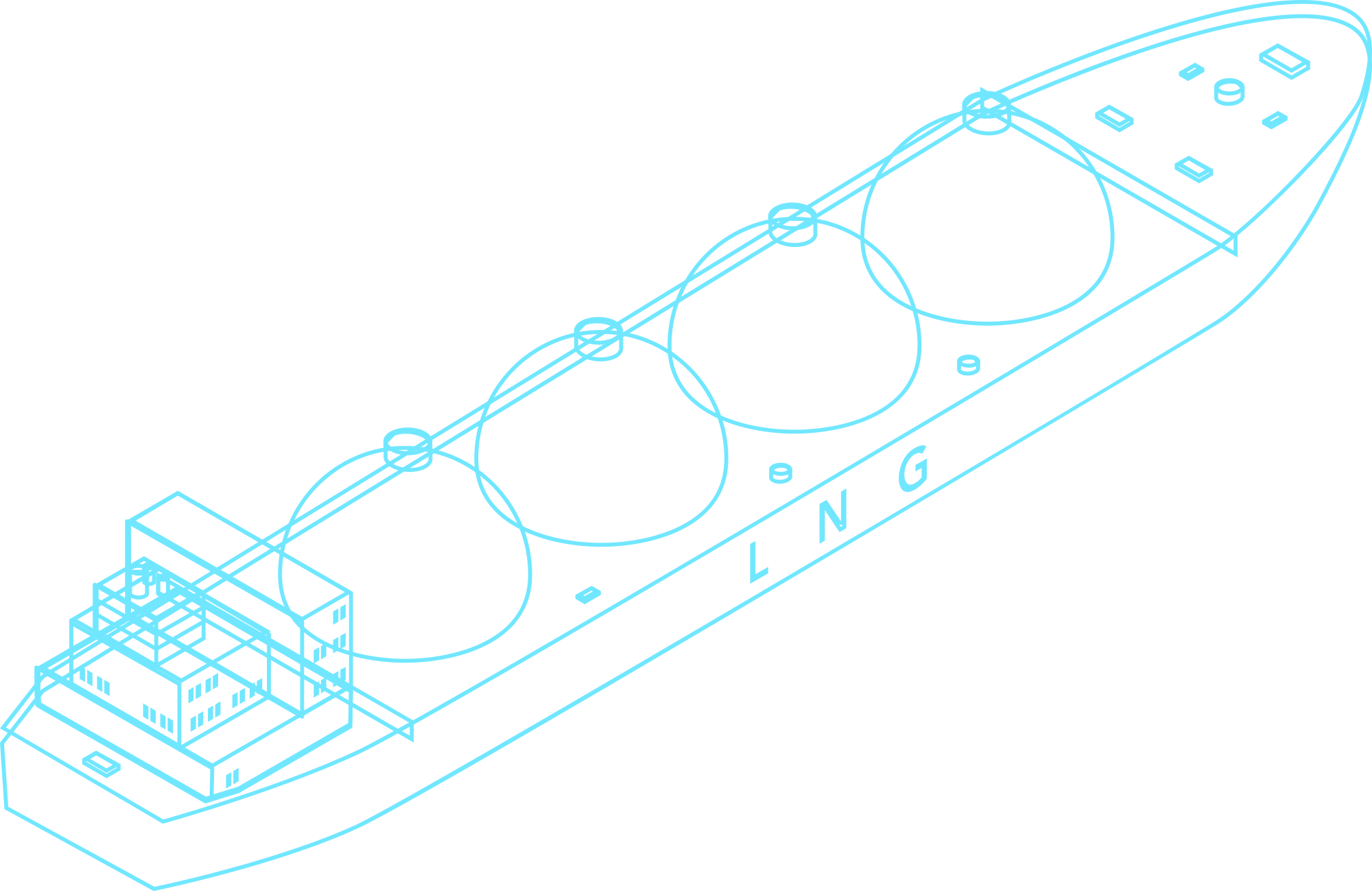
Europe’s grid system cannot function without gas-fired plants that are becoming commercially unviable. Having shifted from Russian pipelines to diversified LNG supply, the EU now faces a deep gas dependency, one it has built into its own grid architecture.
Executive Summary
Europe has built a gas dependency. For years, it invested in wind and solar to reduce its reliance on imported gas. But in doing so, it quietly made gas indispensable in a different way. Gas-fired plants are now the grid’s last line of defence when renewables fail, and no viable alternative exists yet to replace them.
Dunkelflaute episodes of low wind and sun expose this dependency acutely, forcing gas into the marginal pricing role and sending electricity prices to extreme highs. These episodes are not the cause of the dependency, they are evidence of it. As dunkelflaute become less frequent, the commercial viability of the gas peakers Europe still needs is eroding, even as their importance to the grid grows. The response has been 27 separate national fixes, at rising cost and uneven coverage.
This policy brief proposes an EU Strategic Balancing Capacity Framework, enforced through ACER and ENTSO-E, to manage this dependency collectively before the next stress event arrives.

Key Recommendations
Establish an EU Strategic Balancing Capacity Framework
Binding member states to coordinated backup electricity capacity outcomes rather than leaving adequacy planning to national discretion.
Set a Binding Minimum Backup Capacity Standard
ACER should set and enforce a binding minimum backup electricity capacity standard for each member state, calibrated annually through ENTSO-E’s ERAA. This will ensure no member state falls below the threshold at which grid stress becomes unmanageable.
Introduce a Managed Retirement Gate
No gas plant may close until verified clean replacement capacity of equivalent speed and scale is confirmed operational in the same region.
Introduce a Joint Cross-Border Procurement Mechanism
Through ACER, replacing the fragmented national procurement with a single coordinated process that could reduce additional installed capacity needs by up to 70%. The framework dissolves automatically for each member state once its ERAA assessment confirms clean backup capacity covers its adequacy needs, managing gas dependency’s exit rather than permanently entrenching it.
Analysis
The Dependency Nobody Is Naming
Europe’s energy system has changed fundamentally since the 2022 energy crisis, but not in the way most assume. Gas dependency has not disappeared. It has shifted from a supply problem to a structural one embedded in how the electricity system is priced. Gas now generates around 18-20% of EU electricity, down from roughly 25% before the crisis. Yet its grip on electricity prices has tightened, not loosened.
The reason lies in how European electricity markets are structured, as IEEFA’s analysis explains. Prices are set by the most expensive generator needed to meet demand at any given moment, a system known as marginal pricing. Cheaper sources like nuclear, hydro, wind, and solar are used first. Gas plants, which cost more to run because of fuel and carbon costs, are called in when cheaper sources fall short or when the system needs to respond quickly to sudden changes in supply or demand. In most EU markets, gas only sets the price for a few 100 to 1,500 hours a year. But these tend to be the hours that matter most: peak demand, low wind, low sun. Gas therefore has an outsized influence on electricity prices relative to its share of generation.
When gas prices spike, electricity prices follow, swinging from €20-30/MWh in calmer periods to above €60-70/MWh during geopolitical stress. The effect on electricity markets is immediate and uneven: day-ahead prices in Italy and Germany have exceeded €120-150/MWh during these episodes, while prices in France, with its higher nuclear share, have stayed closer to €60-80/MWh over the same periods.
The Dunkelflaute Problem
Dunkelflaute refers to prolonged periods when wind and solar output simultaneously decrease due to weather conditions, exposing the hard limits of a renewable-dependent grid. According to Wood Mackenzie, these events occur on average 1.6 times per year across European markets, concentrated between November and January, with 41% lasting longer than three days. The exposure is uneven. Northern markets relying heavily on offshore wind face the highest frequency, with Belgium averaging three events per year. Southern markets like Portugal record none.
The consequences are immediate and severe. During Germany’s dunkelflaute episodes in 2024, wind generation fell close to zero. Gas and coal filled the gap, supplying 40% of Germany’s electricity load during peak stress, with net imports exceeding 20 GW. Wholesale prices spiked to €1,000/MWh, more than ten times the annual average. Intraday prices, the cost of electricity traded within the same day, reached €820/MWh. Figure 1 confirms that this is not an anomaly: every time wind collapsed in Germany in November 2024, gas ramped up in direct proportion, and prices followed — as shown by SMARD data.
Figure 1: Germany’s Daily Electricity Prices and Generation Sources
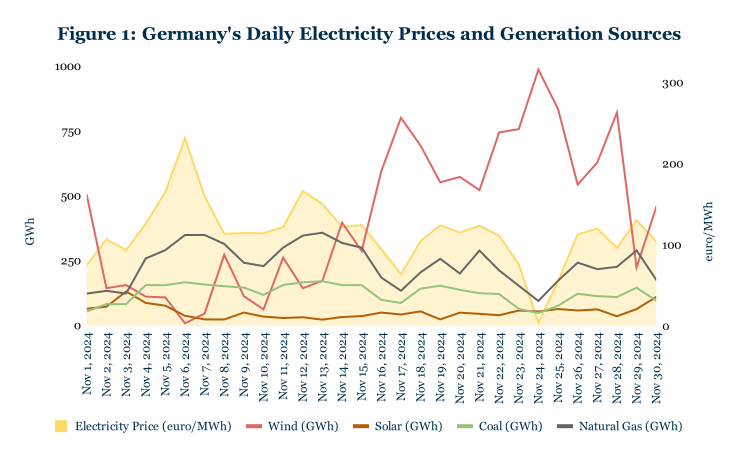
Source: GECF Secretariat based on data from SMARD (Bundesnetzagentur)
This is not a supply story. Germany did not run out of gas. What it lacked was any alternative to gas-fired plants capable of responding at the speed and scale the grid required. This is what balancing capacity means: the dispatchable power that a grid operator can call on instantly when generation from weather-dependent sources falls short. Unlike wind or solar, balancing capacity does not depend on conditions. It runs when commanded, stops when not needed, and exists precisely to absorb the gap between what renewables promise and what the weather delivers. The dunkelflaute is not the problem. It is the diagnostic. It reveals that beneath the EU’s renewable expansion lies an unresolved structural dependency on a technology it is simultaneously trying to eliminate.
The Viability Cliff
Wood Mackenzie’s analysis of gas peaker revenues makes the structural problem concrete: merely two dunkelflaute events in 2024 generated over 50% of the annual wholesale revenues of the gas peaker plants, the gas-fired generators designed to switch on quickly during periods of peak demand. Their entire business model depends on stress moments being frequent enough and prices being high enough to cover fixed costs across the whole year.
That model is becoming increasingly precarious. Dunkelflaute events are becoming less frequent as the grid evolves, which means the revenue windfalls that gas peakers depend on are arriving less reliably. Yet the price impact of each event is growing. In 2024, the annual average electricity price fell to around €80/MWh, while prices on dunkelflaute days spiked to €202/MWh, a gap of over €120/MWh and the largest relative divergence since the 2022 energy crisis. Figure 2 illustrates this: as normal-day prices stabilised, dunkelflaute-day prices pulled sharply upward, compressing the window in which gas peakers can earn enough revenue to remain commercially viable.
Figure 2: Comparison of Base Prices With and Without Dunkelflaute Days in Germany
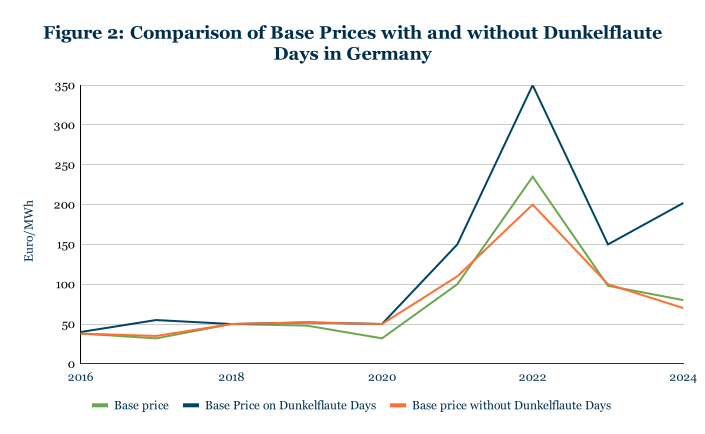
Source: Montel Energy
This creates a structural trap. Shutting these plants down before sovereign alternatives exist at scale would leave the grid with no safety net. Yet keeping them running means accepting that every dunkelflaute pushes emissions upward and pulls the system further from its climate commitments. Europe is simultaneously closing coal plants, watching its gas fleet age, and managing an uneven nuclear transition, with several reactors retiring in countries like Germany even as others expand capacity elsewhere. The result is a system with less and less backup at the exact moment it needs more. A German grid operator has already warned that the country cannot afford to shut down backup capacity without first ensuring viable alternatives are in place. That warning applies across the EU. And unlike supply dependency, this structural dependency on gas as grid backup cannot be resolved by finding a new import partner.
The Fragmented Diagnosis
The balancing capacity problem does not have a European solution yet, only 27 national ones. While Germany seeks Commission approval for 12 GW of new gas capacity under state aid rules, France, Italy, Belgium, and Poland each operate under entirely separate capacity mechanisms with different designs, rules, and price signals. Each member state is essentially solving the same problem independently, at greater cost and with less certainty. Figure 3 illustrates the financial consequences. The amounts member states are paying to secure backup capacity are rising overall but concentrated in a handful of countries, primarily France, Belgium, Ireland, Italy, and Poland. Meanwhile most of the remaining 22 member states have no comparable mechanism in place at all.
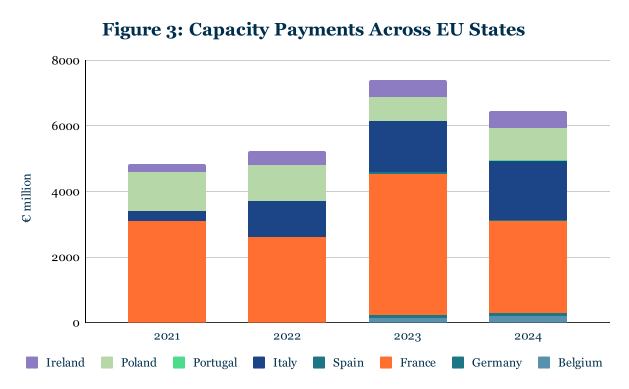
“The amounts member states are paying to secure backup capacity are rising overall but concentrated in a handful of countries.”
The costs are measurable. Since no binding cross-border solidarity obligation exists, each member state plans for worst-case scenarios independently, building in redundancy that a coordinated system would not require. ACER modelling, from the EU’s energy regulatory agency, shows coordinated procurement could reduce additional EU installed capacity needs by up to 70%, a saving that fragmented national approaches fail to capture. Meanwhile, capacity auction prices differ by more than tenfold across the EU. These prices are set through competitive processes where generators bid to provide backup electricity capacity. Cross-border participation also remains minimal despite the EU Electricity Regulation, which sets general principles for capacity mechanisms but does not require member states to open their auctions to generators in other countries.
The Commission has recognised the problem. In March 2025, it released the Clean Industrial Deal State Aid Framework (CISAF) to accelerate approval processes and harmonise capacity mechanism design parameters across member states. But it speeds up approvals without mandating coordinated outcomes and lacks a common vision on design. CISAF therefore remains insufficient to resolve the structural dependency.
Without a coordinated framework, fragmented national bets on gas plant survival will produce uneven adequacy across the internal market, recreating at the system level the same asymmetric vulnerability that has defined Europe’s energy dependency since 2022.
Towards a Pan-European Standard
Existing crisis instruments, including the Risk-Preparedness Regulation and the 2022 emergency intervention measures, address acute short-term shortages and price spikes. Neither establishes a binding long-term capacity standard or a managed retirement pathway, which is why the structural problem persists beneath them. The Commission should establish an EU Strategic Balancing Capacity Framework. Unlike CISAF, which accelerates national approvals without coordinating outcomes, this framework would bind member states to a collective European standard.
The starting point is a binding minimum dispatchable capacity standard, meaning a guaranteed floor of electricity generation capacity that can respond instantly to demand, regardless of weather conditions. The standard would set a floor below which no member state’s balancing capacity may fall, calibrated through the European Network of Transmission System Operators for Electricity‘s European Resource Adequacy Assessment (ENTSO-E’s ERAA) and enforced through ACER. ENTSO-E’s ERAA 2025 identifies Austria, Czechia, Slovakia, Hungary, the Netherlands, and Luxembourg as facing projected adequacy shortfalls. These are smaller, less interconnected markets with limited fiscal capacity to fund backup capacity, precisely the member states least equipped to address shortfalls alone. The Commission sets the minimum standard. Member states choose how to meet it. This mirrors how EU renewable energy targets already work, binding on the outcome, flexible on the means. The standard does not prevent member states from maintaining more backup than the minimum requires. It ensures no part of the interconnected EU grid falls below the point at which stress events become unmanageable.
The second element is a managed retirement gate for gas plants. No balancing capacity may be decommissioned until a verified replacement capacity of equivalent response speed is operational and confirmed through the ERAA. The ERAA is the EU’s independent annual assessment of whether each member state has sufficient electricity generation capacity to meet demand reliably under stress conditions. This does not permanently protect gas plants. It conditions their exit on evidence rather than market timing. ENTSO-E projects that 6 to 8 GW of balancing capacity faces decommissioning between 2028 and 2030 before replacements are in place. Without this gate, those plants exit before anything fills the gap they leave behind.
The third is a coordinated cross-border procurement mechanism. In March 2026, ACER received ENTSO-E’s proposal to integrate capacity mechanism parameters into the ERAA 2026 framework. That is progress in planning coordination. But the Commission must go further by setting a joint procurement target through the EU Electricity Regulation, while leaving member states free to choose how they meet it. This would convert the coordination savings already identified by ACER into an actual reduction in costs for consumers and industries across the internal market. Planning coordination alone, without a binding target and managed retirement pathway, stops short of a European solution.
“This is not a permanent entrenchment of gas dependency. It is a mechanism for managing its exit on Europe’s terms.”
The Commission has the legal basis to act through the EU Electricity Regulation and the state aid framework. What is missing is the political will to bind member states to collective outcomes. The proposed framework includes a built-in sunset condition: the obligation dissolves once each member state’s ERAA assessment confirms that clean backup capacity not dependent on imported fuel covers its adequacy needs. This is not a permanent entrenchment of gas dependency. It is a mechanism for managing its exit on Europe’s terms.
Every dunkelflaute between now and then will test a grid that is becoming less buffered, not more. The next stress event will not wait.
More from the ESP Series
Addressing Europe’s Strategic Dependencies — ten policy briefs inaugurating our European Strategic Policy Unit.
View All ESP Policy Briefs →About Euro Prospects
Euro Prospects is an independent platform for in-depth analysis of European political affairs. We publish articles on the issues shaping Europe today, from the EU–Mercosur trade agreement and Europe’s semiconductor supply chains to the European Union’s strategic shift on Syria and Serbia’s global arms trade, to name a few.
But informing readers is only part of our Mission. Euro Prospects was founded to help cultivate a European public sphere — a transnational space of political curiosity and civic engagement among Europe’s citizens.
Visit Euro ProspectsAbout ESP
The European Strategic Policy Unit (ESP) is Euro Prospects’ dedicated think tank department. We produce forward-facing, policy-actionable analysis on European strategic sovereignty across defence, technology, trade, energy, industry, and digital infrastructure.
Partnerships
Interested in citing, discussing, or building on this research? ESP is actively building relationships with researchers, institutions, and publications working on European strategic policy.
Contact UsESP Members
Francesco Bernabeu FornaraHead of Unit; Editor-in-Chief, EP
Giulia ConvertiniDigital Systems Sovereignty
Finn Sands RobinsonTrade & Industrial Strategy
Rimsha ArifEnergy Market Resilience
Matilde MinettiEU-China Strategic Competition
Orla HarrisDigital Infrastructure Sovereignty
Jerfi WigleySupply Chain Resilience
Annika GerbigDefence Industrial Autonomy
Trinabh BanerjeeStrategic Digital Security
Luka OkropirashviliEastern Neighbourhood
Juan Carlos LeunissenTransport & Energy Connectivity
Erik Giuliano WürthnerESP Outreach & Partnerships Coordinator