Addressing the Growing Threat of Crypto-Asset Circumvention to EU Sanctions
Policy Brief
1 October 2026
Fintech Sovereignty Analyst
Addressing the Growing Threat of Crypto-Asset Circumvention to EU Sanctions
Sanction circumvention is an adaptation game, and crypto has dealt Russia a new hand. To prevent the erosion of sanctions effectiveness, the EU must adapt to new evasion practices and tools to better target entry points into the formal economy.
Executive Summary
Since the start of Russia’s war of aggression on Ukraine, the 21 sanctions packages set out by the EU have been the union’s main tool to isolate the Russian economy. However, Decentralised Finance (DeFi) has enabled the emergence of new sanctions-circumvention practices and tools, undermining the effectiveness of sanctions. In particular, the crypto-ecosystem’s open-source, permissionless and non-custodial nature enables bypassing banking chokepoints that sanctions enforcement relies on.
Russia’s use of these technological innovations has enabled it to adapt beyond traditional financial freezes. Sanctioned entities use on-chain and off-chain practices to bypass blockchain transparency, seamlessly funnelling crypto into traditional finance. In response, the EU has expanded from individual listings to broad sectoral bans and restrictions on third-country platforms. Nonetheless, significant gaps persist, as the unique nature of decentralised code impedes state action.
For the EU to deal with crypto-enabled sanctions circumvention, it must update its sanctions framework to actively scrutinise the next frontier of practices and tools used by sanctioned entities, and raise its requirements for the regulated crypto-economy, while simultaneously helping those actors comply through proper information and tools. These steps are vital to avoid superficial political signalling and successfully freeze assets on blockchain ledgers.
Key Recommendations
1
2
Correspondent-banking-style duty for CASPs
To handle the one-to-two-hop laundering gap that name-matching alone can not help mitigate: amend Regulations 269/2014 and 833/2014 to turn CASPs compliance obligations into active one or two-hop tracing, using existing MiCA authorisation relationships and Travel Rule data (Regulation 2023/1113).
3
Product/practice bans on privacy-enhancing protocols
To cut off suspicious transactions using privacy-enhancing protocols: adopt a delegated act under AMLR (2024/1624 – Article 79) to prohibit CASPs from interacting with addresses flagged as touching mixers, suspicious and non-compliant DEXs and SE-MEV.
4
EU-level derogation mechanism for crypto-asset freezes
To avoid excessive CASPs’ legal exposure in distinguishing between legitimate and suspicious transactions: amend Regulation 269/2014 to add crypto-asset freezes to its derogation procedures, creating a single EU-level authorisation (licence) point for CASPs processing a flagged but legitimate transaction, hosted by AMLA.
5
Scaled public-private forensic tooling and sanctions-address database
To harmonise, scale and improve blockchain forensics at the EU level:
- In collaboration with the crypto industry, scale Horizon Europe’s CRYPTOACTION project to build public-private forensic tooling against on-chain and off-chain circumvention techniques.
- Replace periodic sanctions list updates with a live database pairing entities, persons and wallets to map circumvention networks, hosted by the EBA through an extension of its Travel Rule mandate and shared directly with CASPs.
Analysis
DeFi and Sanctions Erosion
Since the EU adopted its very first sanctions package against Russia’s war of aggression on Ukraine, Russia has continuously tried to link itself back to the financial system through circumvention.
Circumvention strategies are practices by which individuals or legal entities seek to evade the effects of restrictive measures. Sanctions rely on enforcement and checks by the country of governing jurisdiction, so circumvention tries to obscure the provenance, transparency and identification processes on which these checks rely. While the tangible part of this story is the Russian shadow fleet, which circumvents crude oil price cap sanctions (e.g, through flags-of-convenience practices), the bulk of the circumvention takes a more digital form.
Decentralised Finance (DeFi) offers Russia a range of new evasion pathways and tools. DeFi is the open financial system in which smart contracts replace traditional financial intermediaries. It is most often open-source, permissionless and decentralised: a libertarian innovation to money. Yet DeFi also poses challenges to the traditional playbook of global sanctions enforcement. It is becoming an entry point into the traditional financial ecosystem by removing chokepoints and benefiting from less stringent oversight. DeFi fuels regulatory challenges, as it lacks legal grounding and can easily be instrumentalised for circumvention.
“DeFi poses challenges to the traditional playbook of global sanctions enforcement… by removing chokepoints and benefiting from less stringent oversight.”
The Russian Adaptation Game
DeFi, especially cryptocurrencies, provides Russia with shiny new toys to innovate from. In December 2023, when US President Joe Biden issued Executive Order 14114, which froze conventional Russia-China payment corridors, Russia adapted by establishing a state-backed architecture that used cryptocurrencies as a settlement tool: the A7 network. Through innovative tech workarounds (VPN gateways, automated “invoicer” software for edit trade documents, etc.), particularly through the elaboration of a ruble-backed stablecoin (A7A5), Russia was able to continue settling dual-use military trades with counterparties in over 80 jurisdictions, including EU member states Hungary and Germany.
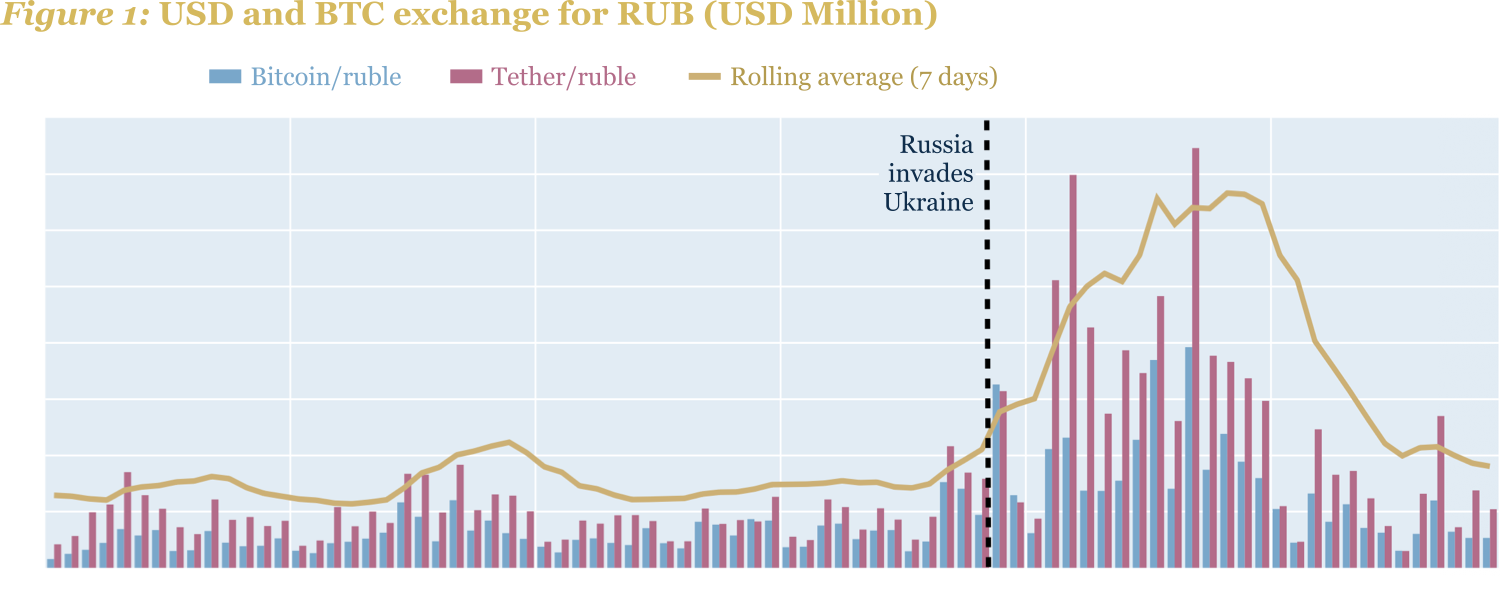
Post-invasion, Russia’s stance on cryptocurrency has rapidly shifted. Prior to 2022, the Central Bank of Russia (CBR) considered banning crypto mining, investing and trading. A position that was quickly reversed to show support towards crypto retail and wholesale adoption and its promotion for international settlements, including the most volatile assets. In June 2023, the Governor of the CBR himself advised Russian businesses to raise their crypto adoption. The signs that crypto-enabled circumvention has reached a state-backed, institutional-scale, don’t lie. Recent studies that expand beyond the focus on Bitcoin and Ethereum to incorporate a broader range of blockchains (USDT, XMR and XRP) support this narrative. By simply adding USDT into the equation, “an unusually high increase” in flows from RUB to blockchains becomes visible (Figure 1). In addition, cryptocurrencies have become net recipients of return spillovers from the RUB/USD exchange rate, confirming “capital flight-to-crypto” in Russia.
However, to understand the depth of Russian circumvention, volume alone is an insufficient measure. As blockchain transparency is becoming a myth, a growing number of privacy-enhancing and obfuscating practices and tools (e.g., Mixers, Privacy coins, On-Chain movements) are reducing the traceability and identification that are inherently possible on a ledger. Crypto markets do lack the liquidity to replace Russia’s national foreign exchange (FX), but stopping here would be a misunderstanding of illicit finance. Circumvention operates on the margins. Through isolated transactions, targeted actors (e.g, oligarchs) use crypto to absorb only a part of their capital. In the adaptation game of circumvention, the EU is unravelling with latency the techniques and pathways that Russia has put in place since 2022.
The Tools of Crypto-Enabled Sanctions Circumvention
Because circumvention occurs below the radar, the solution is to examine every layer of the crypto system and ecosystem.
RUB stablecoins such as A7A5 and USDKG are now serving to disintermediate the USD clearing mechanism, entering SWIFT through the back door. RUB stablecoins played a key role in the $37.8 billion in trade transactions that Russia passed through the A7 network. Russia is developing its own exchange platforms, which are proving very hard to restrain. Garantex, which had a lifetime transaction volume of $6-8 billion, saw 35% of its activity used for Russian sanctions evasion. After being sanctioned by the EU and others, the platform rebranded as Grinex and resumed operations, proving that operating under sovereign-state protection renders standard sanctions designations insufficient.
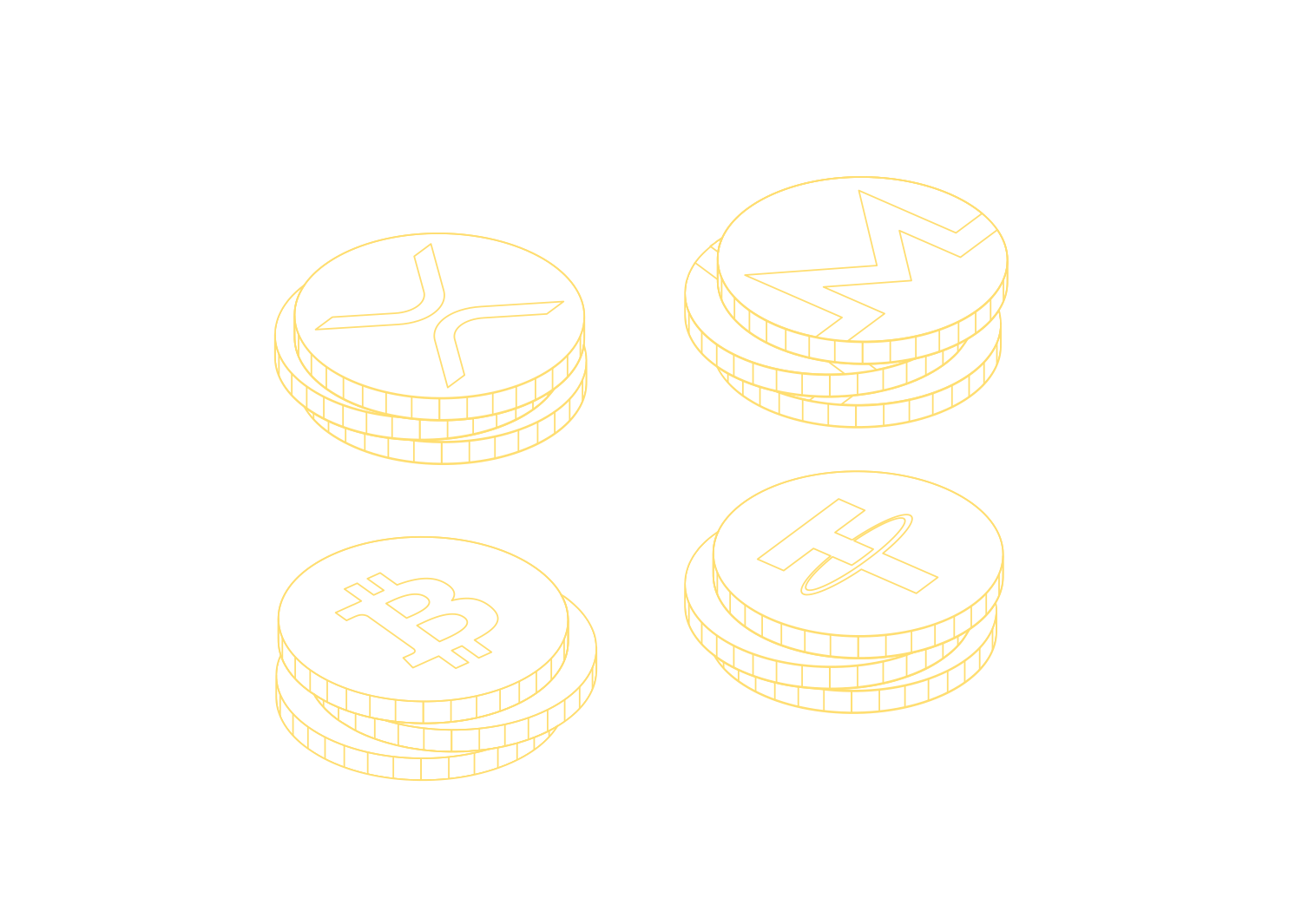
Most importantly, Russian evasion instrumentalises open-source software and protocols. The rise of anonymity-enhancing technologies (AETs) on the blockchain has come at the perfect time for circumvention. For the EU, banning significant privacy coin transactions (e.g, Monero) on Crypto-Assets Service Providers (CASPs) is only the first part of the puzzle. Scaling the practices historically used by Russian ransomware groups to blur transaction traceability, circumvention actors are increasingly turning to mixing and tumbling protocols. Tornado Cash has been the most prominent example, due to the mediatisation of its users’ legal battle against the US Office of Foreign Assets Control. Ultimately, the US regulator lost the case and had to remove the protocol from its sanctions list due to its autonomous code nature. Since then, multiple other protocols have gained prominence (e.g., Blender.io and Sinbad.io), ensuring that Russia’s financial movements remain invisible to blockchain tracking and forensics. Similarly, decentralised exchanges (e.g., BitPapa) or even exchanges that operate without personal identification (e.g., FixedFloat, simpleswap) all report high volume and activity in Russia.
The taxonomy of crypto-enabled circumvention tools is extensive, but can be clustered into on-chain and off-chain practices. On-chain circumvention disrupts the transparency of a public blockchain and its ledger. Off-chain circumvention exploits DeFi interoperability to layer and obscure funds. Both types of practices create ways for Russia to swap sanctioned fiat for crypto, and reverse these flows back into traditional finance. For the EU, this taxonomy should matter because it is impossible to sanction on-chain code, which is largely open-source and decentralised. Targeting off-chain circumvention, specifically the bridging infrastructure to the formal economy, is a more viable option for any regulator.
“It is impossible to sanction on-chain code, which is largely open-source and decentralised. Targeting off-chain circumvention, specifically the bridging infrastructure to the formal economy, is a more viable option…”
Assessing the EU’s Current Response
The effectiveness of the EU’s response to crypto-enabled sanctions circumvention has been growing. While the first 19 packages maintained the status quo approach by using individual listings, the 20th package signalled a promising shift. In April 2026, rather than extending listings, the EU imposed a total sectoral ban on any Russia-established crypto provider or platform, and prohibited EU entities and individuals from “netting” transactions with Russian counterparts. Effectively, this widened EU sanctions on Russia and showed that the EU was now also targeting the tools Russia used. One month later, the 21st package continued that trend, introducing the possibility of adding crypto providers or platforms in third countries to the individual listings, and a full third-country ban, as Russia quickly responded to EU sanctions by re-domiciling (e.g., in Georgia, Panama, the UAE, Kyrgyzstan). With a delay, this path was the same as the one that led to EU banking sanctions on Russia.
However, for crypto, that path continues and can’t stop here. Gaps still exist in the EU’s approach, limiting the effectiveness of its sanctions. Firstly, addressing privacy coins and netting was a first step towards addressing the very practices that make the crypto environment a fertile ground for Russia’s circumvention. Nevertheless, as has been observed, on-chain and off-chain practices are plentiful and widespread, and the EU needs to scrutinise the next frontier through which Russia operates. Secondly, the EU needs to remind the world that its sanctions are not just a signalling tool. Sanctions only work when they are executed, and in the crypto ecosystem, private firms (CASPs) are the ones carrying them out. EU operating firms are legally mandated to comply, but the combination of limited practical means due to the complexity of the blockchain and the fragmented monitoring of their activity across 160 national competent authorities means that a gap most certainly exists.
The EU needs to continue affirming its answer to crypto-enabled circumvention by broadening its sanctions and placing greater demand on its crypto ecosystem. However, extending sanctions is only effective if the entities tasked with enforcement are properly equipped and supported in their compliance journey. Failing this trade-off means generating signals rather than effectively freezing assets on a ledger.
More from the ESP Series
View All ESP Policy Briefs →About Euro Prospects
Euro Prospects is an independent platform for in-depth analysis of European political affairs. We publish articles on the issues shaping Europe today, from the EU–Mercosur trade agreement and Europe’s semiconductor supply chains to the European Union’s strategic shift on Syria and Serbia’s global arms trade, to name a few.
But informing readers is only part of our Mission. Euro Prospects was founded to help cultivate a European public sphere — a transnational space of political curiosity and civic engagement among Europe’s citizens.
Visit Euro ProspectsAbout ESP
The European Strategic Policy Unit (ESP) is Euro Prospects’ dedicated think tank department. We produce forward-facing, policy-actionable analysis on European strategic sovereignty across defence, technology, trade, energy, industry, and digital infrastructure.
Partnerships
Interested in citing, discussing, or building on this research? ESP is actively building relationships with researchers, institutions, and publications working on European strategic policy.
Contact UsESP Members
Francesco Bernabeu FornaraHead of Unit; Editor-in-Chief, EP
Giulia ConvertiniDigital Systems Sovereignty
Finn Sands RobinsonTrade & Industrial Strategy
Rimsha ArifEnergy Market Resilience
Matilde MinettiEU-China Strategic Competition
Orla HarrisDigital Infrastructure Sovereignty
Jerfi WigleySupply Chain Resilience
Annika GerbigDefence Industrial Autonomy
Trinabh BanerjeeStrategic Digital Security
Luka OkropirashviliEastern Neighbourhood
Juan Carlos LeunissenTransport & Energy Connectivity
Erik Giuliano WürthnerESP Outreach & Partnerships Coordinator
Antoine Cerqueira Da CostaFintech Sovereignty
Sofia CigoliniEuropean Strategic Policy Unit