Inside NATO 3.0: Where Europe Leads, and Where It Still Can’t
Inside NATO 3.0: Where Europe Leads, and Where It Still Can’t
NATO’s own leadership calls it a new era of partnership, a stronger Europe within a stronger alliance. Europe is taking on more of NATO’s responsibilities and is assuming more authority within the alliance, however, it still depends on America for nearly everything that leadership runs on.
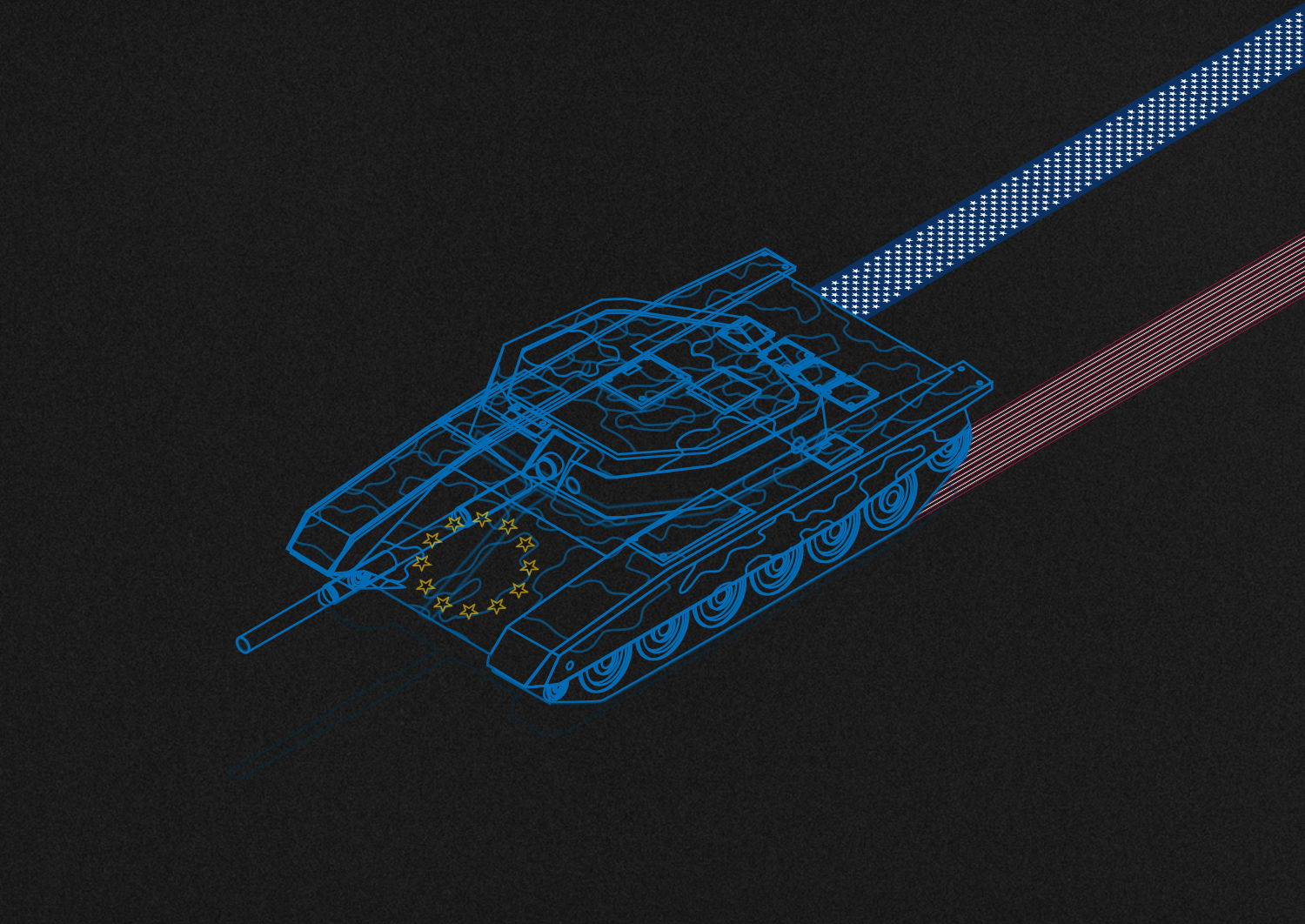
Image Credit: Euro Prospects
By Matteo Nilsson, NATO Analyst, Security & Defence Unit (S&D)
Edited by María Gil Martínez, Transatlantic Relations Analyst, Security & Defence Unit (S&D)
September 24, 2026

In February 2026 at a defence minister’s meeting, US Under Secretary of War for Policy Elbridge Colby, reintroduced the concept of ‘NATO 3.0’. It outlines a new phase of the alliance’s strategy, centering on European powers assuming responsibility for Europe’s conventional defence, while the US re-orders its strategic priorities, focusing primarily on deterring China. This categorisation assumes a chronological periodisation of NATO history: where the Alliance has shifted through three distinct phases defined by different threats. NATO 1.0 was built to deter the Soviet Union through conventional military force, NATO 2.0 emerges with the collapse of the USSR and pivots towards the diffuse threats of the Post-Cold War era and uni-polar world order, combating terrorism, as well as cyber attacks. We are now entering this new phase, one that Colby highlights is ‘built on partnerships, not dependencies’.
‘NATO 3.0’ has been a central focal point of the Summit in Ankara this July. Secretary General Mark Rutte stated that he hoped the Summit would ‘breathe life into the concept of NATO 3.0: a stronger Europe in a stronger NATO’ leading to ‘an alliance that is less dependent on the US, but in which the US remains firmly rooted’. The following piece aims to dissect Rutte’s claim and ask what a NATO 3.0 actually looks like? Picture NATO as a car, for all of its history the US has been in the driver’s seat: it has built the vehicle, it has developed the engine and it has the decision-making power on which direction the car is heading. This new phase describes a shift where European powers are making their way into the front seats, without the US conceding its role as the ‘driver’. Beneath the surface however, the picture looks more familiar: Washington has tightened its grip on the Allied Marine, Air and Land Commands, the classified intelligence networks run on a single American company, most of the alliance’s cloud infrastructure sits on American services, and the nuclear guarantee remains fundamentally American. This is the story of what NATO 3.0 actually looks like.
Rutte’s ‘less dependent’ claim sits in NATO’s command structure. In February 2026, NATO confirmed that its two most senior warfighting commands: Allied Joint Force Command Naples and Allied Joint Force Command Norfolk would be led by Italy and the United Kingdom, transitioning from a US leadership. This comes together with the decision that Germany and Poland will share command of Joint Force Command Brunssum on a rotational basis. This is not a small transition as all three Joint Force Commands lead at the operational level in crisis and conflict and have always been under American leadership. It is the first time European officers have held operational command at this level of seniority. The passage reflects a shift to ‘a more fairly shared responsibility within NATO’. Even as Naples and Norfolk moved to European command, the post of the Supreme Allied Commander Europe (SACEUR), the most senior military position within the alliance, remained American. This was confirmed by the 2026 National Defense Authorization Act, a US federal law that bans any further US troop reduction from Europe without formal Congressional certification.
Europe’s incremental role within the alliance does not end at the command level, financing tells a similar story (at least on paper). Last year’s Summit in The Hague centered on a pledge to raise defence related spending to 5% of GDP by 2035 (3,5% on core defence spending, and 1,5% on defence related projects) for all members. This has already translated into tens of billions of Euros in additional spending across the alliance with Poland leading its European partners. NATO’s estimates show that as of 2026, five European allies exceed the 3.5% core defence spending already this year, with three more spending more than 3%. These numbers indicate a strong commitment to the target set in The Hague. The total share of the European allies and Canada is forecast to increase to 42,7% of NATO’s total spending: this compared to 40,7% last year and 30,3% in 2021. Whether this trend is sustainable and for how long is a separate question, but the direction of travel is unmistakable. European governments are paying more of NATO’s bill than at any point since the Cold War.
Europe’s defence-industrial base echoes the same growth illustrated by European governments. Ankara alone produced over $50 billion in new procurement commitments, including a ‘Drone Edge’ initiative worth roughly $40 billion over five years. Most symbolically, NATO’s planned acquisition of Swedish-built GlobalEye surveillance aircraft to replace the US surveillance fleet which had been in service since 1982. This development doesn’t just highlight the growing European defence industrial base, it spotlights a rare and concrete case of European technology stepping in for a function American systems performed for the Alliance for decades.
The hardware under Europe’s rearmament tells an important story: According to SIPRI, for the first time in two decades, the largest share of US arms exports went to Europe between 2021-2025 (38%). Even as European industries ramp up, much of what fills them is American. The figures indicate that it may take some time for European countries to become less dependent on American arms. The European industrial base is growing but it has been growing around American supply.
The clearest evidence of American dependency sits in the digital layer. In June 2026, NATO’s own procurement and command bodies certified that the Maven Smart System, an AI platform built by the American firm Palantir, had reached full operational capability on NATO’s classified networks, handling core functions of intelligence fusion and targeting. This is the clearest case of a US tech giant entering the alliance and occupying a fundamental space in the alliance operations. Palantir remains subject to US law, including statutes that can compel American firms to hand over data to US authorities. It raises important questions on the dominance of American digital technology and European digital sovereignty. There are individual allies that are already uneasy about Palantir: Spain blacklisted it from public contracts and Germany and France are both attempting to replace it domestically. Yet at the alliance level, NATO’s own institutions certified the same system for wider use.
Beneath that sits a larger dependency. 72% of European defence-industry cloud usage runs on American providers, against just 13% on European ones. Whoever controls the cloud, controls the access to the data and the systems running on it. While NATO remains an alliance based on partnership, this could represent an American political bargaining chip in the future and certainly should raise questions for European states. NATO has recognised the need for a shared digital infrastructure through the ‘NATO Digital Backbone’ initiative, yet its rationale centers on ‘interoperability’ rather than American dependency.
Even on nuclear deterrence, NATO’s most sensitive and American domain, there has been a European opening. In March 2026, France announced an expansion of its own arsenal and a framework for ‘forward deterrence’ with willing partners. Yet, nowhere is Rutte’s ‘firmly rooted’ half of his statement clearer than on nuclear deterrence. The US remains the power providing the nuclear umbrella to its European allies. A report of the European Nuclear Study Group, published by the Munich Security Conference in February 2026, explicitly states that neither France nor the UK could ‘seamlessly replace’ the US as Europe’s extended deterrence provider as neither country has the capabilities that underpin America’s nuclear umbrella. In January 2026, at the European Parliament’s Committee on Foreign Affairs, Secretary General Rutte could not have been more explicit, he claimed that “if anybody thinks that Europe can defend itself without the US, keep on dreaming”. He later stated that the “ultimate guarantor of our freedom” is the US nuclear umbrella. On the single capability that ultimately underwrites Article 5, in other words, Europe is behind, it is missing components that cannot be built quickly, regardless of the amount of political will that exists to build them.
Conclusion
‘Less dependent but firmly rooted in the US’. Dissecting this claim and the core developments taking shape, we see that the picture that emerges is not so clear. Europe is not simply stepping into American shoes and nor is ‘a more European NATO’ an empty rhetoric. We see that Europe is indeed assuming leadership and responsibility on command, financing and increasingly industry, while the system and guarantees that make NATO function, remain American built. As demonstrated by Norfolk and Naples, command charts can be redrawn in a single statement. The infrastructure and assurances underneath them, cloud, AI-enabled targeting, and above all the nuclear umbrella, cannot be rebuilt on the same timeline.
‘NATO 3.0’ should therefore not simply be seen as a phase Europe is passing through to full strategic autonomy nor is it a representation for American retreat. NATO 3.0 can best be viewed as a phase of redistribution: a hybrid model where European leadership and American infrastructure coexist and an alliance in which European powers continue to step up on defence yet remain fundamentally tied to the US on several critical aspects.
Disclaimer: While Euro Prospects encourages open and free discourse, the opinions expressed in this article are those of the author(s) and do not necessarily reflect the official policy or views of Euro Prospects or its editorial board.

NATO Analyst, Security & Defence Unit (S&D)
An Italian-Swedish graduate student in International Relations at the Geneva Graduate Institute, currently studying at the European University Institute in Florence. He earned his Bachelor’s in Political Science from the University of Amsterdam, where his thesis focused on Sweden’s accession to NATO and its implications for deterrence architecture in the Baltic Sea region. His research interests center on NATO cohesion, extended deterrence, and European strategic autonomy, with emphasis on how Europe is strengthening its security position amid transatlantic challenges.
Edited by María Gil Martínez, Transatlantic Relations Analyst, Security & Defence Unit (S&D) | Follow our European journalism