Beyond Cheap Talk? The EU’s Fragmented Turn to Indo-Pacific Security
Beyond Cheap Talk? The EU’s Fragmented Turn to Indo-Pacific Security
In 2025 the EU committed to more in Indo-Pacific security than ever before. It is not clear it has the means to follow through.
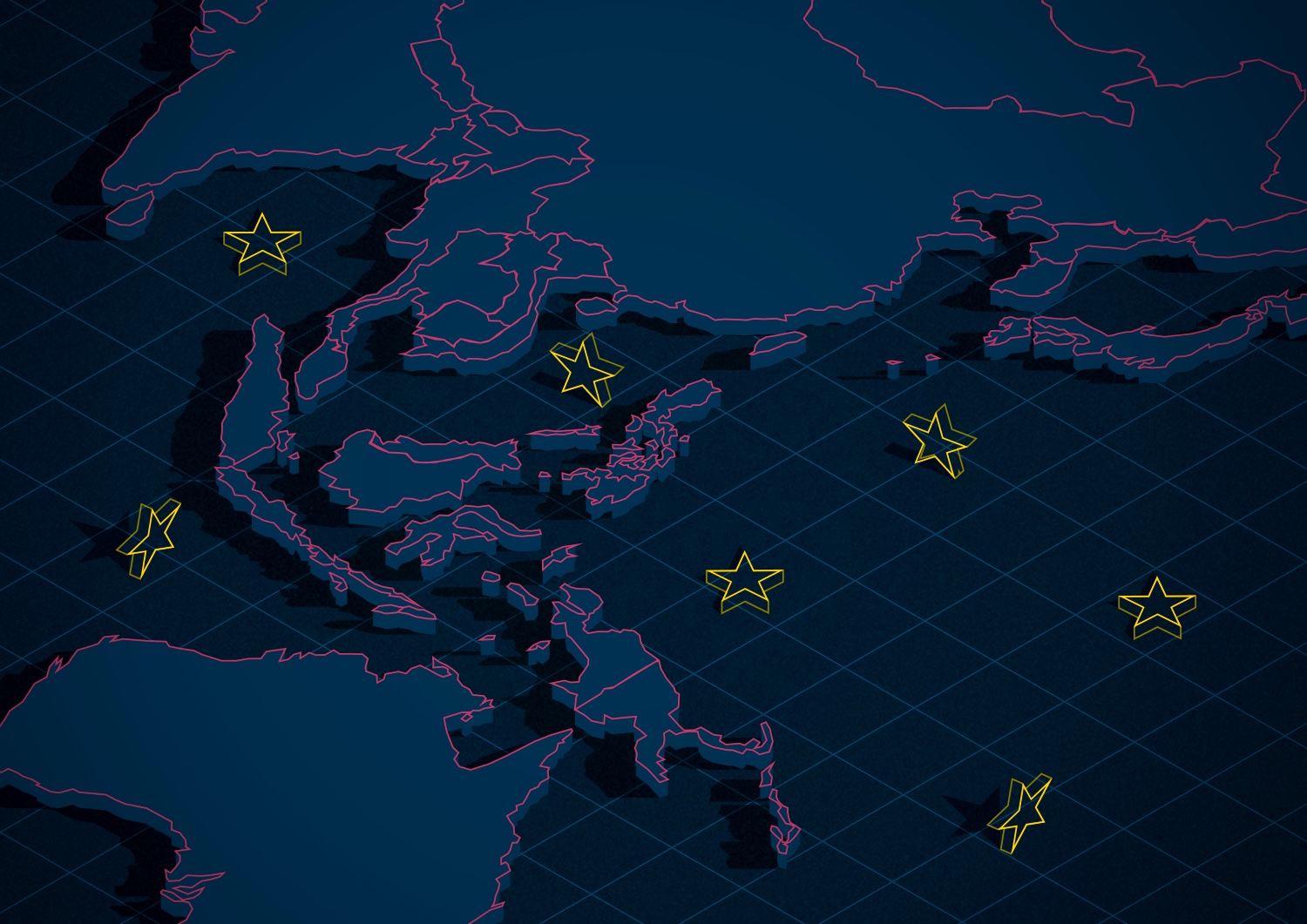
Image Credit: Euro Prospects
By Mariona Fortuny Jané, Europe in the Indo Pacific Analyst, Security & Defence Unit (S&D)
Edited by Arthur Langley, UK & Nuclear Policy Analyst, Security & Defence Unit (S&D)
September 22, 2026

On 20 October 2025, the Council of the European Union adopted conclusions on the EU Strategy for Cooperation in the Indo-Pacific, first published in 2021, which strengthen and in part invert its priorities: security and defence now appear as the first of three fields of action, and Europe’s security is described as increasingly intertwined with that of the Indo-Pacific, with cooperation set out in maritime security, cybersecurity, counter-terrorism and space. This article examines the gap between that rhetoric and effective action, what signalling theory terms cheap talk: communication that is costless to the sender and carries no penalty for non-fulfilment, and which therefore offers no credible guarantee that declared commitments will be followed by action. Closing it is difficult for three sets of reasons, addressed here in turn: the EU’s internal fragmentation, the skepticism of regional partners, and the clash of powers running through both the transatlantic order and the region.
The EU’s internal problems
The 2021 Strategy, which called for a greater European presence in the Indo-Pacific and specifically in security and defence, did not originate in a centralised impulse from Brussels but in a bottom-up aggregation built on the positions of France, the Netherlands and Germany. It thus reproduces the structural paradox inherent to the EU as a sui generis institution: intergovernmentalism set against supranationalism.
Member states diverge on key questions of the emerging transatlantic order, and this materialises in their positioning towards the Indo-Pacific, particularly in security and defence. For some the region is a crucial geopolitical space; for others it is simply not deemed important: Croatia, Estonia, Greece and Malta remain largely uninterested, since distance, absent stakes and closer priorities such as Russia or the Mediterranean crowd out attention, while others have no formal regional policy at all. China is the clearest case: Hungary and Bulgaria privilege economic bilateralism with Beijing and resist European de-risking, while the Baltic states withdrew from the 17+1 framework and Vilnius hosted a Taiwanese representative office. On military effort, France remains the only member state for which defence ranks as its top national policy priority overall. Norm contestation erodes the capacity to speak with a single voice, and the result is a persistent preference for intergovernmental interests over the EU as a collective actor.
The consequence is direct. Because the Union’s institutions are weakest precisely in security and defence, where national capitals retain most authority, these disagreements reduce any common position to the lowest common denominator. What survives is the declaration everyone can sign; the operational commitment, which requires resources and sustained consensus, doesn’t. Hence the persistence of cheap talk: the EU can announce jointly what it can’t execute jointly.
How the EU is perceived in the Indo-Pacific
Perception deepens the same gap. The region is defined by heterogeneity, and expectations differ sharply from one location to the next, both in what partners want from the EU bilaterally and regionally, and in how they read their own security environment. A few cases explained in the literature convey the range; the perception evidence comes from the EUIP Network1. Japan and South Korea are the principal beneficiaries of the EU 2025 shift, whose preferences are far better represented than in the original Strategy, particularly the explicit naming of North Korea. At the opposite end, India is the most sceptical location of all, criticising a strategic ambiguity on China that erodes credibility, while in Australia key informants place the EU at roughly a third of the weight they give Washington and Beijing, with AUKUS and the Quad providing clear alternatives. Thai respondents see the EU’s habit of framing the region through its own security concerns as counterproductive in a setting built on inclusion rather than blocs. China holds a bifurcated view: valued as a normative and economic power, distrusted as a regional actor. Across these differences, partners converge on one point: the EU is accepted as a normative power in low politics, and far less as a key actor in regional security.
Why does this make the gap harder to close? Because the region is a theatre of power politics in which securitisation keeps intensifying: being recognised as a normative power but not as a security actor relegates the EU to a second-order partner, present on the low-politics agenda but absent from the conversation that determines regional order. With limited military projection, a Common Security and Defence Policy that’s institutionally weak and incapable of replacing NATO, and recurrent internal divergences, partners conclude that the European contribution would be marginal in a balance settled between Washington and Beijing. The result is a self-reinforcing cycle: excluded from frameworks like the Quad and AUKUS and holding only a marginal role in forums such as the ASEAN Defence Ministers’ Meeting Plus, the EU has fewer opportunities to build the track record that would earn it a larger one. Without prior credibility, any European security commitment is read as declaration rather than action.
Modes of cooperation: from drawback to opportunity
The diagnosis would be incomplete without acknowledging real traction since the 2025 review, on a baseline that is not minor: EU trade with the Indo-Pacific reached EUR 848 billion in 2024. In the multilateral register the EU holds the position most consistent with its identity yet one that delivers least: it participates in the ASEAN Regional Forum, implements an Economic Partnership Agreement with four Pacific states, and sustains the IORIS maritime information platform, used by a hundred agencies from fifty countries. Movement is greatest bilaterally, where agreements with five Asian partners have been extended through a Comprehensive Economic Partnership Agreement with Indonesia, and tailored Security and Defence Partnerships with Japan and South Korea are complemented by regular dialogues with six further partners, India among them. This is legitimacy without leverage in one register and commitment without collectivity in the other.
The minilateral and operational register is where commitment materialises: joint naval exercises with seven regional partners, Operation ATALANTA and EU NAVFOR ASPIDES, the Coordinated Maritime Presences concept, and projects such as CRIMARIO, ESIWA+ and the HIPPA pilot action on hybrid threats. The shift towards these formats responds to partners’ preference for flexibility over institutionalisation, and to the erosion of multilateral mechanisms. Hence the ambivalence: traction is real and growing, but what grows fastest least resembles a common European policy.
Opportunity: fragmentation as an advantage
Read in terms of opportunity, this admits of a more favourable interpretation. The EU is acting, gradually but steadily, and the route to traction may not lie in multilateralism alone but in complementing it with registers that aren’t mutually exclusive but complementary. It could sustain credibility and greater capacity for action, particularly in security and defence, by deepening tailored partnerships with the states inside the region’s minilateral formats, and pushing towards action even at the cost of internal fragmentation would merely formalise an existing reality: that those states able to act, act.
Are these movements solid, however? It’s unclear how much institutionalisation such efforts require, and the flexibility partners prefer tends to produce temporary structures rather than stable architectures. They must also navigate a dense Euro-Atlantic architecture in which membership and mandates rarely coincide, so that a disorderly proliferation of agreements could produce commitments difficult to reconcile. Abandoning classical multilateralism would also carry a reputational cost for a power that has always defined itself through it. The alternative should therefore function as support rather than replacement.
External challenges: power politics and the clash of powers
The two poles: Washington and Beijing
The external context combines an increasingly unstable transatlantic order with the growing fusion of the economic and the geopolitical, which the literature calls geoeconomics. Recent episodes illustrate it: Ukraine, which has confronted Europe’s ideological positioning with its commercial interests while absorbing policymaking bandwidth beyond the Euro-Atlantic space; the Strait of Hormuz, where the EU has diverged from Washington and deploys missions such as EMASOH; and Gaza, which has opened the deepest European division over an external crisis since Iraq.
The second Trump administration has redefined US engagement as a zero-sum contest with China, where every gain for one side is treated as a loss for the other: naval exercises aimed at denying China ground rather than building inclusive security, tariffs designed to shift trade advantage away from Beijing, and cuts to development assistance that hand China the soft-power space Washington vacates. Towards Europe the approach is transactional, combining tariff threats, pressure on NATO burden-sharing and doubts over collective defence, an expectation Vance’s Munich speech made explicit. The aggregate effect is an alliance architecture the literature calls “fundamentally disrupted”: several Indo-Pacific governments now perceive that aligning with Washington has lost value as a strategy for balancing China.
The second pole is China, which the EU characterises as partner, competitor and systemic rival at once, a functional ambiguity that preserves the commercial relationship and avoids the confrontational language of other Indo-Pacific strategies. This has not prevented friction over Taiwan, Chinese coercion in the South China Sea, Beijing’s support for Russia’s military-industrial base, and the scrutiny of high-risk suppliers foreseen in the revision of NIS2 and the Cybersecurity Act, which Beijing calls discriminatory.
A region that is problematic in itself
The second external challenge is the region’s own configuration. The term “Indo-Pacific” was coined by the naval strategist Gurpreet Khurana and articulated as state doctrine by the United States, Australia, Japan and India in response to China’s Belt and Road Initiative, although each projects divergent interests onto it, which is why much of the Global South still reads it as a Western construct without shared understandings of proximity or identity. The consequence is twofold: the EU operates within a framework it did not help to define, with little scope to set the terms of a debate that does not treat it as a reference actor; and its hedging response, designed to avoid appearing either as an anti-China bloc or as an Atlanticist extension, is read regionally not as calculated prudence but as an absence of high politics.
Synthesis
Both external challenges converge on one constraint. The EU has gradually distanced itself from the defence decisions of the two great powers, yet can’t disengage from either: bilateral trade and investment flows with China have almost doubled over a decade, while towards the United States it has developed a documented strategic reliance, from military assistance to Ukraine to imports of liquefied natural gas. Differentiating without breaking, within a framework it did not define and with internal unity under pressure, leaves the EU in structural in-betweenness: autonomous enough not to follow Washington, but without capacity to sustain its own position. It’s this indefiniteness that perpetuates cheap talk, since it permits declaring a position without committing resources.
Opportunity: the third way, differentiation through technology
The literature reinterprets this difficulty as a potential opportunity: a third way of differentiation. Although not limited to security and defence, its most plausible vector is technological, combining European regulatory leadership with the supply of its own systems. Regional demand exists, since much of the Indo-Pacific seeks a third option amid rivalry between the two technopoles, and it already has concrete expression in the non-aligned surveillance systems offered by firms such as Thales and Airbus. Its scaling, however, is doubtful: the EU’s technological presence is relevant but outmatched by the productive capacity of the two great powers, which limits this differentiation as an instrument for closing the gap.
Conclusion
The gap between the EU’s declared ambition and its effective action in the Indo-Pacific has no single cause, but it does have a recognisable structure. Three mechanisms converge. The first is institutional: a strategy born of the aggregation of national positions, resting on an architecture in which intergovernmentalism and supranationalism coexist uneasily, reduces any common position to the lowest common denominator: EU institutions remain weakest precisely in security and defence, where national capitals retain control over both decisions and capabilities, and the unanimity rule in the Common Security and Defence Policy lets any single state veto a stronger line, so what survives is whatever the most reluctant government will accept. The second is perceptual: recognised as a normative power but not as a security actor, the EU is relegated to second-order partner in a region where debate is heavily securitised. The third is structural: caught between two poles from which it can’t disengage, the EU can differentiate itself rhetorically without being able to sustain a position of its own.
These mechanisms share a common denominator, which explains why the gap is most pronounced in security and defence. This is the domain in which the Union’s institutions are weakest and national capitals retain most authority, in which credibility requires material capabilities the EU doesn’t control, and in which regional partners apply the highest threshold. In trade, technology or the green transition, the EU can deliver with the instruments it already possesses; in defence, it can’t.
Even so, the period opened in 2025 shows genuine movement. The EU has ceased to rely exclusively on the multilateral register and has diversified towards the bilateral and the minilateral: tailored security and defence partnerships with Japan, South Korea and India, regular dialogues with Southeast Asian partners, joint naval exercises, operational maritime domain awareness projects and, following the November 2025 Ministerial Forum, a structured initiative on the protection of critical maritime infrastructure. Their significance lies less in volume than in format: they permit the accumulation of verifiable commitments without waiting for consensus among the twenty-seven.
Three challenges follow. Solidity: the flexibility preferred by many partners produces temporary structures rather than stable architectures. Coherence: a disorderly proliferation of parallel agreements, within an already dense Euro-Atlantic architecture with overlapping mandates, may generate commitments difficult to reconcile. And dependence: while the American commitment remains uncertain, the EU needs security arrangements that hold irrespective of what Washington decides, without placing itself in open confrontation with its principal guarantor.
The opportunities are equally identifiable. In the short term, consolidating what already works: European minilateralism has been described as a model balancing flexibility and institutionalised commitment, and as a more effective instrument of influence under strategic competition than exclusive insistence on classical multilateralism. In the medium term, the technological third way responds to genuine regional demand, even if its scaling is constrained by the productive capacity of the two great powers.
Notes
1. The EUIP (European Union in the Indo-Pacific) Network is a Jean Monnet Network project funded by the European Commission (grant no. 101085570), comprising 27 partner universities (13 in Europe, 14 in the Indo-Pacific) and over 40 experts. Between 2024 and 2025 it conducted 111 semi-structured interviews with foreign policy decision-makers and influencers across eight Indo-Pacific locations, namely Australia, China, India, Japan, New Zealand, South Korea, Taiwan and Thailand, complemented by policy sandpit workshops in each location.
Disclaimer: While Euro Prospects encourages open and free discourse, the opinions expressed in this article are those of the author(s) and do not necessarily reflect the official policy or views of Euro Prospects or its editorial board.

Europe in the Indo Pacific Analyst
Mariona serves as a Risk Consultant at Modelverse, a cybersecurity startup in The Hague, where she focuses on European regulatory frameworks including NIS2, GDPR and DORA. Her expertise bridges cybersecurity regulation, hybrid threats and East Asian security policy, including research on Japan’s security paradigm and collaboration with Oxford Analytica examining North Korean foreign information manipulation operations. She previously interned at Casa Asia in Barcelona supporting diplomatic forums and institutional relations.
Edited by Arthur Langley, UK & Nuclear Policy Analyst, Security & Defence Unit (S&D) | Follow our European journalism