Italy’s Border Controls Over the Ceuta Crisis: A Familiar Tool, an Unfamiliar Storm
Italy’s Border Controls Over the Ceuta Crisis: A Familiar Tool, an Unfamiliar Storm
A migrant crisis in Ceuta. A border closure with no shared border. A word, “suspension,” that is hardly legally possible. Untangling Europe’s strangest border story of the summer.
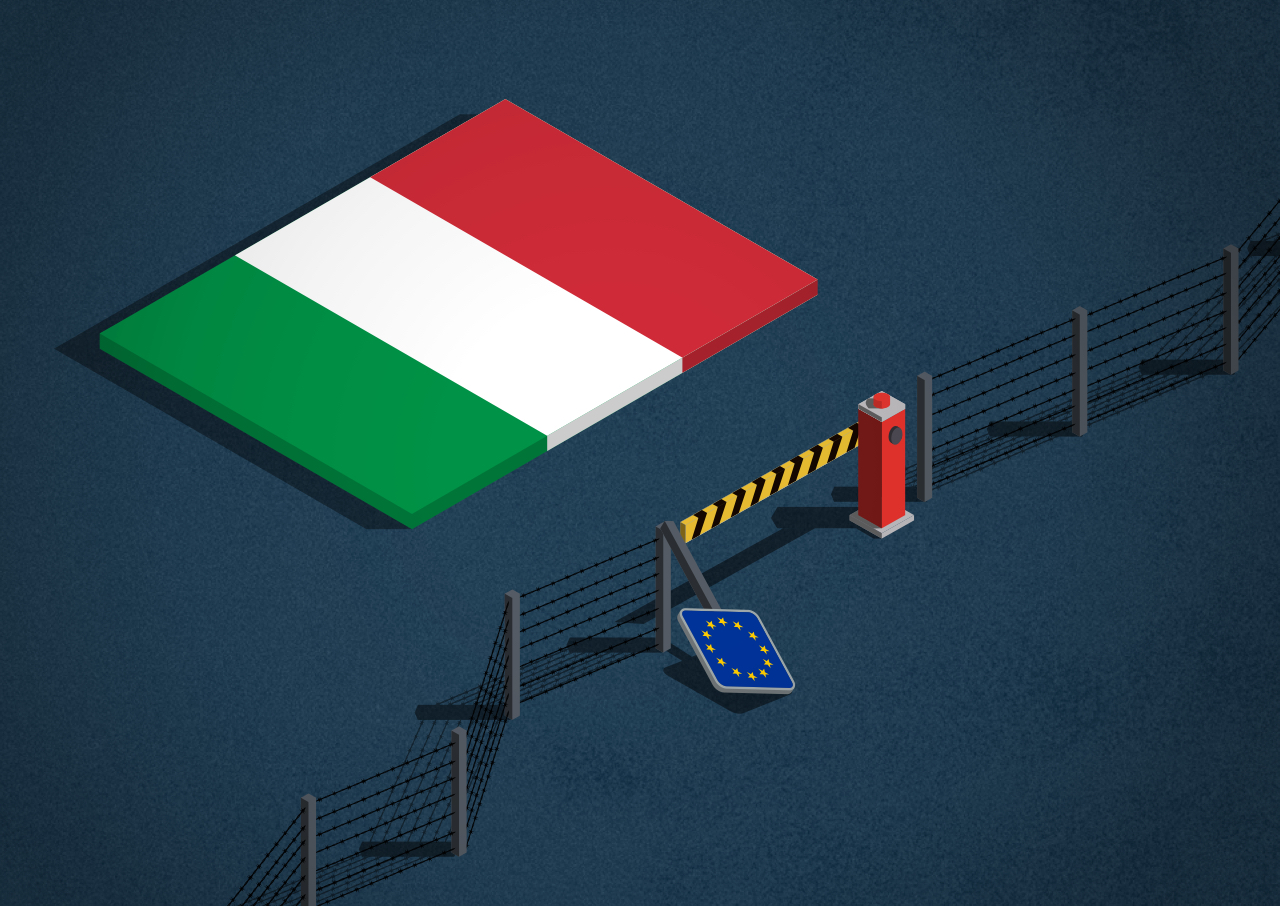
Image Credit: Euro Prospects
By Matheus Maynard, Border Governance Correspondent
Edited by Ofelia Dournel, EU Affairs Correspondent
10 August 2026

The Situation Unfolding
With the news of over 72,000 migrants crossing into the tiny Spanish exclave of Ceuta in North Africa, another chapter of the European migration crisis unfolded, sending shockwaves across the EU. On July 30, 2026, an unprecedented number of migrants crossed into Ceuta from Morocco; Spain’s Interior Ministry reported that around 70,000 had already returned to Morocco. At least 75 people died on the Spanish side of the crossing, with 11 additional deaths reported in Morocco. Spanish Prime Minister Pedro Sánchez faced fierce criticism from fellow European leaders on his government’s handling of the EU’s external border. Italy, in particular, moved quickly to impose temporary border controls with Spain, with Italian officials sharply criticizing Madrid and calling for EU-level action.
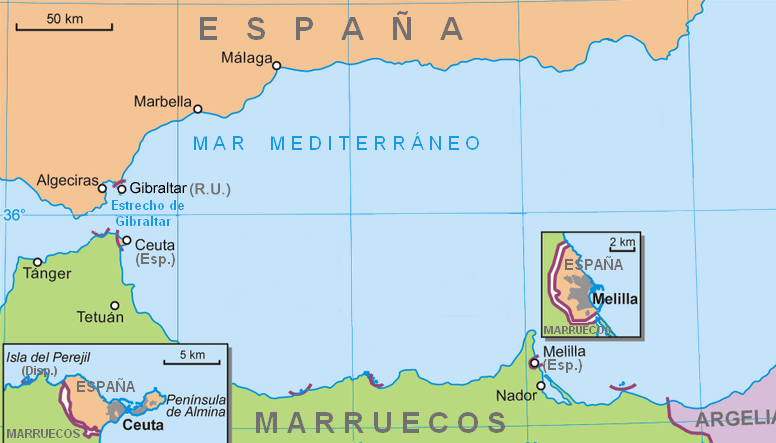
Map: Ceuta and Melilla, by Anarkangel, licensed under CC BY-SA 3.0, via Wikimedia Commons
A Crisis of Terminology
Apart from the political crisis these events have sparked, there is also a crisis of terminology in the reporting and discussions of the story. Several major outlets ran headlines invoking a “Schengen Agreement suspension on Spain,” a framing amplified by European leaders themselves. Meloni said Spain “should be suspended from the Schengen area,” and Finland’s Interior Minister Mari Rantanen went further still, arguing that countries failing to protect the external border “cannot be members of Schengen.” Denmark’s PM Mette Frederiksen struck a more measured note, saying the EU should “consider all options, including a suspension of Schengen cooperation”, a call to weigh the possibility rather than a demand to act on it. Czech PM Andrej Babiš went the furthest, explicitly urging a temporary suspension of Spain’s Schengen membership. This framing implies two incorrect beliefs: that a member state can unilaterally suspend Schengen, and that temporary internal border checks are equivalent to expelling another state from the agreement. In reality, no mechanism exists under EU law to remove a member state from Schengen. These conflations sparked massive social media engagement, often leaving readers with a fundamentally false understanding of what Italy actually did and how it affects the countries involved.
Rome’s Response
The Meloni administration has been particularly fierce in its criticism, with Deputy PM Matteo Salvini and Foreign Minister Antonio Tajani both echoing calls on X and in official statements to suspend the Schengen Agreement with Spain. In an interview with Corriere della Sera, Tajani went further, stating he understood Spain’s “nervousness” over what he called its failed migration policy, framing Italy’s response as a duty to protect not just its own borders but, by extension, those of the wider European Union. Italy did not act alone: alongside Denmark and 20 other countries, it sent a joint letter to Brussels expressing concern over the crisis and calling for an emergency meeting of EU interior ministers. Sánchez and other Spanish officials have pushed back, accusing Italian authorities of instrumentalizing the crisis for political purposes.
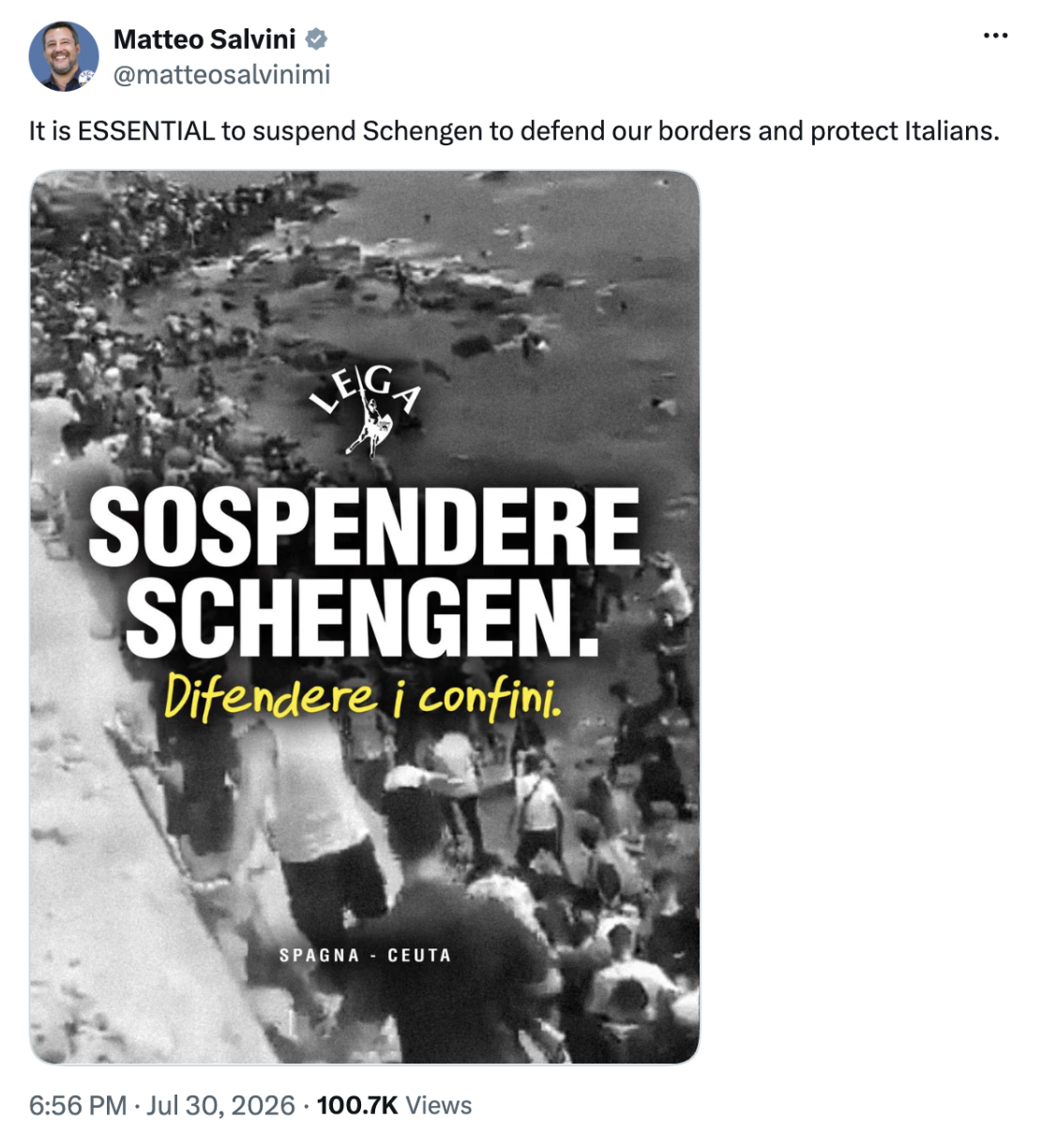
Screenshot: Matteo Salvini on X, 30 July 2026
Brussels’ Response
The European Commission, for its part, has struck a notably different tone than Rome’s. Commission President Ursula von der Leyen said the “good news” was that the vast majority of the roughly 60,000-70,000 people who entered Ceuta had already returned to Morocco, crediting joint Spanish-Moroccan law enforcement efforts, and stressed that not a single person had reached mainland Spain or elsewhere in the EU. She called the episode a demonstration of why border control matters, while also urging a “lessons learned process” and a “united European response.” At an EU interior ministers’ videoconference held on August 4 and chaired by Irish Justice Minister Jim O’Callaghan, member states and Schengen-associated countries issued a formal statement of “strong solidarity” with Spain, describing Madrid’s response as “swift,” “immediate,” and “efficient.” In a separate letter to Sánchez, von der Leyen personally praised the “efficient and effective” handling of the crisis by Spanish and Moroccan authorities. Spain’s Interior Ministry corroborated the return figures, reporting that nearly all of those who had entered Ceuta had already left, with the situation described as largely back to normal within days. That gap between rhetoric and mechanism, what Italy said it was doing versus what the Schengen Borders Code actually permits, is where this piece turns next.
What Schengen Actually Permits
As covered in a previous article in Euro Prospects, the Schengen Borders Code includes a mechanism for the temporary reintroduction of internal border controls between Schengen members, subject to clear rules and criteria, along with comprehensive reporting, notification, and proportionality requirements involving both EU institutions and member states. These controls can be enacted in unprecedented crises, such as the one unfolding in Ceuta. However, several elements of this particular instance are worth examining.
Land Borders and Air Travel
Firstly, common practice for Schengen temporary controls has involved countries that share a land border. Under the Schengen Agreement, free movement and a “borderless” zone have significantly reduced the need for hard borders and border-control instruments between member states. However, since 2015, several countries, such as Austria, have begun reinvesting in strengthening their internal and external borders. In these cases, migratory routes have largely involved travel on foot or precarious boat crossings, making it highly unlikely that migrants using such routes would have access to air travel between member states. This raises real doubts about the rationale for imposing border controls between Spain and Italy in particular. Similarly, air travel generally entails security measures and data collection, making it difficult for migrants seeking to reach another destination undetected. Under the EU’s Passenger Name Record Directive (2016/681), airlines are required to share passenger data, including travel itinerary, contact details, and payment information, with national authorities for flights entering or leaving the EU. While most member states have opted to extend this data-sharing to select intra-EU flights as well, a 2022 ruling by the Court of Justice of the EU limited this practice: blanket data collection on all intra-EU flights is only permitted when a member state faces a genuine, present, or foreseeable terrorist threat, meaning the surveillance capacity, while real, is narrower and more conditional than for external EU flights. Flying, in short, remains a highly unfavorable option for these migrants.
An Unproven Track Record
Secondly, the effectiveness of internal border control measures in hindering migratory flows is far from settled, even in the EU’s own assessments. Under Article 33 of the Schengen Borders Code, member states must report on the impact of their measures, and the Commission must issue its own opinion when controls are prolonged beyond 12 months. A recent example makes the gap between claim and evidence clear: in a June 2026 opinion on Germany’s border controls, in place since September 2024 and prolonged three times, the Commission found that unauthorized crossings at the EU’s external borders fell by a quarter in 2025 and that Germany’s own asylum applications dropped by over 50 percent in the same period, concluding that this decline “cannot be solely attributed to the reintroduction of internal border control by Germany.” Yet the controls remain in place, whilst the Commission’s opinion carries no power to compel their withdrawal.
Not a Suspension
Thirdly, calling this measure a suspension of the Schengen Agreement is incorrect. Temporary internal border controls are very much part of the Schengen Agreement, and what Italy has done falls within its scope. This does not mean that Spain or Spanish citizens will no longer benefit from freedom of movement, or that this measure unilaterally allows a country’s Schengen membership to be temporarily suspended by another country or by the EU institutions themselves. What, in fact, happens is that Italian authorities have the temporary right to conduct border checks at its sea and air borders with Spain, but this cannot affect the freedom of movement of Spanish citizens or other legal border crossings by third-country nationals via the Spanish-Italian route. In fact, the rhetoric used by Italian authorities is also complemented by the current Administration’s desire to push for a border externalization model that several European countries are considering adopting, such as Italy’s Albania model. A compelling Euro Prospects analysis extensively covers the situation of border externalization in the EU.
Echoes of 2011
This ongoing political battle between Spain and Italy over migration and border crossings has some parallels with the 2011 Franco-Italian affair. As the events of the Arab Spring unfolded in Tunisia, a large influx of Tunisian migrants crossed the Mediterranean to Italy. In response, the Italian government issued them residency permits in the hope that they would cross into France to reunite with existing family members and well-established Tunisian communities. France imposed strict border controls at the border crossing point with Italy in Ventimiglia. This produced a significant diplomatic crisis resulting in the reform of the Schengen Borders Code. The parallels between these two cases mostly concern the mass influx of migrants and border closures. The Franco-Italian affair makes more logical sense in one key respect: France and Italy shared a land border, and the move to issue residency permits to allow migrants to join well-established Tunisian communities was a questionable political practice, yet it held pragmatic sense. In the Ceuta crisis, Italy does not share a land border with Spain, and the migrants have not reached continental Europe; the majority have, in fact, been returned to Morocco.
Instrumentalizing a Crisis
Whether Spain’s migration policies were indeed too permissive and thereby caused this crisis is not the question one should be asking. Many factors are being discussed in the media as well as between the countries involved, such as the recent Spanish court ruling that migrants who arrive by sea cannot be returned without due process, as they have not crossed a physical border infrastructure referenced in Spanish law. This ruling has been sitting at the center of these debates, as some argue it left the border effectively weakened, enabling the events that took place in Ceuta. Additionally, the Spanish response was deemed swift and largely efficient by the EU and several member states, meaning the real issue lies not in Spain’s competence, but in the instrumentalization of a crisis moment to push certain political agendas. The real problem of what happened in Ceuta is both the humanitarian crisis and how it demonstrated cracks in Schengen governance and cohesion, and a growing dissensus between member states. Regardless of what fueled a massive influx over the course of 24 hours into the Spanish exclave, many lives were lost, and the full account has yet to be established.
Disclaimer: While Euro Prospects encourages open and free discourse, the opinions expressed in this article are those of the author(s) and do not necessarily reflect the official policy or views of Euro Prospects or its editorial board.

Border Governance Correspondent
Matheus is a Brazilian researcher specializing in Schengen border governance, migration, and European Union politics. He holds a master’s degree from the Erasmus Mundus programme in European Politics, Culture and Society, and studied Journalism and International Relations in the United States. His work focuses on migration policy, border management, European integration, and the political dynamics shaping mobility and security across Europe.
Edited by Ofelia Dournel, EU Affairs Correspondent | Follow our European journalism