6 min read — Global Europe | Policy | Trade | Geopolitics
Conditionality Built the Liberal Order. Now the West is Abandoning It
Western conditionality shaped how the liberal order worked. Beijing is exposing what’s left of it.
By Marcos Benito Álvarez — Guest Author
Edited/Reviewed by: Francesco Bernabeu Fornara
May 27, 2026 | 12:00
Beijing has become a regular stop for leaders who, not long ago, would have made the same journey to Washington. Trump has been there. Putin too. In the span of two years, so has Carney, Macron, Merz, and Starmer. Sánchez has gone four times in three years. After a while, the pattern becomes the point.
No government presents these visits as a concession. Each leader, no matter their differences with China, comes with their own diplomatic script, their own agenda sweetened by a carefully staged backdrop of photographs in front of the Great Hall of the People. When compared to previous decades, the new pattern is fairly obvious.
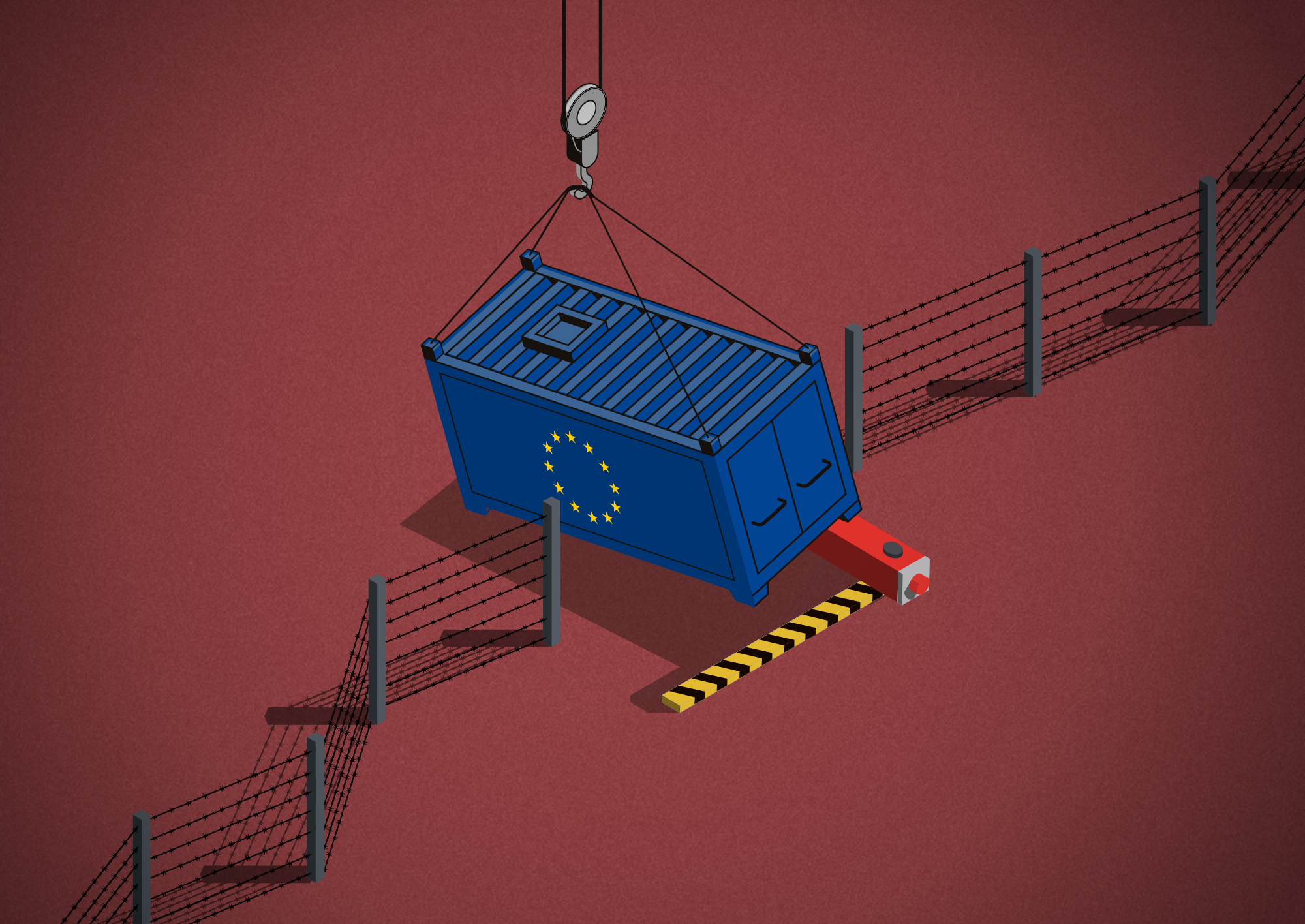
For much of the post-Cold War period, Western foreign policy worked through conditions. Access to markets, investment, diplomatic recognition, financial assistance, even mere summits… all of it often came tied to reforms of one kind or another. The basic assumption was that political and economic convergence could be encouraged from the outside, what political scientists call conditionality. While the practice was often inconsistent and selective, it expressed a wider assumption: that Western engagement would also reshape institutions over time.
The Middle East and North Africa (MENA) region shows the limits of that approach quite clearly. From the Barcelona Process to the European Neighbourhood Policy and the Union for the Mediterranean, the EU repeatedly worked on the expectation that economic proximity would gradually pull neighbouring states closer to European rules and norms. The results were, at best, mixed.
More recent partnership agreements with MENA, for example, suggest a fundamental shift: governance conditions now appear mainly in the policy domains where the EU has the most to gain such as in energy, regulatory reform, and supply chain integration. In areas of migration, where European political pressure is highest, the conditions largely disappear, replaced by operational cooperation on border management and return. Conditionality has become much narrower, replaced by immediate priorities far more than any broader institutional or normative ambition.
China has spent years offering governments a different arrangement: investment, trade, and diplomatic engagement with no governance strings attached. Governments have proved perfectly capable of working with both sides simultaneously, taking European funding with conditions and Chinese money without them, while maintaining full autonomy over their domestic institutions. China revealed that Western leverage was far more fragile than Brussels assumed. Under such a context, conditionality told partner governments that the Western relationship came with a standard attached, not just pragmatic interests.
That distinction is no longer so clear. Today, when the heads of government of Canada and the United Kingdom travel to Beijing to seek agreements, they are not doing so to seek reform in Chinese governance. When a European leader makes four visits in three years to a political system that systematically rejects the norms he formally promotes at home, the message received by foreign governments that have been told conditionality is the price of Western partnership falls flat.
Ikenberry argued that the liberal order lasted as long as it did because it looked legitimate, not just because the United States had the biggest military. States participated because the system seemed to work on recognisable principles that, at least in theory, applied to all equally. Conditionality was a cornerstone to that system and made it seem that Western engagement stood for something beyond cynical interests.
China does not yet look like the builder of a new order. The notion that Beijing is constructing a coherent alternative order overstates what is, in practice, a pragmatic expansion into space that others have left. Building an international order requires accepting costs, such as providing security and absorbing shocks, sustaining institutions even when inconvenient. There is little evidence China is prepared to do that on a global scale. What we seem to be entering is closer to Gramsci’s interregnum: a period in which the old framework is losing coherence and no clear replacement has taken shape.
The EU’s external weight has always been sustained by a disproportionate normative credibility—Europe as a so-called ‘normative power’. Not hard power in the conventional sense, but an economic leverage that partly depends on the idea that access to European markets and frameworks carries a particular quality. In the Southern Neighbourhood that quality is already under pressure. If the conditionality that once gave the liberal order its grammar becomes increasingly optional and the broader Western normative architecture continues to lose coherence, the EU is left with an external policy built on foundations that its most important ally is actively dismantling, with no counter.
The irony for Europe is that the moment it began talking most seriously about strategic autonomy (building its own defence capacity, reducing dependence on the United States, developing an independent foreign policy voice) is precisely the moment when the normative foundations that gave European external policy its distinctive character started to look shakiest. Strategic autonomy without normative credibility is a different thing entirely, and I am sure that is not quite the strategic autonomy anyone had in mind.
The visits to Beijing will keep happening. That is probably fine, as engagement with the second largest economy in the world is rational for any government. The real question is what still comes attached to Western power. Right now, that is getting harder to answer, and non-Western governments are drawing their own conclusions from the ambiguity.
Disclaimer: While Euro Prospects encourages open and free discourse, the opinions expressed in this article are those of the author(s) and do not necessarily reflect the official policy or views of Euro Prospects or its editorial board.
Write and publish your own article on Euro Prospects
Subscribe to our newsletter – stay informed when we publish articles on pressing European affairs.