6 min read — Migration | Economy | EU | Policy
Migration Alone Won't Solve Europe's Labour Problem
Migration has long been framed as the solution to Europe’s labour shortages and demographic challenge. Yet why do millions of jobs across the EU remain unfilled even as many working-age migrants remain underemployed or excluded from the labour market? Europe’s labour problem is becoming less about labour supply and more about its ability to absorb and integrate workers effectively.
By Rimsha Arif — European Strategic Policy Analyst
Edited/Reviewed by Francesco Bernabeu Fornara
June 3, 2026 | 9:00
Labour shortages remain a persistent feature of the European economy, even as the EU operates close to full employment. This happens because many workers are unable to access jobs that match their skills, location, or wage expectations, while employers struggle to fill vacancies requiring specific qualifications or sectoral experience. The result is a labour market where shortages and underutilised labour coexist.
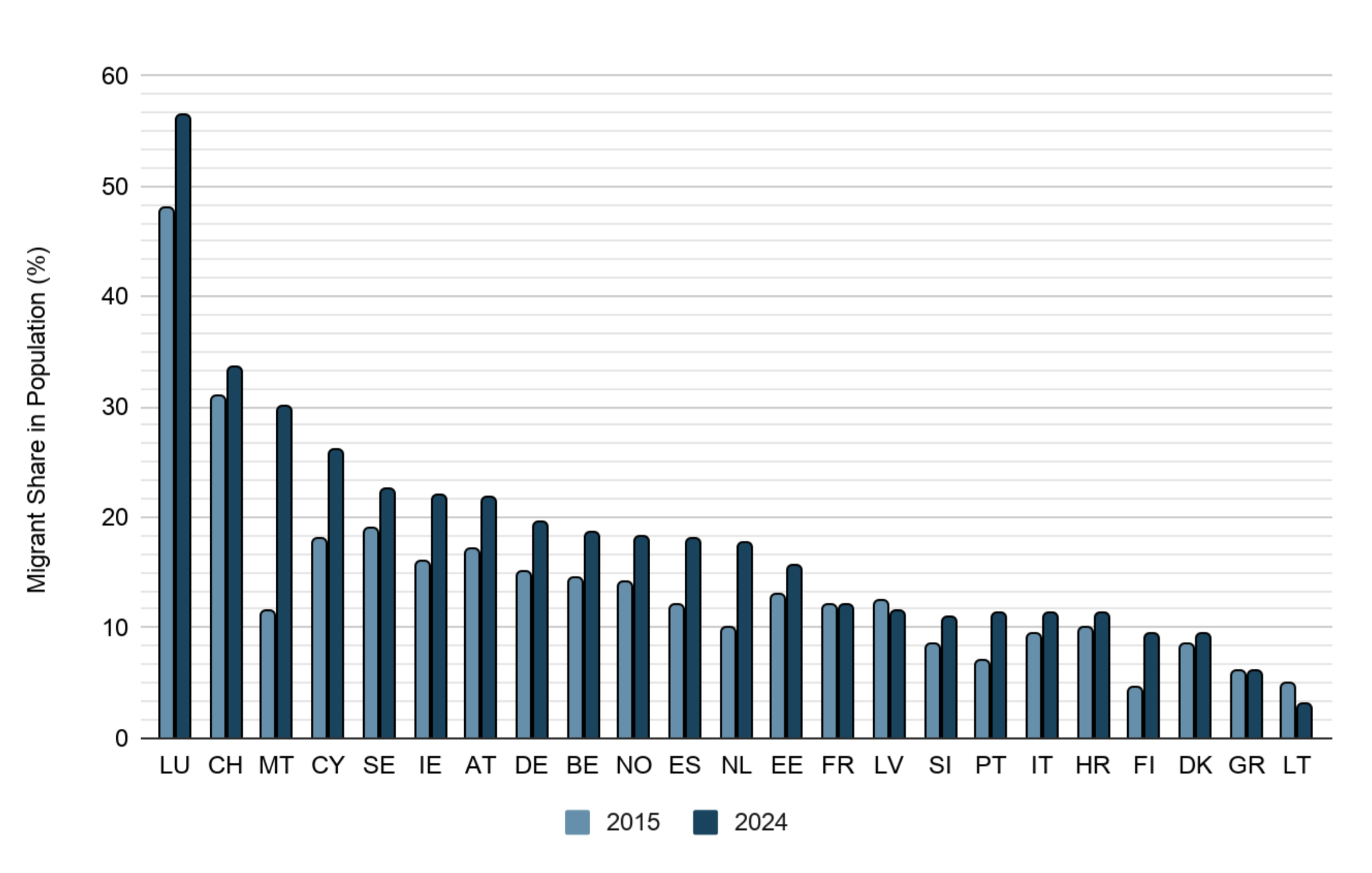
In May 2025, Eurostat reported that 13.1 million people were unemployed in the EU. Yet shortages persisted because unemployment and labour demand were concentrated in different sectors, skill categories, and geographic regions. In response, labour migration has often been presented as the natural solution. From 2015 to 2024, the share of the foreign-born population increased from 12.1% to 15.5% in EU14 (ie., pre-2004 EU Member States), corresponding to more than 12 million additional foreign-born residents. Figure 1 shows the migrant share across European countries, with notable growth in the Netherlands, Germany, Finland, Cyprus and Malta.
In 2024, every three out of four migrants were of working age. Yet labour shortages have persisted, suggesting that the problem lies not in the volume of migration, but in what happens after migrants arrive.
A Mismatch Rather Than A Shortage
A structural skills mismatch exists in the European labour markets because they consistently fail to match the qualification and experience workers hold with what employers actually need, creating shortages in some sectors and surpluses in others. Unlike a simple lack of workers, this type of imbalance cannot be resolved by simply increasing labour supply alone.
According to Eurostat, shortages caused by mismatch rose from 42% in 2018 to 75% in 2023 in 21 European countries, reaching 82% in Germany and Greece. The EURES 2024 report reinforces this: for the 430 occupations classified as facing shortages in at least one country, 422 were simultaneously identified as having labour surpluses elsewhere in Europe. Healthcare services, construction and hospitality continue to face acute shortages across much of the EU, while demand remains weak in other sectors.
This matters particularly for migrants. Despite migrants and native-born Europeans displaying broadly similar shares of tertiary education at an aggregate level, migrants have an employment probability of 15.6 percentage points lower than similarly educated natives. Nearly 40% of non-EU citizens working in the EU were overqualified for the jobs they held, compared to around 20% of nationals. It was estimated that if migrants worked in roles matching their qualifications, the European economy could gain up to €33.8 billion annually.
The Credential Recognition Bottleneck
A prominent feature of the European labour markets is brain waste, in which migrants’ qualifications and skills acquired outside the EU go unrecognised. Language barriers and unfamiliarity with local market conventions play a role, but they only tell part of the story. In 2021, the lack of native language skills was the most commonly cited obstacle in finding suitable employment among migrants. Figure 2 illustrates barriers migrants face within the European labour markets.
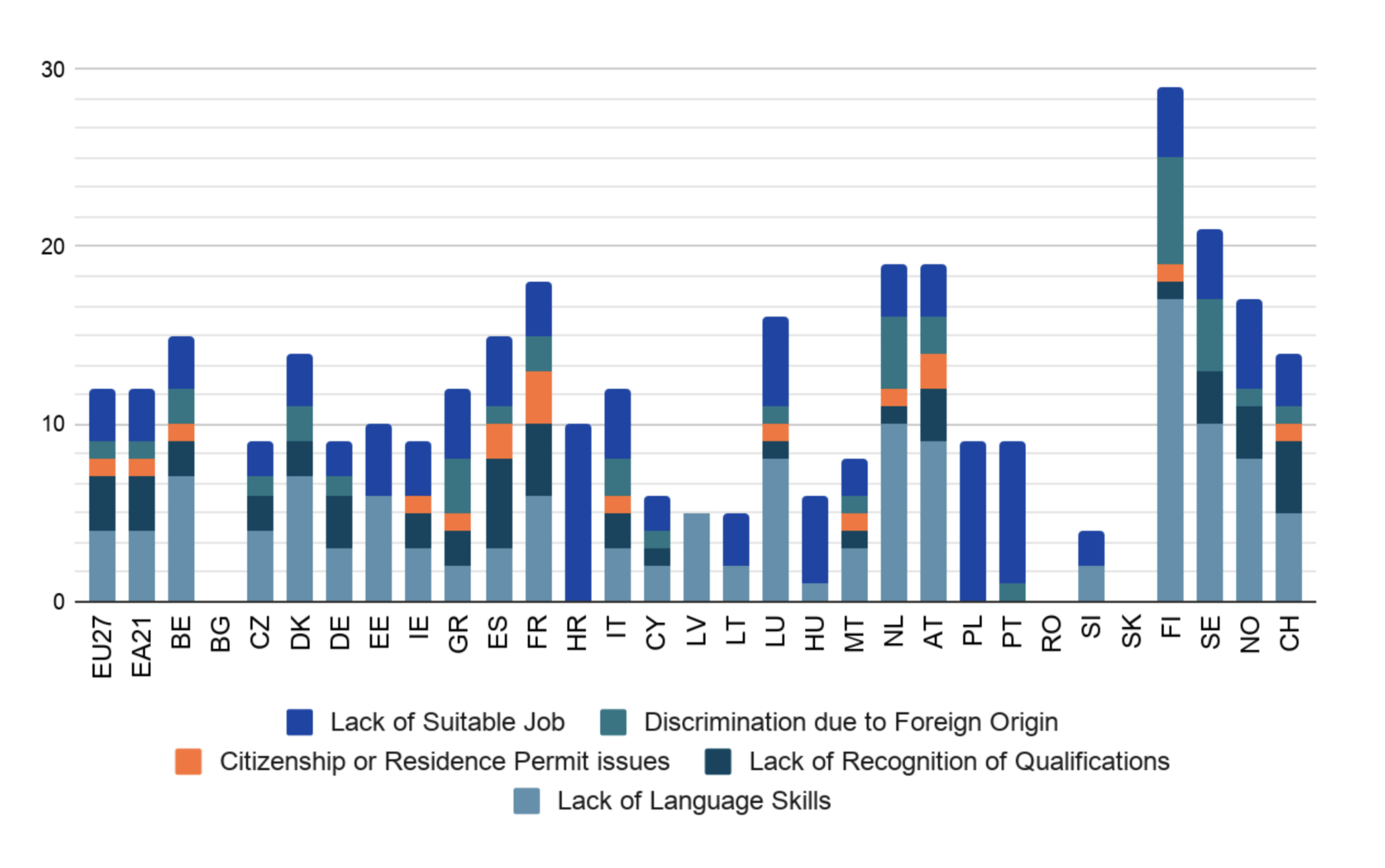
But language alone does not explain the overqualification gap, especially when non-EU citizens in equivalent roles still earn 18% less than the natives. A large part of the answer lies in how European countries handle foreign qualifications. Recognition systems are nationally determined, fragmented across member states, and often weak. In Italy, recognition procedures are often slower, highly bureaucratic, and dependent on profession-specific ministries and regional authorities. Germany, in contrast, treats credential recognition as part of labour-market policy. Since the 2012 Recognition Act, migrants have been given a legal right to have foreign qualifications assessed against German standards. The economic effect has been significant; around 88% of migrants whose qualifications were officially recognised were employed afterwards, while average monthly income reportedly increased by roughly 40%.
Integration Systems Are Not Built for Scale
Even where migrants successfully navigate credential recognition, the systems meant to integrate them into the labour market are uneven and, in many cases, simply not built for the volume of people now arriving. The MIPEX 2025 index, which measures how effectively governments design integration policies across the EU, gives the bloc an average score of just 54 out of 100, with little movement since 2019. More telling than the average is the gap it conceals: pre-2004 EU member states score 63 on average, while post-2004 members average just 44. A migrant’s integration outcome depends heavily on which country they settle in, not on what they bring to it.
This institutional unevenness has direct labour market consequences. MIPEX identifies labour market access as one of the stronger policy areas at 55 out of 100, yet political participation scores just 37 and access to nationality just 44. This matters because integration is not a single policy lever. A migrant who cannot access stable residency, civic life or quality language training is also a migrant who cannot fully enter the labour market, regardless of their qualifications. The strongest performers, Sweden, Finland, and Portugal, treat integration as a system, ranking above 80. The weakest treat it as a procedure.
What Policy Needs to Do
Migration can expand the available workforce, but without the institutional infrastructure to deploy it effectively, the economic return remains well below potential. Three interventions address the problem directly.
The first is to extend and enforce the EU’s existing credential recognition framework for third-country nationals. Directive 2005/36/EC has coordinated mutual recognition of professional qualifications across member states since 2005, and the Commission has already recommended extending its logic to third-country nationals, in 2022 for Ukrainian refugees and more broadly in 2023. The problem is that recommendations are not binding, and the Directive was never designed with third-country nationals in mind. Those two gaps together explain why the overqualification problem persists despite the framework nominally existing. What is needed is a targeted amendment to 2005/36/EC that brings third-country nationals within its scope and pairs that extension with enforceable procedural rights. This includes defined assessment timelines, transparent equivalency criteria, and shortage-linked pathways. Germany’s 2012 Recognition Act shows what happens when recognition becomes a legal right rather than an administrative courtesy: recognised migrants saw a 19.8% wage increase and were 24.5 percentage points more likely to be employed.
The second is to condition Cohesion Fund disbursements on integration outcome metrics. The MIPEX gap between pre and post-2004 member states is not primarily a resource problem; it reflects political prioritisation. Canada’s Provincial Nominee Programme demonstrates the alternative logic, where provinces are held accountable for settlement and retention outcomes, not just arrival numbers. The same principle applied to EU fund access would make integration infrastructure a shared obligation rather than a discretionary one.
The third is to formalise bilateral mobility agreements targeting documented mismatch. Free movement exists in law but not as an active allocation mechanism. Agreements channelling workers from surplus occupations in one country toward shortage roles in another, built on portable social security entitlements and mutual recognition, would convert an underused legal right into a functional labour market tool. The data infrastructure through EURES and Eurostat already exists. What is missing is the political will to act on it.
Disclaimer: While Euro Prospects encourages open and free discourse, the opinions expressed in this article are those of the author(s) and do not necessarily reflect the official policy or views of Euro Prospects or its editorial board.
Write and publish your own article on Euro Prospects
Subscribe to our newsletter – stay informed when we publish articles on pressing European affairs.