From Shia Ascendancy to Sunni Resurgence: The Emerging Middle East Europe Has Little Role In
From Shia Ascendancy to Sunni Resurgence: The Emerging Middle East Europe Has Little Role In
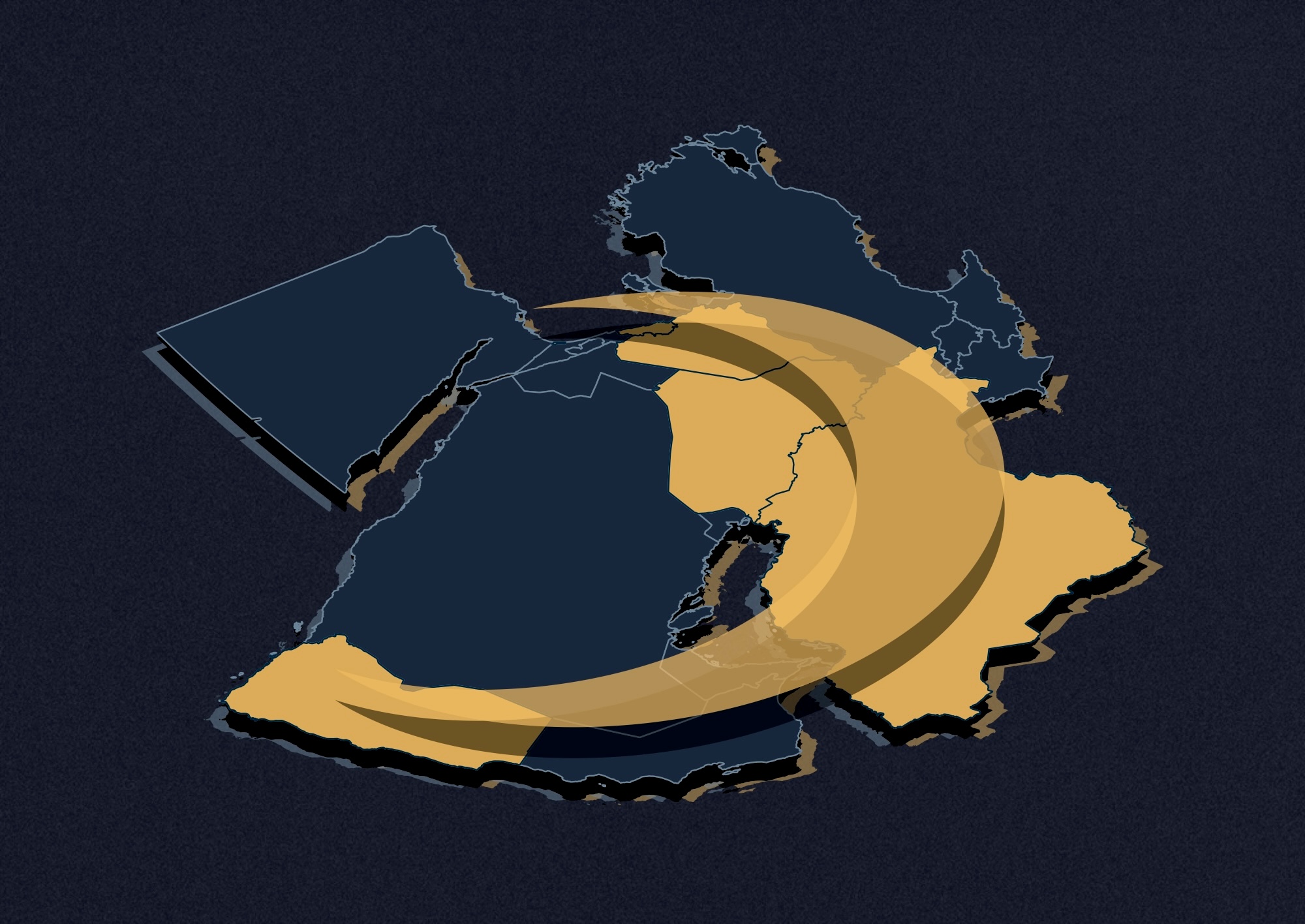
The Shia Crescent built by Iran over two decades has fractured with startling speed. What is emerging in its place is a contested Sunni resurgence, and Europe has been absent from every pivotal moment of this transformation.
Image Credit: Euro Prospects

For much of the modern Middle East, sectarian power was defined by imbalance rather than confrontation. The post-colonial order led to the formation of nation-states such as Iraq and Syria through a series of agreements beginning with the 1916 Sykes-Picot accord between France and Britain and formalised through the subsequent League of Nations mandate system. What these arrangements failed to account for, in drawing their lines, were the demographic, socio-cultural, and religious interests and aspirations of the people who lived there. Many of the nation-states formed produced minority-dominated political orders that suppressed sectarian majorities, most notably in Iraq, where a Sunni-led regime under Saddam Hussein marginalised the Shia majority that constituted roughly 60% of the population. This dominance was violently disrupted when Saddam Hussein was overthrown, which opened the door to unprecedented Shia expansion across the Middle East.
What followed was not just a redistribution of power within individual states but the emergence of an Iranian-led axis of influence stretching across an increasing part of the Middle East, from Iran to Lebanon, held together less by ideological solidarity than by strategic patronage and shared opposition to Israel and the United States. Coined as the Shia Crescent by King Abdullah II of Jordan, it consisted of Hezbollah, the Houthis, Syria, and Iraq under the influence of Iran. For nearly two decades, this axis appeared not only durable but ascendant. It was a coherent arc of Shia political and military power reshaping the region’s balance in Iran’s favour. Yet by 2024, that arc had begun to fracture with startling speed. The assassination of key Hezbollah leaders in Lebanon and Hassan Nasrallah, the sudden fall of Syria’s Bashar Assad, and the inability of the Iranian regime to stop this suggested that the Shia Crescent was built on strategic opportunism rather than ideological solidarity or institutional foundations. This article argues that what we are witnessing is not a temporary setback for Iran, but rather the unravelling of a regional empire, opening the door for a Sunni resurgence whose shape remains deeply contested. It further argues that this entire transformation has unfolded without European influence, with major players consisting of Israel, the USA, and Turkey, with Europe sidelined.
The Height of the Crescent: Iran’s Imperial Moment
To understand the scale of what has unravelled, one must first appreciate how commanding Iran’s regional position once appeared. By the mid-2010s, Iran achieved something that no power in the modern Middle East had managed since the height of pan-Arab nationalism: a contiguous arc of political and military influence stretching from the Iranian plateau through Iraq and Syria to the Mediterranean coast of Lebanon. Known as the Axis of Resistance, it consisted of armed movements and aligned states whose role was to deter and absorb military pressure before it reached Iranian territory. It represented a functional corridor through which weapons, arms, and fighters flowed efficiently, stretching from Tehran to the Mediterranean via Syria, the linchpin of the axis.
At the heart of this network sat four nodes of power. In Lebanon, Hezbollah had transformed from a guerrilla force into a full-spectrum military organisation unrivalled by the Lebanese state. In Iraq, the Popular Mobilization Forces, formed in 2014 to combat the rise of ISIS, had grown into a 230,000-strong force composed of pro-Iranian factions. In Yemen, the Houthis, rooted in Zaidism, a branch of Shiism, ruled a third of Yemen’s territory and two-thirds of its population. In Syria, Bashar Assad had become deeply dependent on Iranian militias to survive. All of these state and non-state actors answered to Tehran and the Quds Force, the special operations branch of the IRGC. Tehran city representative Ali Reza Zakani captured the ambition publicly, boasting in September 2014 that with the fall of Sanaa, Iran claimed to control four Arab capitals: Baghdad, Beirut, Damascus, and Sanaa.
The strategic consequences of this expansion were profound. For Saudi Arabia, the emergence of a pro-Shia movement on its southern borders threatened the kingdom. In 2015, Saudi Arabia and the UAE, with a coalition of nine other Arab countries, began bombing the Houthis and imposed a blockade on Yemen, ultimately failing to oust them. For Israel, the entrenchment of Hezbollah on its borders transformed its security policy, leading to direct strikes across the region. For the USA, it was a profound irony: the removal of Saddam, intended to remove a dangerous adversary, had inadvertently enabled the rise of the Iranian network. At its zenith, the Shia Crescent was not merely an expression of sectarian solidarity; it was a functioning imperial project, and Iran was its metropole.
The Unravelling: From Nasrallah to Assad
The unravelling began with Israel’s systematic degradation of Iran’s most capable proxy. The assassination of Hassan Nasrallah in September 2024, preceded by the pager attacks that decimated Hezbollah’s command infrastructure, exposed the network’s fundamental vulnerability: it was held together by key individuals rather than durable institutions. Without Nasrallah, Hezbollah’s capacity to project power into Syria, and thereby sustain the corridor to Tehran, collapsed.
Assad followed within months. The December 2024 fall of the Assad regime, accelerated by an unexpected offensive by Hayat Tahrir al-Sham, severed the geographic linchpin of the entire axis. Syria had been the land bridge through which Iranian weapons, financing, and fighters reached Lebanon. Its loss did not merely weaken the Crescent, it broke it. Iranian embassy staff were evacuated from Damascus as rebels vandalised the building, a symbolic punctuation to two decades of Iranian strategic investment in the Syrian state.
The 2026 war between the United States, Israel, and Iran dealt a severe blow to Iran’s capacity to project regional power. Despite demonstrating genuine military innovation, including an Iranian F-5 penetrating Camp Buehring’s air defences in Kuwait in one of the war’s most remarkable tactical episodes, Iran emerged from the conflict with its nuclear programme set back, its proxy network further degraded, and a successor leadership drawn entirely from hardline IRGC ranks. Iran retains military capabilities and has not been eliminated as a regional actor, but the integrated, mutually reinforcing architecture of the Crescent is no longer there.
The Sunni Resurgence: Contested and Fragmented
Russia’s diminishing grip on the Middle East, combined with Iran’s retreat, has created a vacuum that several actors are now contesting. The Sunni resurgence that has followed is neither monolithic nor without its own profound dangers.
Turkey has moved decisively to fill the Syrian space, leveraging the HTS-led transitional government in Damascus and pursuing influence in Aleppo and the country’s north. Saudi Arabia, meanwhile, has pursued its own regional assertiveness, signing a Strategic Mutual Defence Agreement with Pakistan in September 2025, and drawing Turkey into discussions of a broader trilateral security framework. What is striking about this emerging bloc is who is absent: the UAE, which now backs opposing sides to Saudi Arabia in both Sudan and Yemen, finds itself increasingly isolated from Riyadh’s new alignment.
The Sunni space is also not free of extremist risk. The fall of the Assad regime allowed ISIS to exploit the resulting vacuum, increasing the frequency of attacks on the new Syrian government. And Iran, though weakened, has demonstrated in the 2026 war that it retains the capacity to strike US bases across seven countries, disrupt Gulf state confidence in American deterrence, and complicate any settlement that excludes it. The Shia Crescent, in other words, may have fractured, but the underlying tensions it once suppressed have not been resolved.
What this shows is not that a stable Sunni order is replacing a destabilised Shia one, but that the Middle East is entering a period of contested multipolarity, with different actors, different alignments, and risks no less serious than those of the preceding era.
Europe’s Absence: A Strategic Question
What is equally striking about this transformation is who was absent from it. Two decades ago, Europe, through its colonial legacy, its proximity, and its stated ambitions for a rules-based Middle East policy, might have expected to shape this new order. Instead, the dismantling of the Shia Crescent and the emergence of its Sunni successor have been negotiated almost entirely between Washington, Jerusalem, Ankara, and the Gulf capitals, with Brussels reduced to the role of spectator, occasionally issuing statements of concern.
European governments watched Hezbollah’s collapse, Assad’s fall, and the reconfiguration of Syria’s alliances largely through the same news cycles as the rest of the world, with little capacity to influence the outcome and even less input sought by the actors driving it. As CIDOB’s 2026 assessment put it directly: in a moment defined by hard power contestation, Europe is increasingly marginalised. The EU’s engagement has been reduced to humanitarian funding, €458 million in 2026 across Palestine, Lebanon, Syria, Jordan, and Egypt, and declaratory diplomacy through the High Representative’s office.
Yet the consequences of this new order will not stop at Europe’s borders. A reconfigured Syria under Turkish and Gulf influence, a fractured Sunni bloc competing for primacy, and an Iran that remains armed and aggrieved all carry direct implications for European energy security, migration flows, and counterterrorism cooperation. China has meanwhile stepped up its trade with Iraq, reaching over $50 billion in 2024, compared to a total EU-Iraq trade of €24.3 billion in 2023, securing major contracts in Iraq’s construction and energy sectors while Europe deliberates.
If Europe continues to treat the unravelling of the Crescent and the uncertain order replacing it as a distant American, Israeli, and Turkish concern rather than a matter demanding its own strategic investment, it risks discovering, as it did in 2015, that the Middle East’s instability does not respect the distance Europe has tried to place between itself and the region.
Disclaimer: While Euro Prospects encourages open and free discourse, the opinions expressed in this article are those of the author(s) and do not necessarily reflect the official policy or views of Euro Prospects or its editorial board.
MN
Correspondent for the Middle East
Born in Delft and currently residing in London, Mohammad Nasser completed a Bachelor’s degree in History and International Relations and is now pursuing a Master’s degree in International Relations and Security Affairs. Being of Kurdish heritage, his expertise and primary focus lie in the Middle East, particularly in matters related to security and geopolitics in the region.
Edited by Mehak Kulaar | Follow our European journalism