Europe’s $750 Billion Promise to Buy US Energy That Nobody Needs
Policy Brief
8 October 2026
Energy Market Resilience
Europe’s $750 Billion Promise to Buy US Energy That Nobody Needs
The EU has pledged $750 billion in US energy purchases at the exact moment its own gas demand is beginning to fall. Priced to satisfy trade negotiators rather than actual demand, the commitment risks locking Europe into fresh import dependency just as its own consumption starts to shrink.
Executive Summary
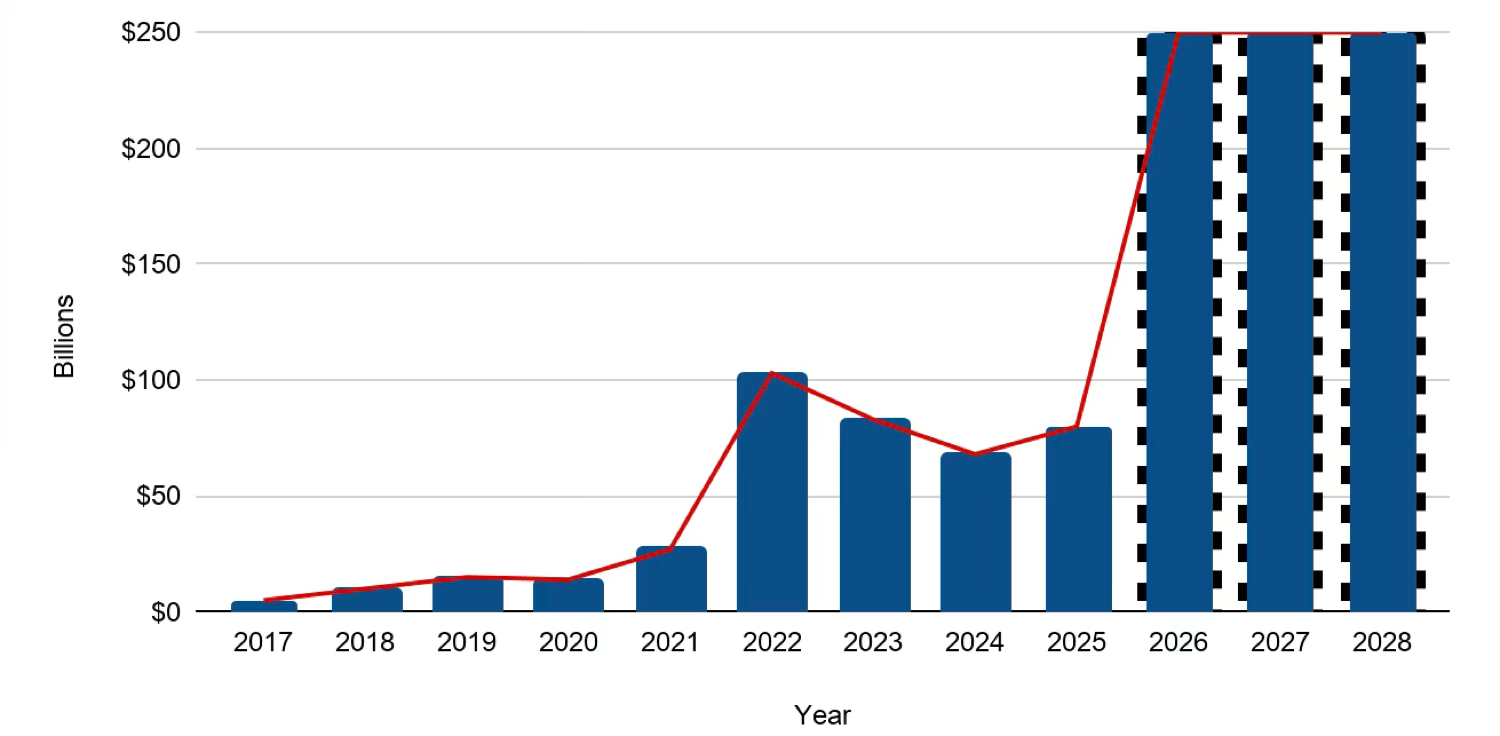
In July 2025, the EU pledged a $750 billion energy deal to the US through 2028 as part of a trade agreement with Washington. The agreement uses non-binding language, the EU “intends to procure” energy with an “expected offtake” of $750 billion, not a firm contractual floor. The EU bought roughly $80 billion in US oil, LNG, LPG, and coal in 2024, meaning it would need to triple that volume to hit the pledge’s implied pace.
The deal’s deeper problem is structural. EU gas demand is forecast to fall 10% by 2030, and LNG demand could fall around 29% between 2025 and 2030. At the same time, the US is on track to supply up to 80% of EU LNG imports by 2028. Honoring the deal risks one of two outcomes.
Either the EU builds new import infrastructure to absorb US volumes it will not need in five years, or political pressure crowds out investment the EU actually needs in grid balancing and storage as it phases out fossil gas. Either outcome replaces one energy dependency with another.
This brief argues that the US-EU energy deal does not need to be abandoned. It does, however, need discipline the EU can enforce on itself, using tools that the EU already has at its disposal.
Key Recommendations
1
Enforce Transparent Reporting
Require public, transparent reporting on what actually counts toward the $750 billion figure outlined in the deal, building on the existing EU Energy Platform and EU Energy and Raw Materials Platform, to remove the ambiguity that currently exposes the EU to unilateral compliance claims.
2
Link Funding to Private Contracts
Tie public investment, permitting, and infrastructure support to verified private purchase activity, not the pledge’s headline figure, so governments do not commit ahead of the private contracts that would actually justify that commitment.
3
Implement Conditional Infrastructure Retirement
Attach new LNG import infrastructure to a clause that automatically retires capacity as EU domestic storage and grid balancing come online, using the EIB’s Energy Lending Policy as a working precedent for conditional, climate-aligned public financing.
4
Pivot Nuclear Investments to Security
Direct the portion of the pledge that goes toward nuclear specifically toward displacing Russian uranium dependency, since nuclear cooperation avoids the climate conflict new fossil infrastructure creates while closing a real, documented security gap.
Analysis
A Deal Built for the Negotiating Table, Not the Grid
The US-EU Framework Agreement is a bilateral deal between the United States and the European Union, negotiated on behalf of its 27 member states, to address matters related to trade and tariffs. Its substance is almost entirely about trade, rather than energy. According to the deal made in July 2025, the US commits to apply a tariff rate of 15% on most EU goods, with a few exceptions. This tariff rate is 50% less than what President Trump had originally intended to apply during his much-headlined ‘Liberation Day’. In return, the EU would eliminate tariffs on all US industrial goods including chemicals, pharmaceuticals, machinery, and vehicles. Energy enters the agreement almost as an afterthought to that bargain.
In doing so, the EU states its intention to purchase $750 billion worth of energy from the US by 2028, meaning an average purchase of $250 billion ($750 billion divided in three years) worth of US LNG, oil and nuclear fuel per year. This is a non-binding pledge since energy remains a shared EU competence. The member states and European companies would be the ones actually purchasing. While the pledge is in line with the broader EU commitments to replace Russian fossil fuel imports, the number set was arguably chosen to close a trade deal, not to map that transition.
“The number set was arguably chosen to close a trade deal, not to map that transition.”
Since the EU has no legal power to guarantee the purchases happen, there is a real chance the pledge goes unmet. If that happens, President Trump has threatened to reinstate the tariffs, a threat that has continued into this year. In May 2026, he threatened “much higher” tariffs over the EU’s pace of implementation. The real risk is that governments, wary of triggering it, commit to import infrastructure sized to a political target, while private companies, driven by their own commercial logic, may never sign the contracts to fill it. None of this reads as energy planning. Rather, it is a commitment made under pressure to hold a tariff deal together, one with real consequences for Europe’s energy grid, but never actually built around Europe’s energy needs.
The Arithmetic Doesn’t Work
Even if political will were enough, the numbers do not add up. The EU imported roughly $80 billion worth of US LNG, liquefied petroleum gas, and coal in 2024, against $433 billion in total EU energy imports that year. The US accounted for barely a fifth of what Europe actually buys. Reaching the pledge’s implied $250 billion annual pace does not mean growing that share, it means tripling it, in three years, a shift with no precedent in EU energy trade.
Figure 1: EU Energy Imports from the US (2017-2025) vs EU-US Energy Deal Target (2026-2028)
Source: American Action Forum
The product mix makes the gap worse. By mid-2025 the US already supplied 54% of EU LNG imports, but LNG is the smaller prize. That share may grow further still. Iran’s attacks on Qatar’s export infrastructure since February 2026 have knocked out roughly 17% of its LNG capacity, with repairs expected to take years, removing a supplier that once accounted for roughly 7% of EU’s LNG imports.
Oil makes up 65-70% of total value of US-EU energy trade, more than LNG’s 29%. But that’s a different measure from market share. Of all the oil the EU imports, from any supplier, the US supplies just 14% of EU oil. The same share Russia still holds in EU LNG.
And even if the EU cut off all remaining Russian energy imports, worth roughly $25 billion in 2024, and redirected every bit of it to the US, the combined total would reach only about $105 billion, less than half of the pledge’s commitment. Closing the remaining gap would require the US to overtake the EU’s oil market entirely, pushing its share past 50% market share.
That shift would also have to take into account two facts : (1) EU oil demand has already peaked, so there is no growing pool of new demand to redirect toward American suppliers; and (2) much of what the EU still buys is locked into long-term contracts with Norway, Kazakhstan, and other producers, accounting for supply that cannot be reassigned as per existing contracts.
Building for a Market That’s Shrinking
Although the EU’s appetite for new LNG projects may be growing, causing an expansion in its import capacity, LNG demand is less likely to keep up. Much of that capacity was approved in the rush after Russia’s 2022 invasion, a security response to lost pipeline gas, not a bet on future demand.
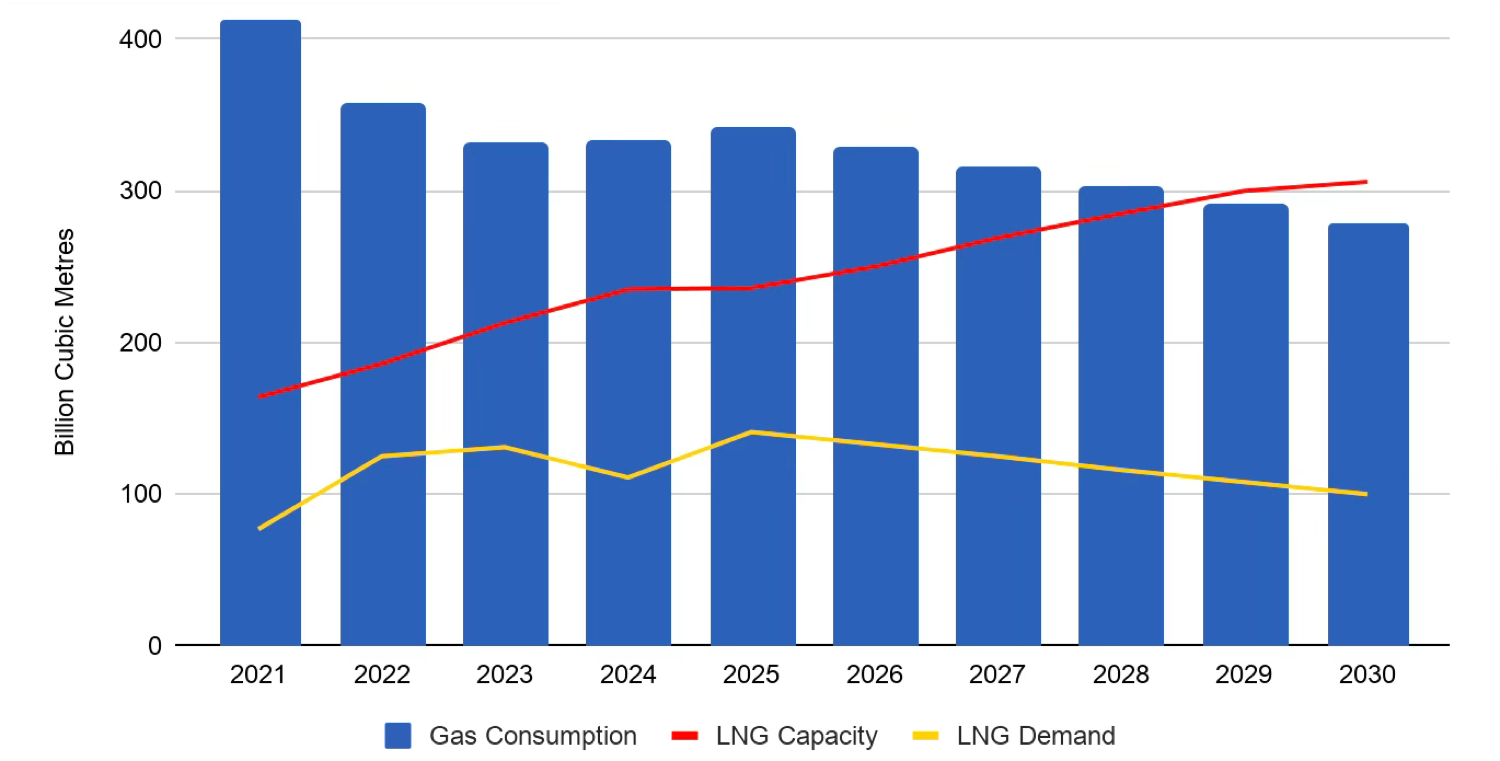
According to the Institute for Energy Economics and Financial Analysis (IEEFA), the EU’s LNG terminal capacity is projected to reach 406 billion cubic metres (bcm) by 2030, while LNG demand over the same period is forecast to fall between 150-190 bcm. Meanwhile, the EU’s gas consumption is also likely to witness a decrease of 14% from 2025 to 2030, but LNG, the marginal supply the EU relies on once pipeline gas is exhausted, is hit harder still. The EU’s LNG demand is likely to fall by almost 29% between 2025 and 2030, roughly double the rate of the overall decline.
Figure 2: EU’s LNG Regasification Capacity and Demand Outlook
Source: Institute of Energy Economics and Financial Analysis
This shrinking market is also becoming more concentrated. Given the ongoing disruptions to Qatari LNG exports, IEEFA forecasts the US could supply up to 80% of the EU’s LNG imports by 2028, meaning the pledge would not just add capacity the EU doesn’t need, it would deepen reliance on a single supplier at the same time.
Some of the demand for US LNG reflects a genuine security choice. The EU’s Russian gas ban, taking full effect from 2027, has already delivered real diversification. But the Middle East war has added a second, unchosen pressure, one that IEEFA says has left Europe’s energy security strategy worse off, not better. US LNG imports rose from 21 bcm to 81 bcm between 2021 and 2025, and the US currently supplies 57% of EU LNG imports.
This is what makes the pledge a distraction rather than a security tool. The EU’s diversification away from Russian energy is happening regardless of it. What the pledge actually does is divert investment, permitting attention, and political capital the EU needs for its domestic grid balancing and storage. Chasing a dollar figure to achieve a security goal already being met organically is not extra assurance. It crowds-out beneficial private investment instead, with an energy security justification attached to it.
“Chasing a dollar figure to achieve a security goal already being met organically is not extra assurance.”
With capacity expanding well past what demand can absorb, the risk of stranded assets has also gone up. As of 2023 projections, member states like Spain were predicted to have 50 bcm of stranded-capacity risk, France 14 bcm, Italy 10 bcm, and Germany 9 bcm by 2030. Current data already bears this out. As of Q1 2026, the average EU terminal utilization rate stood at 55%, with nine of the EU’s 30 terminals running below 30%, and Italy’s Panigaglia and Spain’s El Musel at just 12.4% and 13.9% respectively.
The stranding these forecasts warned about are now visible in terminals sitting idle today, capital and maintenance costs locked in for decades on infrastructure moving little to no gas. Honoring the US pledge would mean building even more capacity infrastructure for US imports for a system that is already overbuilt for falling demand.
“Honoring the US pledge would mean building even more capacity infrastructure for US imports for a system that is already overbuilt for falling demand.”
Some argue this misses the point, that spare gas-fired generation capacity, not import terminals, is what actually provides grid resilience, pointing to Iberian blackout of April 2025, where investigators found too few power plants running at that moment to stabilize the grid’s frequency. That is a dispatch problem, whether enough plants are switched on and generating electricity. It has nothing to do with how much LNG sits unused at a coastal import terminal. A full, idle terminal does not put a single extra power plant online. Terminals running below 15% utilization are not a hidden safety margin. They are stranded now.
What the Nuclear Half of the Deal Gets Right
The EU’s pledge met with strong objections within the European Parliament. The French liberalist, Christophe Grudler, backed by 20 MEPs, wrote a letter to Commission President Ursula von der Leyen, Trade Commissioner Maroš Šefčovič, and Energy Commissioner Dan Jørgensen condemning the energy purchase commitment and pushing for a reconsideration. Calling it a “climate time-bomb”, the letter warned that the US-EU deal weakens EU’s climate efforts, impacting the Carbon Border Adjustment Mechanism, and exposes the EU to political blackmail.
Even though the pledge signals the EU’s intention to procure energy products from the US, it does not break down the $750 billion by product category. Nuclear energy is just one of three named categories meant to account for it, giving the EU room to determine the energy mix. The EU can even use energy mix to address vulnerability to Russian uranium supply, a strategic vulnerability that has a genuine mutual US-EU interest behind it, and one that sits more easily with the EU climate goals than new LNG infrastructure could.
That vulnerability is substantial. Nuclear power supplies 20-25% of electricity in the EU. Of the EU’s 99 operational reactors, 19 are Soviet-era VVER reactors whose fuel is overwhelmingly supplied by Rosatom. In 2023, the EU imported 38% of enriched uranium for its reactors from Russia. In 2024, it bought over $700 million worth of Russian uranium products.
Yet this dependency has gone largely unaddressed. Following Russia’s invasion of Ukraine, the EU sanctioned Russian oil and coal, but placed no comparable ban on Russian enriched uranium. The EU has sanctioned only one Rosatom subsidiary, the operator of its icebreaker fleet, while Rosatom’s core nuclear operations remain untouched, a position shaped in part by Hungary’s continued nuclear cooperation with Rosatom on its Paks II reactor project.
The US shares an interest in closing this gap. Rosatom controls 46% of global enrichment capacity and is a vital supplier to the US too, earning an estimated $1 billion from US exports in 2022 alone. 25% of US uranium demand is currently met by Russia, though Washington has already banned Russian enriched uranium purchases by law, effective 2028.
This is where the pledge’s vagueness becomes useful rather than a liability. With no fixed split between LNG, oil, and nuclear, the EU could direct its nuclear share toward American enrichment capacity, displacing Russian supply for the reactors that need it most. The US has its own reason to say yes, its 2028 ban creates a supply gap American producers are already racing to fill. Built around nuclear cooperation, this pledge could close a real security gap on both sides, without the stranded-asset risk or falling demand curve that makes its LNG half so hard to justify.
A Framework Instead of a Number
Despite the shortcomings, the deal does not need to be abandoned. But it should be restructured around what the EU can actually control.
Most importantly, the deal should push for public, transparent reporting on what actually counts toward the $750 billion. This would help get rid of the ambiguity in what qualifies as a “purchase”, exactly the kind of vagueness that let the MEP letter call the deal exposure to political blackmail. Publishing a clear methodology is a low-cost, high-value ask that doesn’t require new legal authority, just political will and transparency. The EU already has the machinery for this. The EU Energy Platform and its AggregateEU mechanism, now folded into the EU Energy and Raw Materials Platform, already track what member states and companies are actually demanding and purchasing, in public. A similar accounting mechanism applied to this pledge would remove the US’s ability to unilaterally claim the EU is falling short.
“Despite the shortcomings, the deal does not need to be abandoned. But it should be restructured around what the EU can actually control.”
The deal should also tie public investment to verified private purchase activity, protecting public money from being committed to a politically driven target private actors haven’t actually agreed to fund. This isn’t a case against crowding in private investment generally, it’s about sequencing: no new public backing, permits, or infrastructure support tied to LNG or oil until private buyers actually sign. Individual member states or the European Investment Bank (EIB) could adopt this unilaterally.
This kind of conditional financing already has a precedent. Any new LNG import infrastructure should include a clause automatically retiring capacity as EU domestic storage and grid balancing comes online. This is genuinely hard to execute, LNG terminals are typically financed through long-term, often cross-border structures running 20-30 years. Therefore, a clause like this needs to be enforceable, through conditional permitting or the ability to withdraw financing, to actually bind private decisions.
The EIB’s Energy Lending Policy shows this is possible. In 2019, the EIB, an EU public institution, stopped financing fossil fuel projects entirely, unless they met strict emissions criteria, while continuing to fund renewables, storage, and grid infrastructure, €19.4 billion in 2022 alone. The policy faced real resistance, Poland, Romania, and Hungary voted against it, and gas projects already under appraisal got a transition exemption until the end of 2021. It has already been done once, it can be done again.
Finally, the deal should direct the portion of the pledge that goes towards nuclear specifically toward displacing Russian enrichment dependency. Since the deal names no fixed split between LNG, oil, and nuclear, this recommendation turns that ambiguity into a real, positive use. It steers diplomatic and regulatory effort toward US enrichment cooperation rather than leaving nuclear as an afterthought inside a bigger, harder-to-justify number. This will not be easy. Nuclear fuel trade is a niche business that cannot absorb headline-scale targets on its own, and most advanced cooperation, new reactors, enrichment capacity, will not deploy before the 2030s. It is still worth the effort. A dependency this documented, and this dangerous, does not close itself.
More from the ESP Series
Explore the other ESP policy briefs, each offering actionable recommendations on a strategic challenge facing the EU.
View All ESP Policy Briefs →About Euro Prospects
Euro Prospects is an independent platform for in-depth analysis of European political affairs. We publish articles on the issues shaping Europe today, from the EU–Mercosur trade agreement and Europe’s semiconductor supply chains to the European Union’s strategic shift on Syria and Serbia’s global arms trade, to name a few.
But informing readers is only part of our Mission. Euro Prospects was founded to help cultivate a European public sphere — a transnational space of political curiosity and civic engagement among Europe’s citizens.
Visit Euro ProspectsAbout ESP
The European Strategic Policy Unit (ESP) is Euro Prospects’ dedicated think tank department. We produce forward-facing, policy-actionable analysis on European strategic sovereignty across defence, technology, trade, energy, industry, and digital infrastructure.
Partnerships
Interested in citing, discussing, or building on this research? ESP is actively building relationships with researchers, institutions, and publications working on European strategic policy.
Contact UsESP Members
Francesco Bernabeu FornaraHead of Unit; Editor-in-Chief, EP
Giulia ConvertiniDigital Systems Sovereignty
Finn Sands RobinsonTrade & Industrial Strategy
Rimsha ArifEnergy Market Resilience
Matilde MinettiEU-China Strategic Competition
Orla HarrisDigital Infrastructure Sovereignty
Jerfi WigleySupply Chain Resilience
Annika GerbigDefence Industrial Autonomy
Trinabh BanerjeeStrategic Digital Security
Luka OkropirashviliEastern Neighbourhood
Juan Carlos LeunissenTransport & Energy Connectivity
Antoine Cerqueira Da CostaFintech Sovereignty Analyst
Sofia CigoliniEU Fiscal & Monetary Sovereignty Analyst
Erik Giuliano WürthnerESP Outreach & Partnerships Coordinator