Can the EU Replace Russia as the Dominant Power in the South Caucasus?
Can the EU Replace Russia as the Dominant Power in the South Caucasus?
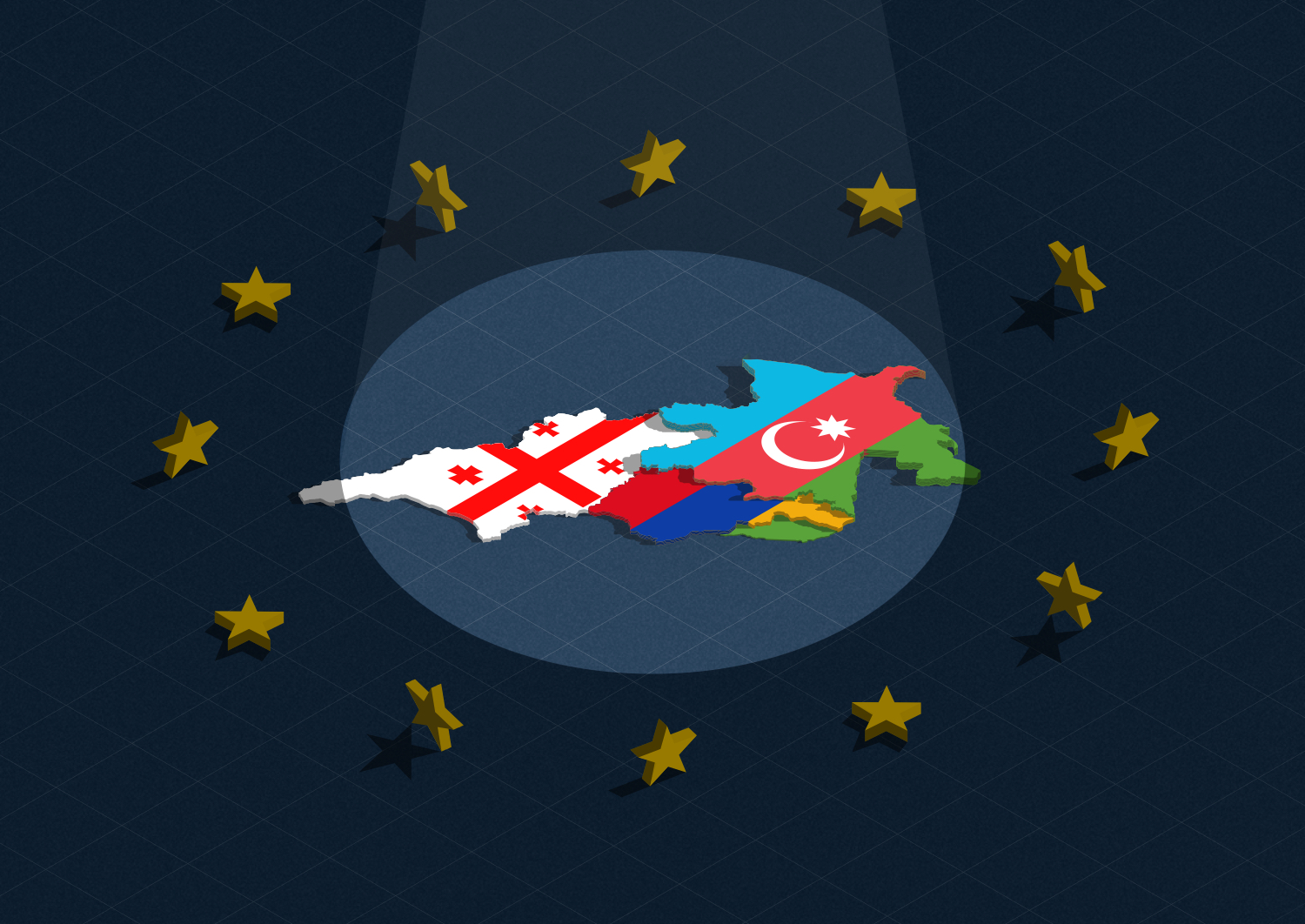
As Armenia, Azerbaijan, and Georgia navigate a complex web of power rivalries, each state pursues divergent geopolitical trajectories. With Moscow’s sphere of influence increasingly challenged, the EU faces a crucial opportunity to expand economic and political sway over the South Caucasus.
Image Credit: Euro Prospects
By Oskar Genney, International Affairs Correspondent
Edited by Berk Tuttup, International Security Correspondent
14 November 2026

Russia’s costly invasion of Ukraine changed the geopolitical landscape well beyond Ukraine, raising questions about Moscow’s ability to maintain its influence across neighbouring regions. In the South Caucasus, Armenia is pivoting towards the EU, Azerbaijan is asserting greater regional autonomy and Georgia’s relations with Brussels have become increasingly strained. These developments have created opportunities for the EU to expand its influence in a strategically important region. However, a declining Russian influence does not translate into European dominance. The EU is expanding its diplomatic, economic and security presence, but a crucial question remains: Can the EU replace Russia as the South Caucasus’ dominant external power?
The South Caucasus: A strategic crossroads
The South Caucasus, comprising Armenia, Azerbaijan and Georgia, connects Europe, Russia, Turkey, Iran and Central Asia. Its geographical position makes it significant for energy supplies, international trade and transport connectivity and places the region at the intersection of competing security interests.
Russian influence over the region began during its imperial expansion and was consolidated during the Soviet period. Following the dissolution of the Soviet Union, Armenia, Azerbaijan, and Georgia became independent and began pursuing their own political, economic and security interests. Although Russia lost some of its former control, it retained considerable influence through military deployments, economic ties, political relationships and its role in regional conflicts. This influence is best understood in the way Armenia relies on Russian security, in Georgia’s 2008 war with Russia, which exposed the limits of US support, and in the way Azerbaijan has maintained a comparatively independent foreign policy. Russia has not simply disappeared from the South Caucasus. Russia is dealing with three sovereign states simultaneously. This opens up a crucial opportunity for the EU and shapes how Brussels has to plan its strategy.
Russia’s weakening position and geopolitical strain
Since February 2022, Russia’s full-scale invasion of Ukraine has drained its military resources and political attention. Russia’s influence was challenged in other strategically important regions. In Syria, Russia’s presence was threatened by the sudden fall of its ally, Bashar al-Assad, in December 2024. Meanwhile, Armenia pursued closer collaboration with the European Union owing to its dissatisfaction with the Collective Security Treaty Organization (CSTO). Together, these events in three different regions put heavy pressure on Moscow and overwhelmed the government, affecting its political sphere and causing its influence to tremble in several places at once.
However, not all South Caucasus states have distanced themselves from Russia. Since 2024, Georgia–EU relations have deteriorated due to disputed elections, which the opposition and many Western governments say were marred by irregularities, and because of the Georgian government’s growing closeness to Moscow. Benefitting Moscow, the Georgian Dream Party has enabled Russia to deepen its political and economic footprint alongside the EU “deadlock“, most notably by refusing to join international economic sanctions and resuming direct flights in 2023.
The clearest example of Russia’s decreasing security presence is Armenia’s deteriorating relationship with Moscow. For decades, Armenia has relied heavily on Russian military assistance and actively participated in the Russian-led Collective Security Treaty Organisation (CSTO), but after the 2020 war, Azerbaijan’s 2022 incursions into Armenian territory and its 2023 offensive, Armenia was left dissatisfied with the CSTO’s inaction, which ultimately led Yerevan to freeze its CSTO membership. As Armenian Prime Minister Nikol Pashinyan announced: “the Republic of Armenia’s membership in the CSTO is frozen, and no steps will be taken to return to active participation…”. However, this does not mean that relations are severed between them, but rather it shows a growing reluctance towards Moscow and towards reliance on the security it can provide.
The shift by Armenia has created an opportunity for the EU. In February 2023, the European Union Mission in Armenia (EUMA) was officially launched. The task of EUMA is to monitor and report on civilian security along Armenia’s border areas. This provides a civilian presence in a conflict-affected area and the mission also focuses on confidence building between Armenia and Azerbaijan. However, EUMA has no military deterrence mandate, and the EU cannot offer a collective defence guarantee such as Russia can.
Armenia’s altering foreign policy away from Russia does not mean that the two are now complete strangers, nor that Armenia is now a great ally of the EU. Armenia still faces difficult security and economic choices that are connected to Russian-led institutions such as Eurasian Economic Union (EAEU) and CSTO. This situation is more of an effort by Armenia to diversify and reduce dependence on one external power.
The EU’s expansion: Trade, connectivity and energy
Lacking Russia’s military mobilisation capability, the EU instead leverages its substantial economic presence. The EU’s cooperation with Azerbaijan on energy trade and the development of alternative transport routes has become an important cornerstone of the EU’s growing influence. According to the European Commission, Azerbaijani gas supplies to the EU have increased by more than 40 percent through the Southern Gas Corridor between 2021 and 2024 and the EU has become Azerbaijan’s largest trading partner. Also, the EU’s Peace through Connectivity Package, announced in Baku in July 2026, will provide up to €200 million in grants for connectivity across the South Caucasus, with a further €20 million for local communities in Armenia and Azerbaijan. Through the EU4Digital initiative, the EU and EBRD supported a project in late 2022 to expand broadband infrastructure to over 280,000 households in Azerbaijan, an effort aimed at boosting economic growth and bringing the country more in line with EU norms. This relationship between Baku and Brussels provides an incentive for both sides to collaborate more closely: for Baku this solidifies a good economic partner and for Brussels it creates a base for them to expand.
Furthermore, the EU has also increased its presence by funding the Trans-Caspian Transport Corridor project. The TCTC creates an alternative to trade routes that are heavily dependent on Russia, namely the Northern Corridor and the International North-South Transport Corridor (INSTC). The EU’s capability to replace Russia as the region’s dominant power comes down to initiatives like this, which strengthen the EU’s presence through connectivity trade routes. The initiative between Azerbaijan and the EU marks a shift in the region’s power dynamics.
However, new independent trade routes, energy independence and a good financial opportunity do not mean that Baku has a clear political alignment with Brussels. For Azerbaijan, the relationship with Brussels is at the moment based only on a substantial and mutual economic interest rather than an incentive to join the EU. Azerbaijan continues to pursue its own foreign policy, balancing its relationships between Ankara, Moscow and Brussels.
One region, three sovereign states
European influence differs significantly across Armenia, Azerbaijan and Georgia, so treating the states as a unified geopolitical “bloc” risks overlooking their differences and political agendas.
For instance, Armenia has sought a greater and closer relationship with the EU. In March 2025, Armenia passed legislation that launched a process towards European Union accession. This expressed a political ambition rather than securing candidate status or membership. Subsequently, the EU-Armenia summit in May 2026 marked a step towards stronger cooperation on security, connectivity and economic development.
Azerbaijan is a contrasting case. The country has pursued a more autonomous foreign policy. This can be seen in its energy relationship with Europe, which provides substantial opportunities for cooperation; however, Baku has shown a reluctance to integrate further with the EU in an effort to balance between Moscow, Ankara and the EU.
The situation with Georgia presents a different challenge. In December 2023, Georgia was granted EU candidate status; however, the accession process was halted in 2024 owing to democratic backsliding and deteriorating relations with Brussels. In November 2024, the Georgian government announced that it would not put EU accession talks on the agenda until the end of 2028, which further damaged relations with the EU. This development regarding Georgia complicates the assumption that Russia’s declining regional dominance automatically creates a power vacuum that the EU could seize. Georgia occupies one of the region’s most strategic geographic locations and, according to Civil Georgia, 71% of Georgians support cooperation with the EU; however, the government’s political direction is pulling away from EU-Georgian cooperation and towards the Russo-Georgian relationship it once had.
Between the three independent states, the contrasting political trajectories demonstrate that the EU’s influence does not only depend on Russia’s weakness, but also the political desires of these three independent states. Brussels can offer economic cooperation, institutional integration and diplomatic engagement, however, it cannot assume that all three countries will move towards EU integration at the same time and pace.
By what means could the EU fill Russia’s power vacuum?
The EU’s initiatives and growing involvement in the South Caucasus does not mean that the EU has the capacity to replace Russia as the dominant power in the region. However, the EU is pursuing a greater and larger foothold, competing with Russia in security cooperation, economic integration, infrastructure projects and diplomacy. EUMA represents how the EU has the capacity to establish a security presence in the region along with strengthening its trade relations with Azerbaijan, linking the two markets together. A decisive factor in EU’s strategy is its push for logistical independence. Establishing new, resilient trade routes that bypass traditional Russian corridors serves as a monumental shift in the region’s power dynamics. Lastly, the EU’s deepened political partnership with Armenia provides the EU with a better diplomatic base in the region. With these geopolitical mechanisms, the EU could gradually increase its presence in the South Caucasus in certain areas where the Russian government falls short or where their influence has weakened, without replacing Russia entirely.
A multi-geopolitical competition – Israel, US, China, Turkey and Iran
Furthermore, the South Caucasus should also not be understood merely as a competition between the EU and Russia. For instance, Israel, the US, China, Turkey and Iran are heavily influential in the region and have long supported different sides in the regional conflicts as well as investing in the region. Israel has supported Azerbaijan’s military assets, China has been an important actor in transport infrastructure and trade in the Caucasus, Turkey has been a close ally of Azerbaijan, while Iran, though officially neutral, leaned towards Armenia in the recent Nagorno-Karabakh 2020 and 2023 conflicts. The US acted as a crucial diplomatic mediator, as highlighted by the Washington peace talks. Iran and Turkey have increased their influence through their investments in regional infrastructure developments. For instance, Iran and Russia have backed the International North-South Transport Corridor while Turkey has been a key partner in projects such as the BTC pipeline for oil and TANAP for gas, which carry Azerbaijani oil and gas westwards through Georgia and Turkey. The EU and Russia are competing for influence over the region at the same time as Israel, the US, Turkey and Iran. This multi-geopolitical competition for influence in the South Caucasus showcases that Russia’s declining influence may not create a “power vacuum” for one actor to seize, but rather a multipolar environment where several actors compete and cooperate.
The EU has, to some extent, the capacity and ability to become an influential actor over the South Caucasus. However, to completely replace Russia in this “power vacuum” would be overly optimistic. The EU can expand its influence through trade, diplomacy, infrastructure projects and civilian security missions, but becoming the new dominant power in the region would mean outcompeting all other actors, including Russia, Iran and Turkey. Instead, the EU may expand its influence through trade and diplomacy while cooperating with other external actors.
Conclusion
The EU is expanding its influence in certain areas such as trade, security and diplomacy over the South Caucasus at a time of supposed instability for Russia. However, the EU’s growing influence and Russia’s possible decline do not mean that the EU will, or can, replace a historical actor in the region. As mentioned earlier, the growing independence of the South Caucasus states could go either way depending on what events occur; as the case of Georgia shows, the states choose their own path. This multi-geopolitical competition in the South Caucasus portrays how interconnected the world of politics is, how conflicts between external actors influence other states, and how even a slight weakness in a state could potentially cause it to lose its political, economic and/or military grip over a region.
Disclaimer: While Euro Prospects encourages open and free discourse, the opinions expressed in this article are those of the author(s) and do not necessarily reflect the official policy or views of Euro Prospects or its editorial board.


International Affairs Correspondent
Oskar is a student at Malmö University, Peace and Conflicts studies. His academic interests include conflict analysis, peacebuilding, international relations and contemporary European security issues and policies. During his first year, he authored two research papers: one examining the role of the United Nations peacekeeping in Sierra Leone, and another analysing the United States’ discourse within the United Nations Security Council during the Rwandan Genocide. His work focuses on international security, peace operations, and the political dynamics of conflict and conflict resolution.
Edited by Berk Tuttup, International Security Correspondent | Follow our European journalism