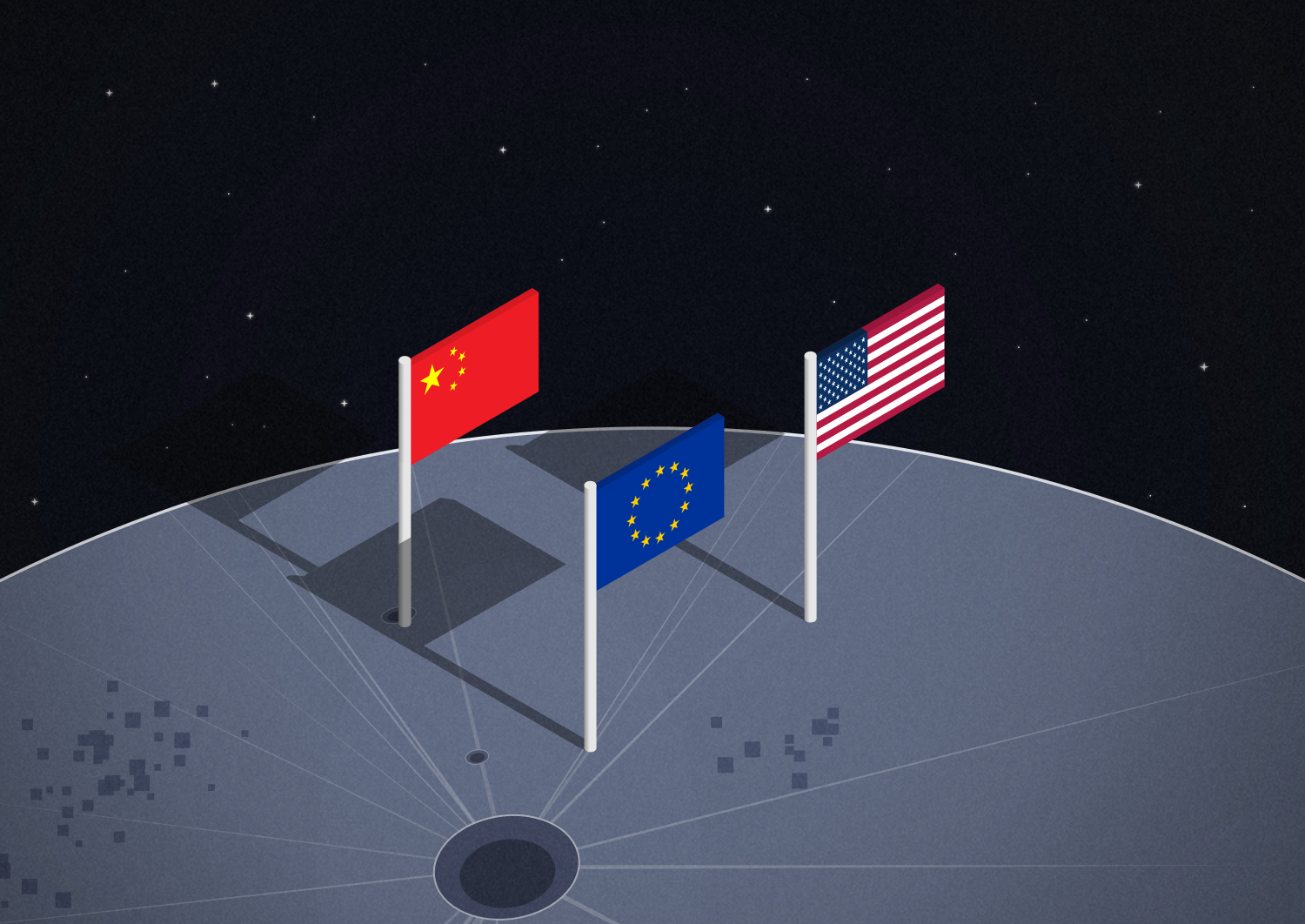
The Race to the Moon Is Back On, And Europe Is Helping Us Get There
The Race to the Moon Is Back On, And Europe Is Helping Us Get There
“The First Space Race proved a flag alone builds no market; this Second Space Race will belong to whoever finances and owns the shared infrastructure that every later mission has to use.”
— Stirling V.C. Forbes, A Merchant Moon: How to Lead In The First Market Beyond Earth
Image Credit: Euro Prospects
By Jake Taltson Southerland, Senior Editor • Int’l Security Correspondent • Director of Security & Defense Team
Edited by Pierre Sabot, Space Security Analyst, Security & Defence Unit (S&D)
23 October 2026

Almost half a century ago, the crew of Apollo 11 traveled to the Moon, planted a flag, and returned home. Alright, that is a vast oversimplification, but at the time, the Moon landings represented a geopolitical victory for Washington over the Soviets in the Cold War. Fast forward to today and America is planning to put its astronauts back on the Moon. With a targeted launch for early 2028, NASA’s Artemis IV aims to land near the lunar South Pole for a week-long mission to lay the foundations for a sustained lunar presence. The possibilities for American interests on the lunar surface are endless. However, Washington will have some serious competition – China. And unlike the last space race that our grandparents experienced, America is not going along.
In the original mission plans, Artemis III was designated to be the first crewed lunar landings since 1972. However, a “course correction” for the Artemis program was announced by Trump-appointed NASA administrator Jared Isaacman earlier this year. Assuming the rendezvous and docking tests performed during Artemis III (Q3 2027) are successful, Artemis IV will see its crew take either a SpaceX or Blue Origin-manufactured lunar lander down to the Moon’s South Pole. Laying the foundations for a prolonged American-led lunar presence. Or the spine-tingling way of saying it: a moon base.
However, we won’t have to wait until 2028 to see NASA activity on the lunar surface. Isaacman has made it clear that NASA plans to send robotic landers to the Moon on a near-monthly cadence by early 2027 to test the “science and technology” needed to support prolonged lunar habitation. With SpaceX’s Starship, Blue Origin’s New Glenn, and other commercially-produced rockets, the groundwork for a lunar base is taking shape well before our return to the Moon.
Yet, it is necessary to emphasize that the entire Artemis program is not solely an American effort. Without the participation of several notable European space agencies, the Artemis missions would have never left the drawing board. One example and arguably the most important component that the Artemis missions rely on, is the European Service Module (ESM), produced by the European Space Agency and its various industry partners spanning 13 member states. Without the ESM, the missions would be short on a few minor details, such as power, propulsion, oxygen, and water. In other words, everything our astronauts need to make it to the Moon and back in one piece. More importantly, the ESA also has a stake in future lunar infrastructure, such as the Lunar I-Hab, which is scheduled to arrive with the crew of Artemis IV.
From major space-faring powers such as France to established players like Luxembourg to even tiny San Marino, more than 30 European countries have signed the Artemis Accords. While it may be easy to breeze past Europe’s role in the program, especially when coverage of the Accords tends to be very U.S.-centric. The wide disparity between U.S. and European launch attempts over the last couple of years doesn’t exactly help the cause. It’s clear that the U.S. is well ahead in the use of reusable rockets, something Europe is only beginning to catch up on with companies like Isar Aerospace leading the charge. However, European contributions have appeared in other ways.
Communications tools such as Lunar Link will be vital for keeping communications flowing between lunar bases, landers, and orbital outposts. Similar to SpaceX and Blue Origin, the ESA is developing the Argonaut Lunar Lander to provide Europe with its own capability to deliver cargo to the lunar surface. Moreover, the Moonlight program, another ESA-driven initiative, could become the groundwork for a lunar derivative of Google Maps, allowing our astronauts to confidently navigate the South Pole. So while the U.S. is making the trip back to the Moon possible, Europe is helping build the life-support, navigation, and communication infrastructure necessary to sustain our presence there. To overlook that would criminally underestimate just how critical European space agencies and their private industry partners are to achieving mission success. And unlike last time, our first steps back on the Moon will be a transatlantic endeavor.
On the other hand, the lunar South Pole has also attracted significant attention from Beijing. China appeared poised to beat NASA to the region. As part of the now-delayed Chang’e 7 mission that was slotted for mid-2026, the Chinese planned to send an orbiter, lander, rover, and flying probe to the South Pole. However, with that mission now being put on the back burner, NASA and its European partners have been given some much-needed breathing room. But Chang’e 7 is only the first step in a much larger Chinese lunar strategy. While Chang’e 7 is focused on exploring the South Pole, its successor, Chang’e 8, is intended to take the next step by testing technologies for using lunar resources and supporting future infrastructure. Yet, with delays to Beijing’s plans, its timeline will be set around the same time as Artemis III and IV. But beneath all astropolitical competition between the U.S. and China lies the real prize.
So, what’s all the fuss about? It has to do with permanently shadowed regions (PSRs) or craters which could have pools of lunar ice sitting at the bottom ready for the taking. The importance of lunar ice as a natural resource deserves its own lengthy analysis. However, I’ll criminally oversimplify the chemistry at work here by saying that water can be split into hydrogen and oxygen, the basic ingredients for rocket propellant. This leads us to the working theory that extracted water from these craters could be used to produce the rocket fuel necessary to propel spacecraft into deep space. However the ice can potentially do more than help produce rocket fuel. Nitrogen-and carbon-bearing compounds could also be recovered, providing essential ingredients for life support and other activities critical for sustaining prolonged lunar habitation.
Hence, giving the age-old saying, “Another man’s trash is another man’s treasure” a literal geopolitical edge to it. Making it clear that the seeds for the impending lunar turf war have already been planted. Both China and the Artemis Accord’s frontrunners (NASA and the ESA) have developed the necessary extraction technology. But, with only so much real estate on the lunar market, the U.S. and China will become locked in a game of “finders, keepers.” Some of the PSRs that have piqued everyone’s interests include the Shackleton, Haworth, and Faustini craters. Yet, with a limited number of suitable landing spots like de Gerlache Ridge situated nearby, both countries will have to compete for a spot in a crowded lunar carpark. Why, you may ask? It’s because the ridge is one of the few places in the immediate vicinity with near-continuous sunlight, making it one of the few attractive locations within the South pole region for lunar touch down. Only then will our neighborly rock be able to serve a whole new purpose.
So, to Neil Armstrong and Buzz Aldrin, it pains me to say that planting a flag is old news. Humanity is planning to turn the Moon into a staging ground. One with economic, political, and social implications for our future role in space. But, with talks of Artemis III being three months behind schedule, the subsequent Artemis missions will more likely face a domino effect. Yet, it’s crucial to convey that breaking lunar ground will be critical to making humanity’s first attempts to reach the Red Planet a fledgling reality. Reaching Mars then creates a possible launchpad for our even greater ambitions into deep space. And perhaps one day, making interstellar travel to our nearest star system, Alpha Centauri, just four light-years away, something future generations might actually experience. By astronomical standards, that’s only a stone’s throw away, but with our current spaceflight technology, our next-door neighbor remains mind-bogglingly far. So, we might need to start asking around for a spare warp drive, or perhaps see if Captain Kirk has any advice. But every journey has to start somewhere, and ours begins with Luna.
Disclaimer: While Euro Prospects encourages open and free discourse, the opinions expressed in this article are those of the author(s) and do not necessarily reflect the official policy or views of Euro Prospects or its editorial board.

Senior Editor • Int’l Security Correspondent • Director of Security & Defense Team
Based in Atlanta, Georgia, Jake has held several roles at Euro Prospects since joining the team in April 2025. As a recent MA in International Relations graduate from Leiden University, focusing on the influence of history on current global politics, Jake aspires to become a security analyst or journalist, with expertise in European security, outer space governance, and transatlantic defense cooperation. He enjoys reading and writing about European defense policy, history, foreign affairs, and international political economy, reflecting his ongoing curiosity about the evolution of geopolitics and international relations. In addition to his work at Euro Prospects, Jake holds leadership positions on Geopol Report’s North America and Europe Desk and serves as the Scandinavian/Nordic contributor and Global Outreach Manager for the British Institute of Global Affairs. These roles are helping him build a strong and diverse portfolio for his future career.
Edited by Pierre Sabot | Follow our European journalism