Between Paris and Washington: Lebanon’s Competing Security Patrons
Between Paris and Washington: Lebanon’s Competing Security Patrons
While France retains a historical basis in its role as the main security guarantor for Mount Lebanon’s Christians, recent U.S. foreign policy strides in Lebanon have evidently challenged France’s capacity in its traditional role.
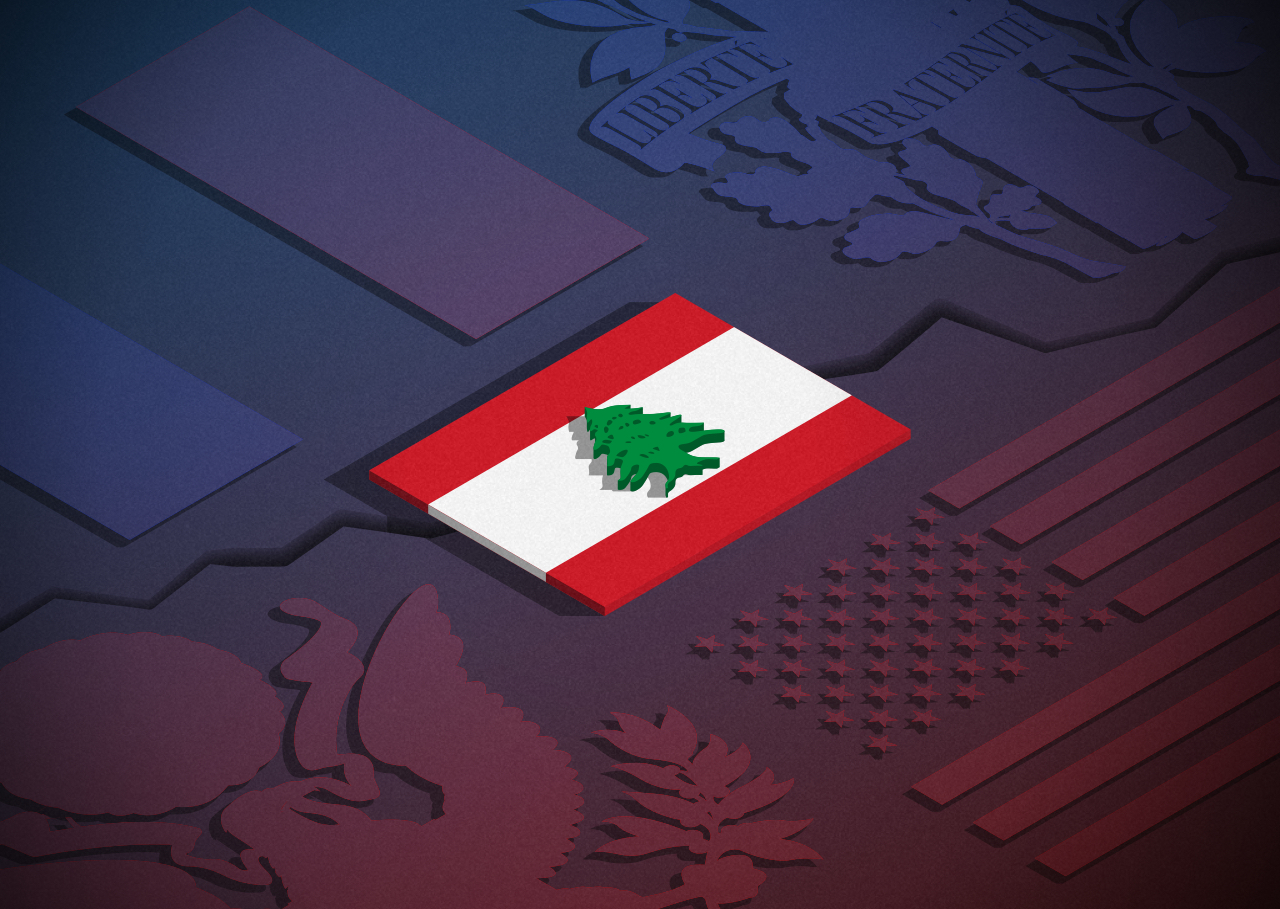
Image Credit: Euro Prospects

France and the Christians of Lebanon have long held invaluable ties, forged mainly on the basis of cultural, religious, and political affinity. A letter sent by King Louis IX to the Maronites in 1250 is often cited as the historical moment that baptized the dynamic of security patronage in the relationship between the two. The letter particularly acknowledged the unique bond shared between the French nation and the Christian community after the latter lent a combined force of Maronites and other fighters amounting to 25,000 men upon the request of the imprisoned king – and later ordained saint – during the 7th crusade.
In the years that followed were significant markers in the relations between the two peoples. 1649 set an important precedent as it is when the French made an official commitment by instructing their representatives to safeguard the Maronite church and its followers. This commitment to stand by the community materialized when Napoleon III sent 6,000 troops tasked with ensuring and maintaining stability for Mount Lebanon’s Christians in 1860. The community benefited again in 1920 through the French proclamation of Greater Lebanon, an expansion of Mount Lebanon under Ottoman drawn borders. This signaled the prioritization of Christian security needs after the disaster caused by the ‘Great Famine’ (1915–1918) that led to the death of 200,000 Maronites and Christians due to the Ottoman blockade on the Mountain in fears that the Christians would support the French in the first world war.
Now, after centuries of acting out this role, France finds itself competing for its capacity to influence decisions for Lebanon’s security, vis-à-vis the United States. While not the first time the U.S. weighs in on Lebanon’s security file, this is in light of its intensified efforts in leveraging its influence in Lebanon amidst the conflict it finds itself between Iran and Israel. Can this change be attributed to a shift in French foreign policy that breaks with King Louis IX’s centuries-old doctrine or is it simply due to the current balance of power in the Middle East that has prompted France to take a more proactive role than usual?
France and its Current Efforts
Lebanon’s security has been particularly vulnerable and exposed to the regional instability that unfolded since October 7th of 2023, culminating in the regional war between Israel, Iran, and its allies. The situation in Lebanon was exacerbated when Hezballah joined the fight against Israel, ending in a ceasefire agreement in November of 2024. War once again erupted when the group decided to support Iran on March 2 in the confrontation that broke out between the latter and the United States and Israel on the 28th of February this year. Since then, both France and the United States – shaped by their differing foreign policy goals – have played various roles in trying to help the Lebanese government resolve its security dilemmas.
For its part, France’s foreign policy has evidently remained in maintaining its traditional role of diplomatically standing by the 83-year-old republic in a number of ways. This is because it still finds a historic and practical partner in the form of Lebanon’s sizeable Christian population as well as other willing local partners. Beyond Lebanon, the country also remains as France’s best outlet for influence in the region, be it in matters of trade, soft power and culture, and other considerations.
Efforts have included holding a fundraising conference in Paris that raised $1 billion in humanitarian aid, with $200 million dedicated for the Lebanese Armed Forces (LAF) as the war was ongoing between Hezballah and Israel in October of 2024. That was of course not the only instance where the French offered military aid. President Macron promised to deliver armored vehicles and logistical support to Lebanon’s military amidst the shockwave experienced across the republic as it was absorbed into the intensity of the new Gulf war.
A month later, France gained a seat in the ceasefire monitoring mechanism, a committee comprised of the U.S., France, Lebanon, Israel, and the UNIFIL, tasked with ensuring the implementation of the ceasefire. Perhaps most significant is France’s joint announcement with Italy in their desire to form a multinational force on the ground when the mandate of the UNIFIL, the peacekeeping force in South Lebanon since 1978, expires by late 2027.
However, until initiatives like a multinational coalition or the directing of donated funds metastasize, diplomacy has been the most utilised card by the French in attempting to alleviate Lebanon of its security woes in the meanwhile. President Macron earlier this year immediately urged Israeli prime minister, Benjamin Netanyahu, to refrain from a ground invasion after Hezballah joined the war alongside Iran. Despite the invasion taking place, rhetoric in regards to Lebanon’s crises stepped up when French presidential envoy Jean-Yves Le Drian held not only Israel responsible for Lebanon’s heightened security situation, but also Hezballah and its priority of Iranian regional foreign policy. Particularly significant was the fact that this was the first critique and condemnation from the French directed against the armed group within the broader scope of impeding upon the country’s security. France has also pushed the extent of diplomatic pressure to the point of holding an emergency UNSC meeting following Israel’s capture of Beaufort Castle late last May, condemning continuous military action that falls outside the scope of self-defence.
Lebanon Within America’s Middle East Security Framework
Alternatively, broader American foreign policy in the region is reflected through American foreign policy towards Lebanon, which has been to support the government and its legitimacy through pushing for its monopoly on arms within the country. This is in direct contention with Hezballah and other armed groups outside the scope of the state.
Revitalised efforts in dealing with Lebanon had been in the process since president Trump’s second ascension to the White House through special envoys like Morgan Ortagus and Thomas Barack. This came right after the fragile ceasefire that Amos Hochstein helped broker between Lebanon and Israel towards the end of the Biden administration in 2024. Said envoys have attempted to leverage American influence more directly with continuous follow up visits and conditioning help like reconstruction through bolder stances on Hezballah’s disarmament.
Adding to this, American strategy at maintaining and restoring Lebanon’s security, as well as that of the region’s, has been to pit Lebanon and Israel together diplomatically, exerting evidently extensive efforts at facilitating direct communication and negotiations between the two states who have been in an official state of war since 1948. In light of the latter fact, a number of significant developments have taken place, beginning with the U.S. establishment of the ceasefire monitoring committee. Particularly significant is that said committee, upon the request of the Americans, produced a civilian representative by Lebanon, marking the first time non-military officials participate in communication with Israelis regarding matters of technical security. Furthermore, Lebanese and Israeli ambassadors met in Washington on the 14th of April under American auspices for the first round of negotiations. It was the first direct communication between the two states that took place since the negotiations in 1983 during the height of the Lebanese civil war. In addition, American facilitation of diplomacy has most recently led to the signing of a 14-point framework agreement between Lebanon and Israel, one of the points affirming each side’s right to “live in peace”. This sparked controversy within Lebanon between those who wish to see a cessation of hostilities and those who emphasise on Israel’s status as an enemy, setting a new precedent on how the state attempts to achieve security and stability.
Regardless, the Americans are seeking to cement the change in the dynamic after president Donald Trump invited Lebanese president, Joseph Aoun, to Washington on the 21st of July for official talks between the two on a number of points, including bilateral relations and regional security. Perhaps the American position on Lebanon can be best summed up through vice president J.D. Vance, who appealed to the Christians in late June, telling them to “keep your faith in Jesus Christ” and that they had “friends” in the U.S. government.
France and the United States: Competing or Sharing Space?
France still comprises a key role in Lebanon’s security affairs. However, momentum picked up on by the Lebanese government on alternative motions by the Americans, further complicated by Israeli pushback against French involvement, have put France on the defensive. In April, Israeli ambassador to the U.S., Yechiel Leiter, made comments such as, “we like to keep the French as far away as possible from pretty much everything…” and other similar comments that expressed France’s role as “not positive”. On the backdrop of the high-level meeting between the ambassadors of the two countries, the publicity of these comments signals an obvious intent at driving out the French on matters of security and diplomacy.
The growing observation of France’s limited role in Lebanon is also believed to be tied to the ongoing recession of its soft power in the country, attributed to the decline of the Christian population – relative to 1932 – and the dominance of English as the local lingua franca, even though French soft power still retains outlets within the country.
Sovereignist Christian groups have likewise intensified their engagement with American policymakers. On the agency for both the Christian community and Lebanese state, Christian leader and MP, Samy Gemayel of the Kataeb party, led a delegation to Washington in late 2025, meeting with congressmen and the U.S. Department of State. These high-level meetings concerned Gemayel presenting the socio-political situation in the country, attempting to foster awareness and an enhanced partnership with the United States at upholding security and sovereignty in the country. Other sovereignist groups, on a comprehensive security solution for both Lebanon and the Christian community, still opt for appealing to French support in their endeavours. Lebanese Forces MP, George Okeis, was slated to appear in the French Senate on the 4th of July in a bid to drum up support for the idea of federalism as an alternative solution. As Okeis explained, it would address both the agency of the Christian presence and the strengthening of the state as a central authority. Regardless, both parties have always appreciated the efforts of both France and the United States through a history of ties, diplomacy, engagement, and an affinity of political and social values.
While this shows that Lebanon has continuously found an ally in France, it also shows that the European power is not the only one operating on this side of the Mediterranean, the centre of influence drifting away from France to a more shared environment with the Americans.
Conclusion
While cementing security in Lebanon and enhancing influence in it are common bottom lines, they act more as means for the various ends for broader French and American foreign policies. The United States under president Trump would stand to gain in being central to Lebanon’s security as it would deny Iran an outlet in the region through taking up Lebanon as a security partner. Additionally, it would potentially further cement, alongside English as a pillar of soft power, its standing with the Christian community and other elements of Lebanese society by acting as a vital alternative security guarantor to France. France, in its own right, will have been preserving centuries worth of political and diplomatic capital that it has accrued if it manages to remain a security guarantor in line with its historic precedent. It would also retain its strategic position of leverage and influence in the Levant and the Eastern Mediterranean on issues related to oil and gas, migration, and so on.
A far cry from Napoleon III’s 6,000 troops in 1860, France still has a stake in how security shapes up in the country of a little more than 5 million people. However, unlike 1860, France must now also navigate the flurry of American foreign policy in the Middle East, and what that means for Lebanon.
Disclaimer: While Euro Prospects encourages open and free discourse, the opinions expressed in this article are those of the author(s) and do not necessarily reflect the official policy or views of Euro Prospects or its editorial board.
AK
Guest Author
Arman is an MA student in political studies at the American University of Beirut, previously serving as the president of his political science department’s student body from 2022 till 2025. He is a former civil service intern at the Lebanese ministry of foreign affairs who specializes in international relations, primarily focusing on matters of security, geopolitics, and foreign policy. He received his Bachelor’s degree in political science from Haigazian University and speaks Armenian, English, Arabic, and a bit of French. His regard for politics as a noble pursuit has led him to organize dozens of debates and policy discussion events covering foreign and domestic affairs, such as power politics, education, statehood, and ideologies.