14 min read — Political Parties | United Kingdom | Democracy
Is There a Future for Multi-Party Politics in the UK?
Why the UK’s current multi-party era will likely be temporary, unless electoral reform is implemented.
By Wout Willemsen — European Politics Correspondent
Edited/Reviewed by Kristóf Hermann and Anthony Lobinski
July 17, 2026 | 21:00
In the local elections held in the United Kingdom last May, five parties – Reform UK, Labour, the Liberal Democrats, the Conservatives and the Green Party – achieved between 16% and 26% of the national vote share. In Scotland and Wales, these parties enjoyed significant support alongside the respective nationalist parties, who achieved a plurality of both seats and votes in both parliamentary elections. In a democracy where elected representatives from all levels – national, regional and local – are chosen through a first-past-the-post system, this level of party fragmentation among voters is extraordinary.
Indeed, throughout recent British political history, two parties – the Labour Party and the Conservative Party – have dominated British politics until recently. In a first-past-the-post system, also used in countries such as the United States and Canada, voters unite under one party to prevent the other party from winning the election, thereby naturally forming two-party systems. This phenomenon is known as Duverger’s Law. Without knowing the background of the UK’s local elections in May, it may seem puzzling, considering the country’s political system and tradition, that voters have spread their votes among five (or six) different political parties to such an extent.
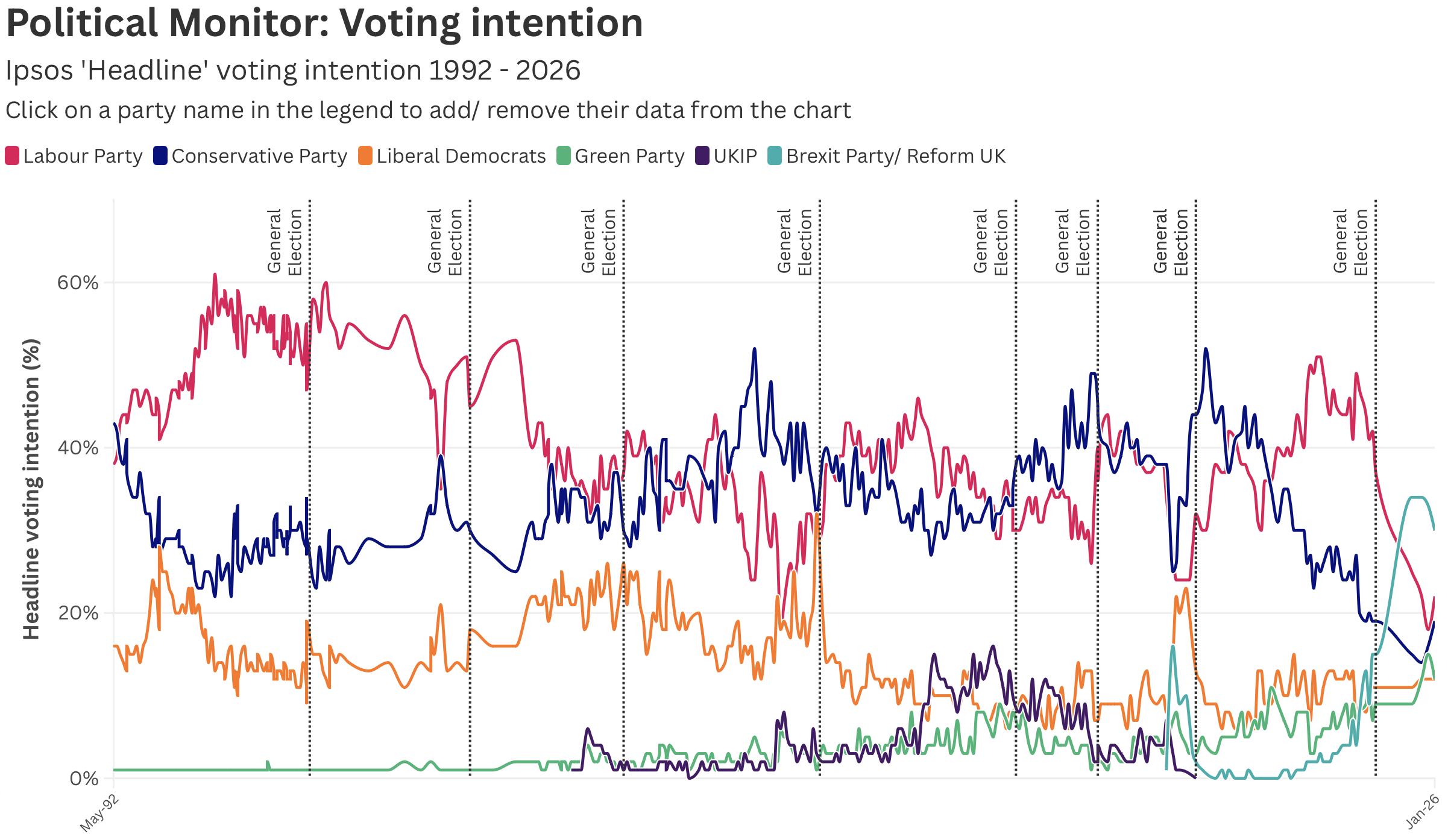
This fragmentation is caused by the disillusionment of voters with the traditionally leading parties. The Tories were the first to fall in the polls, while Labour has recently lost its dominant position, as is seen in figure 1.
Fall of the traditional parties
The Conservatives’ major defeat in the 2024 parliamentary elections, where the party fell from 365 to 121 seats, came after years of scandal-ridden premierships. Boris Johnson failed to follow up on initial widespread support for both his plea to “get Brexit done” and positive perceptions over his government’s early COVID policy. He resigned amid controversies over lockdown parties in Number 10 and the appointment of deputy chief whip Chris Pincher, who faced allegations over sexual misconduct.
The Tories’ decline in popular support was further accelerated by Liz Truss’ 49-day premiership, as Truss’s plans for corporate tax cuts were scrutinised by the IMF, causing an immediate economic meltdown, as well as her resignation. Rishi Sunak, who occupied Number 10 for slightly less than two years, was unable to change the Tories’ fortunes in the polls and Keir Starmer’s Labour won 412 from 650 House of Commons seats in the 2024 elections, as observers noted that voters hoped for competent, stable leadership and a solution to the UK’s cost-of-living crisis.
Their hopes appear to have been in vain. Keir Starmer’s government has been perceived to be unable to deliver on these wishes and Starmer did not complete his term, resigning amid increasing pressure from his own party and a leadership challenge from former Manchester mayor Andy Burnham. Starmer’s approval rating hovered around 20% at the end of his tenure, according to YouGov. The pollster conducted an interview, where voters had noted his numerous U-turns on policies, which included scrapping relief for pubs and restaurants, increasing taxes on income and inherited farmland, suspending payments for winter fuel and restricting eligibility for benefits for persons with physical and mental disabilities. All of these measures proved unpopular, and were subsequently either watered down or scrapped entirely.
Voters also mentioned Starmer’s apparent lack of charisma, absence of a clear vision for the future, and his handling of the Peter Mandelson affair, which saw senior Scottish Labour politicians publicly advocate for Starmer’s resignation. Last May’s disappointing election results, where Labour lost almost 1,500 local councillors across the country, increased the pressure on Starmer within the party. The results prompted Health Secretary Wes Streeting to resign, writing in his resignation letter he “lost confidence” in Starmer’s leadership. In his final months in office, Starmer’s government endured two more resignations from Defence Secretary John Healey and Armed Forces Minister Al Carns, who both concluded that the government’s plans failed to deliver meaningful gains in defence investments. Andy Burnham’s victory in the Makersfield by-election, which paved the way for a leadership challenge by the popular former mayor of Manchester, was the final nail in the coffin for Starmer’s premiership.
As voters have walked away from the traditional parties in UK politics following political turmoil and an inability to reverse the cost-of-living crisis, they have sought refuge in non-traditional alternatives. Nigel Farage’s Reform UK was the big winner in last May’s local elections, as the party won 26% of the national vote share and 1,454 of their councillors were elected, leading the overall results. Zach Polanski’s Green Party was the other big winner, as they increased their total of councillors from 146 to 587 among the contested councils. The more traditional non-traditional alternative, the Liberal Democrats, gained 155 councillors nationally and their total amounted to the third highest behind Reform UK and Labour. The Scottish National Party in Scotland and Plaid Cymru in Wales both won most seats in their respective parliaments.
It is not too late for the traditional parties to turn around their fortunes, however. Burnham, who enjoys an approval rating of 60% among Labour voters, has opened up an opportunity for Labour – who are already seeing gains in the polls – to do just that when Burnham becomes prime minister. YouGov shows Tory leader Kemi Badenoch to be more popular than Reform’s Nigel Farage, who recently triggered a much-critised by-election following an investigation into allegations that Farage failed to declare benefits. A rebound of the two traditional parties may therefore be well within the realm of possibilities.
Bizarre election results
The UK’s electoral system is not designed to accommodate a diverse party landscape. In the current first-past-the-post system, local councillors are elected based on the councillor winning their ward, an area – which is usually a neighborhood or small village – smaller than the city or town the council is administering. A candidate does not require a majority to win a ward, merely one more vote than the closest rival, which means votes for rivals are wasted votes. Often, two or three councillors per ward are elected. Competition between more than two parties in this system means votes are translated disproportionately to the council.
In the 2024 parliamentary elections, Labour won 63% of seats with 34% of the vote share, while the Liberal Democrats and Reform UK received 12% and 14% of the national vote share respectively, with the LibDems winning 71 seats and Reform UK only eight. A similar disproportionality was seen in some local elections last May. In Wakefield, a town just south of Leeds where Labour previously held 54 from 63 local council seats, Reform won 58 from 63 seats with just 44% of the votes. In the district of Sefton, near Liverpool, Labour retained an absolute majority, as the party won 36 from 66 seats, with 30% of the total vote share. In Richmond-upon-Thames, a wealthy West London borough, the Liberal Democrats won all council seats with 51% of the votes. These are but a few examples of the disproportionality of the election results in May.
The Economist has dubbed the current era of multi-party politics in a system unable to accommodate more than two parties “slot machine politics”, while the Electoral Reform Society, who calls for the adoption of proportional representation, has described the phenomenon as a game of “snakes and ladders.” Both descriptions seem to accurately illustrate the randomness that is created in a first-past-the-post system when more than two parties have a realistic chance of gaining a substantial number of votes. In this increasingly competitive political arena, this randomisation of politics is likely to persist for a while, making the next parliamentary elections, held in 2029 at the latest, exceptionally unpredictable.
Calls for change
Confronted with the problem of representation that a multi-party political environment creates, many wonder whether the time is right to adopt systems of proportional representation (PR), which would ensure an elected body is an accurate representation of the vote share. Full or partial PR systems are used for the election of Scottish and Northern Irish local councils, as well as Scottish, Northern Irish, Welsh and London assemblies.
The call for country-wide adoption of proportional representation has a long history. In 1998, Labour set up the Jenkins Commission to look into alternatives to first-past-the-post, which recommended the Alternative Vote system: 15 to 20 percent of MPs would be elected via proportional representation. Another independent commission published an extensive report in 2003, which did not go much beyond analyzing the effects of proportional representation – there were virtually no comments on the desirability of further implementation. Calls for proportional representation gained traction in the following years, and a referendum was held in 2011, where 68% voted against adopting the Alternative Vote. It was a political defeat for both the Liberal Democrats and Labour leader Ed Miliband, who had backed the Alternative Vote while many of his own party did not.
Subsequent Tory governments, who favoured retaining first-past-the-post, did not explore further options to implement PR since. In recent years, however, calls for proportional representation have become ever louder. In 2019, the Lib Dems, the Greens, the SNP and the Brexit Party (now Reform UK) have issued a declaration that FPTP needed to be replaced by a proportional system, a stance which all parties have maintained up to now.
There is also growing support within the Labour Party for PR, as on the 19th of May, 64 Labour MPs have championed an amendment to the Representation of the People Bill, which would allow a national commission on electoral reform to be installed. Cynics might say that increasing support for PR among Labour politicians comes as a more competitive political arena emerging from the party’s own popularity suddenly makes the continued existence of FPTP a threat. Andy Burnham, who is set to become Labour leader and prime minister soon, expressed his continued commitment towards PR, which he – contrary to some of his Labour colleagues – has held when Labour’s high poll ratings made FPTP most beneficial to the party, as he called for the adoption of PR when he was still Manchester’s mayor three years ago.
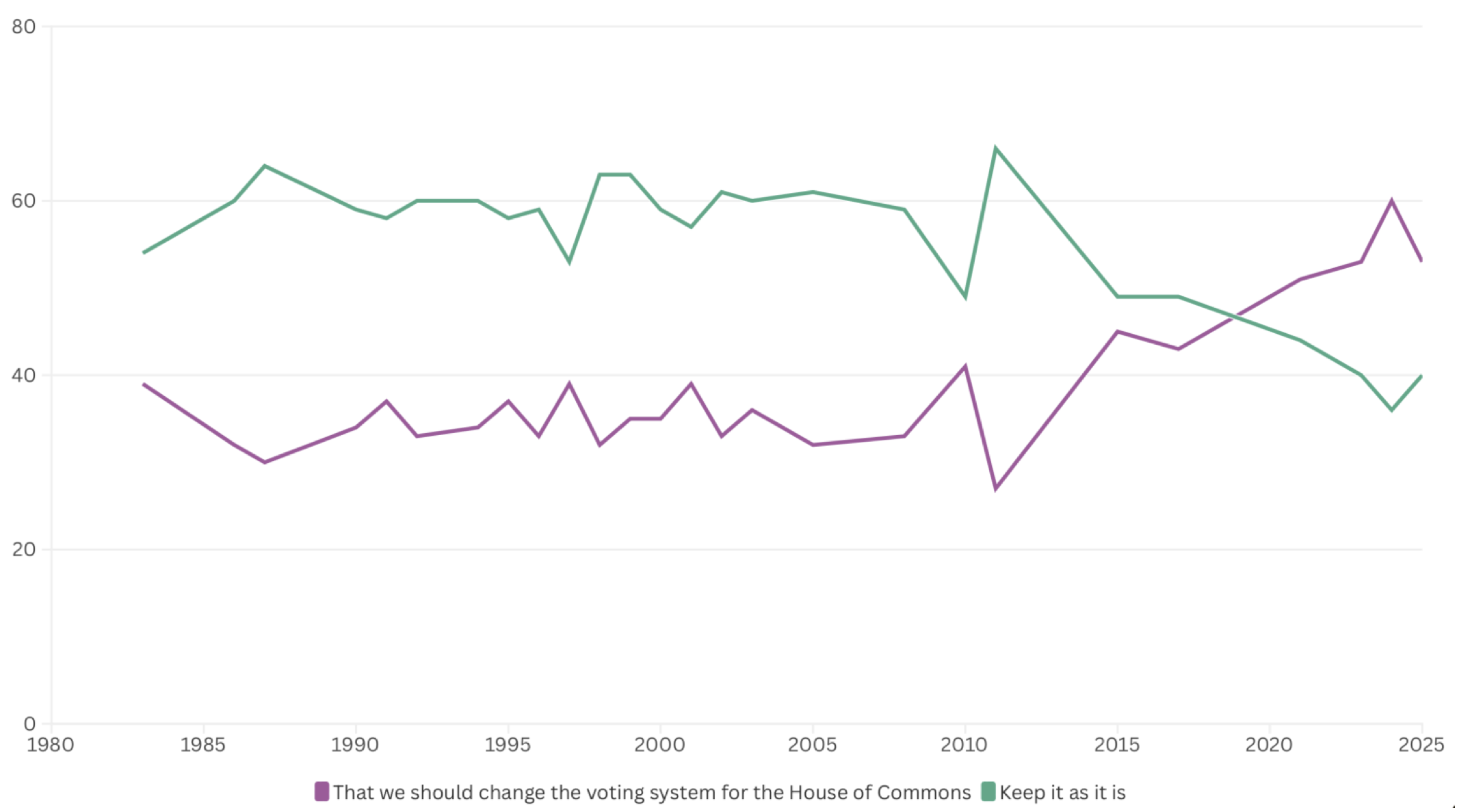
With Burnham as prime minister, it seems more and more likely that proportional representation is on the table once again. Contrary to 2011, the British public might actually vote for the implementation of PR this time. A survey conducted by the National Centre of Social Research last autumn found that more than half of respondents support proportional representation (see figure 2), a continuation of a steady growth of public support for replacing FPTP.
What happens if change doesn’t come?
As the adoption of proportional representation seems more likely than ever, the question arises what happens when FPTP remains and Britain does not leave the old electoral system. Is it possible that multi-party politics is here to stay for the long run?
The follow-up question to this is whether the level of fragmentation seen in the local elections last May has any historical precedent. The answer is mostly no, at least in the UK. It must be said that Duverger’s Law – the natural formation of two-party politics in FPTP systems – does not apply as rigidly to the UK as it does to, say, the US. Two-party politics in the US is especially durable, which seems to be explained by a number of factors. Some political scientists note the importance of a separately elected executive – the president – through the Electoral College, the higher legal barriers for new parties and the unique political culture, where regional parties are notably absent and party discipline is rarer than in most countries: the US historically has always had multiple different factions within the two dominant parties.
The UK has had elections in the past where more than two parties had a sizable share of the vote. The 1918 general elections is perhaps the best example, which took place under the most extraordinary of circumstances, as it was held a month after the end of WWI and marked the first time men over the age of 21 and women over the age of 30 could vote. The Liberal Party (later Lib Dems) had split into two and the Labour Party greatly benefited from the expanded electorate and successfully challenged the two dominant parties – the Conservatives and the Liberals – for the first time, while many votes in Ireland went to the Irish Nationalist parties. In the 1920s, when Ireland had partitioned and the Republic of Ireland achieved independence, the Conservatives, Labour and the unified Liberals (later Lib Dems) all maintained a vote share of at least 17% during each general election (see figure 3).
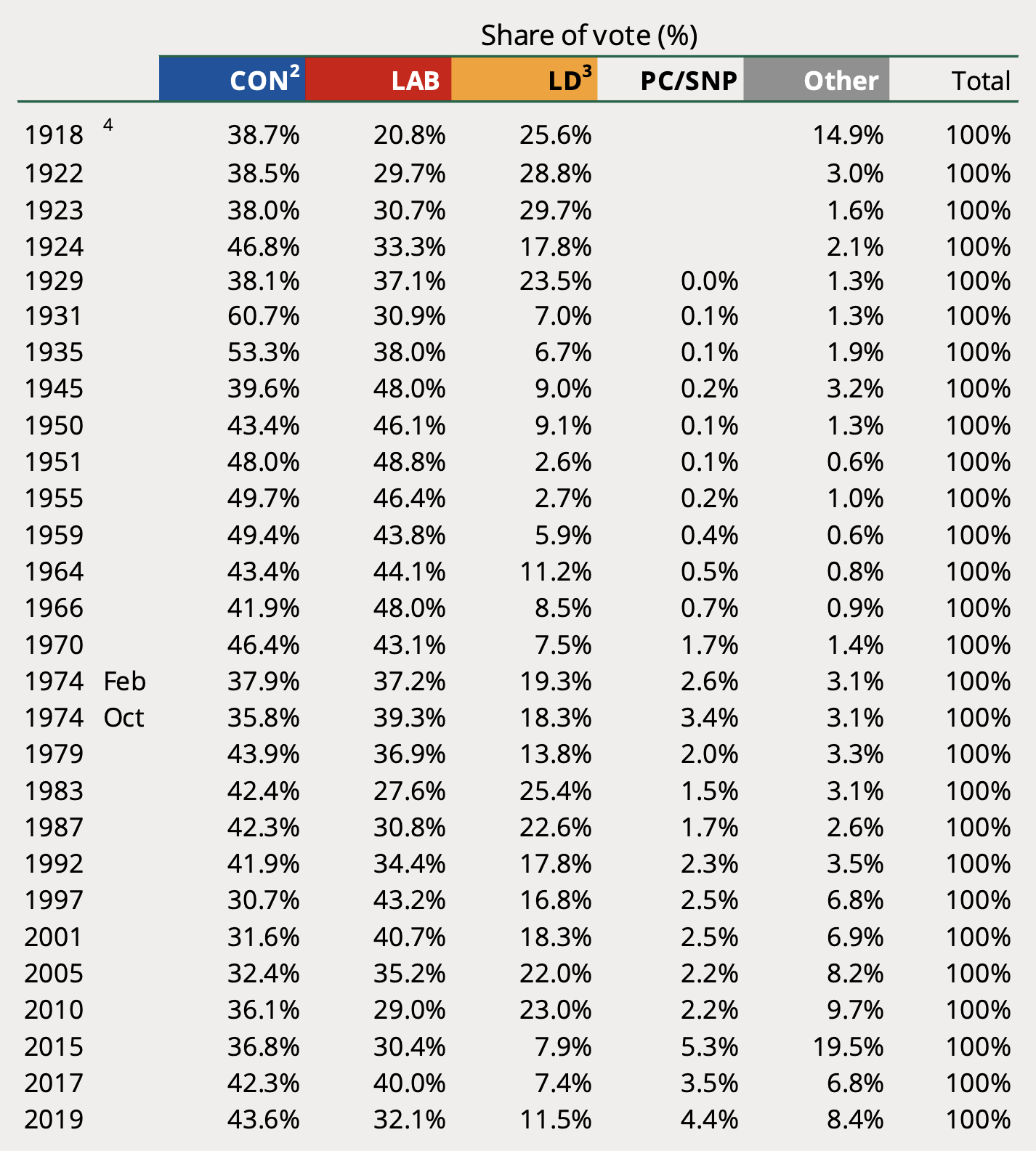
From 1931 onwards, a two-party system began to take shape that existed until 1974, when the Liberals and later the Liberal Democrats consistently acquired a sizable share of the vote. Despite this, seats in parliament were harder to come by for the Liberals in post-WWII Britain (see figure 4). In 2015, Farage’s UK Independence Party (UKIP), and to a lesser extent the SNP and the Greens received large percentages of the vote share, but this only translated into meaningful gains for the SNP in the House of Commons.
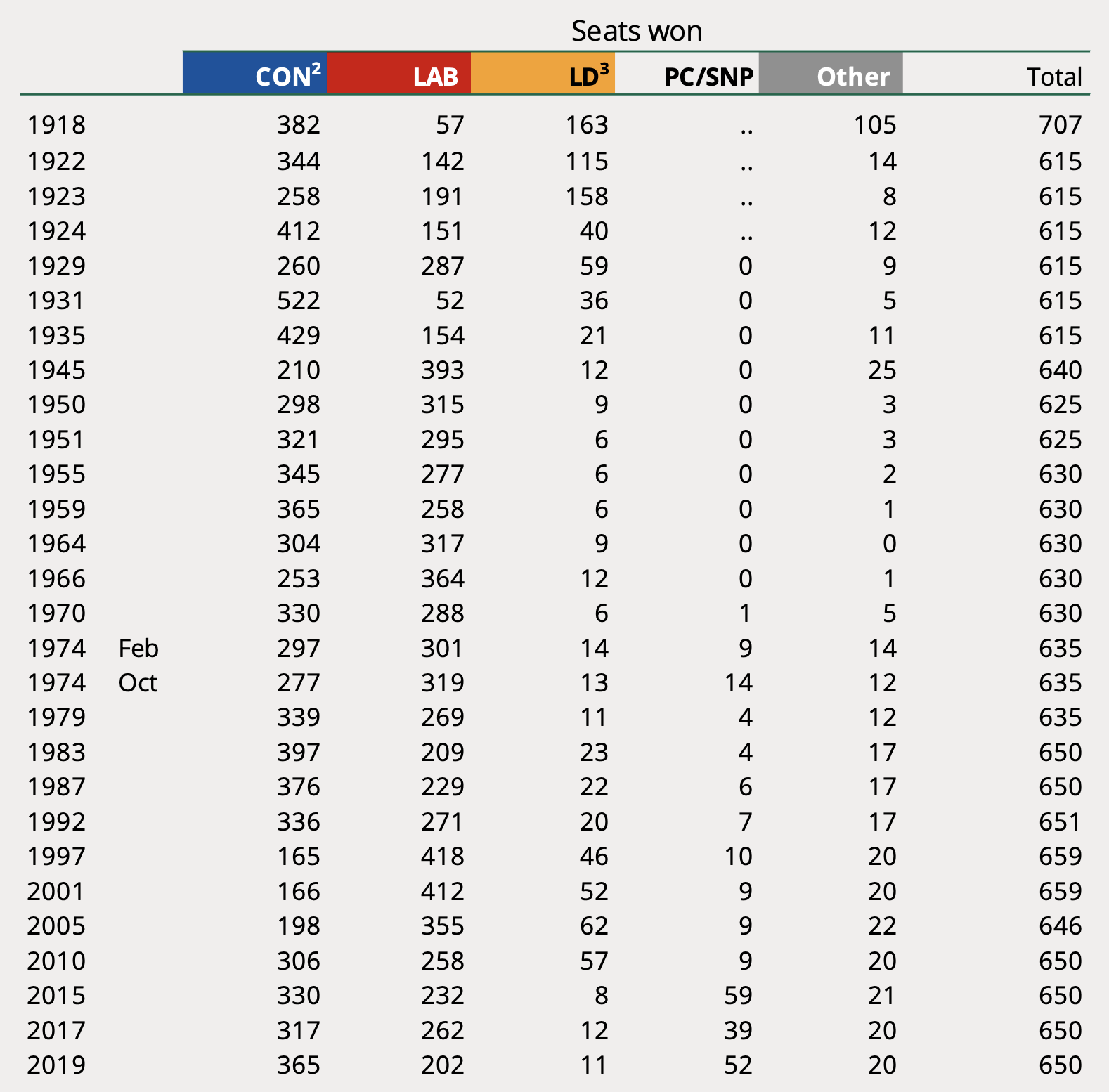
This is reflective of a trend in UK politics throughout history, where third parties who might have national appeal, struggle to gain many seats in Parliament, such as UKIP in 2015, who received 13% of the vote but only one seat. Those parties who have highly concentrated regional support (such as the SNP and Plaid Cymru), however, might be much more likely to have meaningful representation in the House of Commons.
Although elections have been held where three parties have had broad support nationally (or more in 1918), this has not translated into three large parties in Parliament. History tells us that three parties with broad national support do not all fit neatly in the House of Commons with the current FPTP system, let alone five parties having between 16% and 26% of the national vote share.
For historical precedents, one must look at other countries with FPTP systems. Canada has historically had more than two parties, where the dominant ones have often differed over time. Political scientists consider Canada to be the longest running case study of how Duverger’s Law can, in fact, be violated. Some theorise that this is because of the country’s distinct federalism and variation of regional institutions and some argue it is because multi-partyism has become deeply entrenched in the behaviour of Canadian voters.
One caveat must be noted here: Canada is no longer the exception. Canada had been a two-party system on the federal level throughout much of its history, until third parties steadily acquired more votes in the latter half of the 20th century. The 1997 election marks the year in which five parties had more than 10% of the national vote share, but throughout the 21st century, Canada returned to a two-and-a-half-party system – not dissimilar from the UK before this current multi-party era – with the Conservatives and either the Liberal Party or New Democratic Party (NDP) being competitive. In the 2025 election, the Liberals and the Conservatives dominated the vote, with the NDP receiving roughly the same amount of votes as the geographically concentrated Bloc Québecois. The lesson to draw from Canada is that multi-partyism in a FPTP system can occur, but is likely a temporary phenomenon.
There is no major democracy where actual multi-partyism has co-existed with a FPTP system on a more long-term basis nationally. In India, where many regional parties are represented in parliament, either one or two nationally-focused parties have dominated elections throughout its post-independence history. The US had essentially always been a two-party system throughout its 250 years of existence.
New Zealand had abandoned FPTP in favour of a mixed-member representation (MMP) system in a 1993 referendum, largely because of voters’ dissatisfaction with the disproportional results it created. Despite the change, two parties (National and Labour) have dominated general elections ever since, as it did before 1993. A similar phenomenon can be observed in Australia, where FPTP was already abolished in 1918 and its current voting system, proportional-ranked choice voting, adopted in 1948. This system is similar to the proposed system rejected in the 2011 Alternative Vote referendum. It did not prevent the Labor and Liberal parties from dominating the vote share of every election since then.
These examples indicate that the existence of two-party systems may also be explained by its pervasiveness in political culture and that two-party dominance might even last when more proportional systems are introduced. That said, the 2026 local elections have shown that a two-party culture has been broken in the UK, though this break is not irreversible.
Concluding remarks
The competition between five nationally-focused parties is unprecedented in UK political history. The future is therefore hard to predict. Some educated guesses for possible scenarios can be made, though. When electoral reform is adopted, which appears to currently have the support of every major party except for the Tories, a five-way split of the national vote will be reflected much more accurately in the House of Commons and elsewhere.
However, as seen in Australia and New Zealand, moving from first-past-the-post to a more proportional system will not automatically result in the definitive end of the two-party system. Judging from these case studies, there are reasons to believe that pre-existing party dynamics – a two-and-a-half party system – would likely have persisted, had the Alternative Vote been approved by the British Public in 2011. Nevertheless, party dynamics have altered independently of electoral reform. The important takeaway is that a continuation of these dynamics will be the most likely scenario, which is a five-way competition, though recent developments indicate not all hope is lost for the two traditional parties.
What is certain, is that the UK’s current voting system cannot accommodate five parties that each have widespread national support. More bizarre and disproportionate election results will follow, as was seen in the 2024 general elections and in the 2026 local elections. No major democracy has ever experienced a firmly embedded competition between four or five nationally-focused parties in a first-past-the-post system, and there is no evidence the UK will be an exception.
Disclaimer: While Euro Prospects encourages open and free discourse, the opinions expressed in this article are those of the author(s) and do not necessarily reflect the official policy or views of Euro Prospects or its editorial board.
Write and publish your own article on Euro Prospects
Subscribe to our newsletter – stay informed when we publish articles on pressing European affairs.