6 min read — Defence Industry | Military Affairs | EU Institutions
Is the Commission Finally Tightening the Leash on Schengen Border Controls?
The Commission’s new opinions acknowledge breaches across nine member states but stop short of declaring their border controls disproportionate or unlawful, leaving Schengen’s core promise unresolved.
By Matheus Maynard — Border Governance Correspondent
Edited/Reviewed by: Francesco Bernabeu Fornara and Wout Willemsen
July 14, 2026 | 15:00
A Decade of “Temporary” Controls
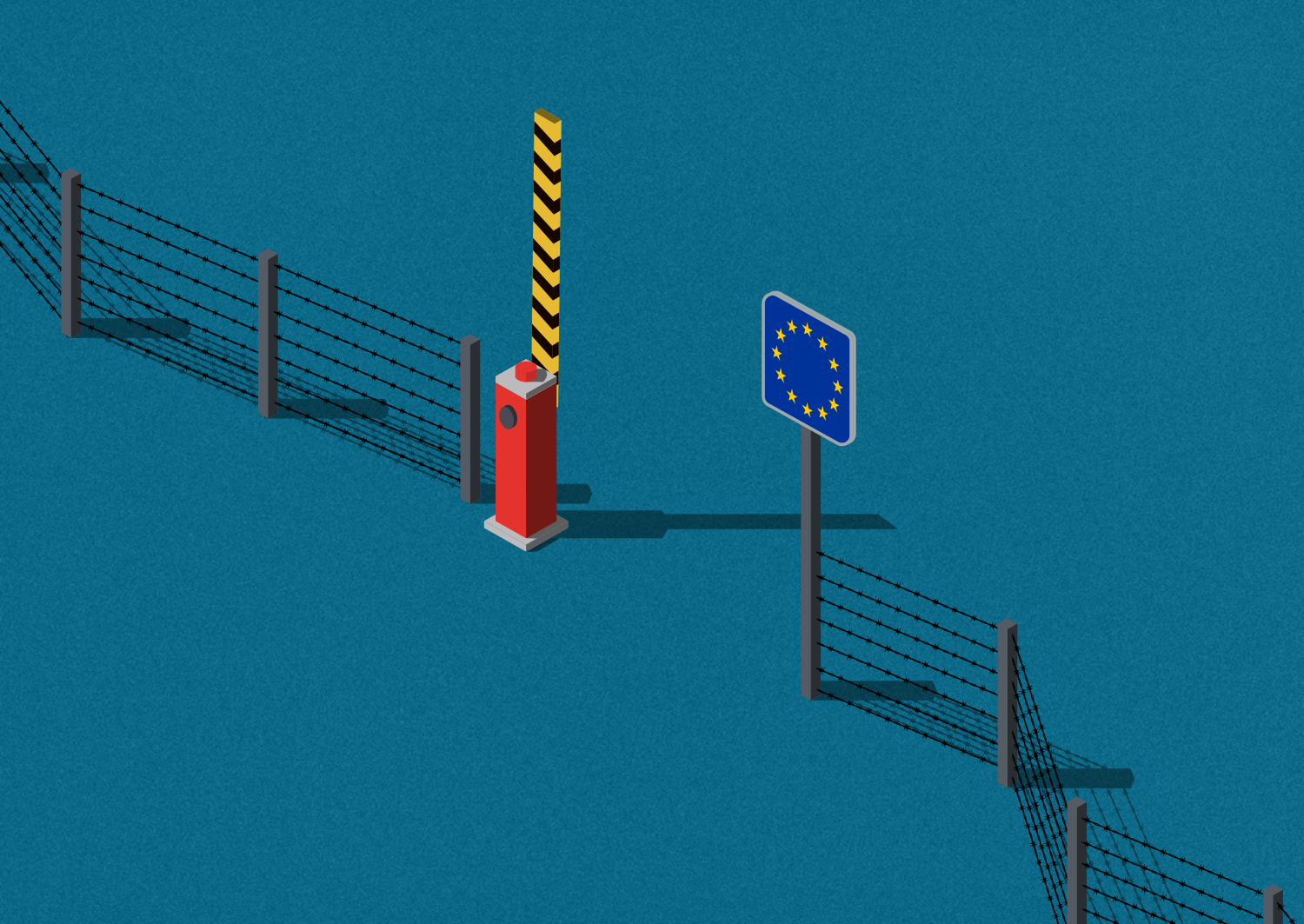
While borderless movement in the Schengen zone has been championed as one of the most tangible achievements of European integration, the reality of such has not been upheld in all Schengen members since 2015. With the 2015 Migration Crisis, some Schengen states have been activating, almost uninterruptedly, a mechanism for temporary internal border controls prescribed by Articles 25, 26, 28 and 29 of the Schengen Borders Code (SBC). Following several SBC reforms, the European Commission issued an opinion in June recommending that these member states gradually abolish internal border controls within the Schengen area.
The Commission’s opinion comes as a long-awaited intervention in a regime of border controls that has been causing financial hurdles within the European Union. It has also sparked significant controversy over the coherence of the bloc’s commitment to its pillar value of freedom of movement, and its flagship cornerstone, the Single Market. The Commission issued opinions specifically for Austria, Denmark, Germany, Norway and Sweden, which have maintained partial or full internal border controls almost uninterruptedly since 2015, as well as for France, Italy, Slovenia and the Netherlands.
The Legal Framework Behind the Mechanism
Since the inception of the Schengen Agreement, a mechanism has existed that allows the temporary reinstatement of internal borders in the event of emergencies and public security threats. The language of the mechanism has evolved into a robust and comprehensive legislative framework since its first signing in 1985. However, there are legitimate concerns that the last reform in 2024 was enacted to accommodate member states that have been using the mechanism beyond the scope and duration established by the SBC, thereby constituting a breach.
Under the reformed SBC, the articles’ overarching last-resort criteria are that reinstating border control should follow in response to a serious threat to public policy or internal security. The scope of threats includes terrorism, organised crime, major international events, and large-scale unauthorised movements. They now also include public health emergencies as a plausible threat, echoing the COVID-19 pandemic, during which most member states used the mechanism to limit intra-space mobility.
Within the codified 2016 version of the SBC, foreseeable-threat controls (Article 25) were limited to 30 days and were renewable in 30-day increments up to a six-month cap, immediate-action controls (Article 28) started at 10 days and renewed in 20-day increments up to a two-month cap, and exceptional-circumstances controls (Article 29) started at six months and renewed up to three further six-month periods to reach the two-year cap. The 2024 reform kept Article 29 unchanged, extended immediate-action renewals to a one-month initial period with extensions up to three months, and restructured foreseeable-threat renewals under Article 25a into six-month blocks renewable up to three times (two years total), with two additional six-month renewals available where a major exceptional situation persists, reaching three years total.
Secondary Movements and the Migration Justification
With the exception of the COVID-19 pandemic period, these controls have largely been justified on the basis of migratory flows and have been renewed extensively within that same scope, though with shifting emphases over time. The five countries, for instance, have extensively employed the term secondary movements, at times broadening it to encompass human smuggling and organised criminal activity allegedly occurring within these migratory flows. Secondary movements refer to the practice whereby asylum-seekers, required under the Dublin Regulation to await processing of their claim in the first country of reception, nonetheless attempt to cross into another Schengen member state.
This internal rebordering of the Schengen space is largely justified by migratory flows, which produce two critical challenges to the coherence of the European project. The first is a commitment to human rights, taken seriously and embedded in EU law, and freedom of movement is also a fundamental pillar of the project. It is interesting to note that the preamble of the 2016 version of the code, in recital 26, establishes that “Migration and the crossing of external borders by a large number of third-country nationals should not, per se, be considered to be a threat to public policy or internal security.” However, as part of the preamble, this is intended more as a guiding principle and is not legally binding.
While there are also significant deficiencies in the EU asylum system, member states appear to have taken upon themselves the task of protecting their internal borders from migrants. Since 2015, the EU has largely sat silent on these internal border controls, with some notable exceptions in which the Commission has sided with member states, but the Court of Justice of the European Union (CJEU) ruled against them.
Germany, Austria, and the Precedents of 2015
Germany set a precedent when it closed its border with Austria in 2015. Member states could rely on this mechanism to manage their internal borders in the face of the uncontrolled influx of millions of migrants. Prior to 2015, member states had primarily used the mechanism to enhance security at events such as sports tournaments, international summits, and other large-scale gatherings that could pose public safety risks.
In 2011, the so-called Franco-Italian affair was a controversial incident of internal border controls related to migratory flows. To cope with the high influx of Tunisian migrants who fled as a result of the Arab Spring. The Italian government issued these migrants residency permits in the hope that they would move to France, given colonial ties and the large, established Tunisian families and communities there. The French government, in response, imposed border controls and strained diplomatic relations across the Union.
Former French President Nicolas Sarkozy and Italian Prime Minister Silvio Berlusconi sent a letter to the European institutions asking the presidents of the European Commission and the European Council to consider France’s proposal for a temporary reintroduction of border controls and to open a more structured political debate on Schengen reform at the European level.
The 2013 reform of the SBC, however, did not incorporate the Franco-Italian demands. Regulation (EU) No 1051/2013 introduced common rules for the temporary reintroduction of internal border controls in exceptional circumstances, but it preserved the mechanism’s exceptional, last-resort character rather than granting states the broader discretion Sarkozy and Berlusconi had sought. The controversial aspect of the French-Italian affair did not set a precedent, given the political backlash it received. It was Germany’s closure of its border with Austria in 2015 that set the real precedent, opening the sustained pattern of internal rebordering that has persisted, in various forms, ever since.
This decision also came in direct contradiction with former German Chancellor Angela Merkel’s open-door policy to welcome over one million refugees. The border with Austria was reinstated in September, and Merkel’s open-door policy quickly started to crumble with internal political and social backlash in view of terrorist attacks that sent shockwaves in Germany and prompted political opposition to instrumentalise it against the Merkel administration. Internal border control practices remained; Germany parted with its open-door policies by mid-2016.
Pushback From the Court of Justice
In CJEU cases, the courts challenged how member states were utilising internal border controls. In Case C-444/17 (Préfet des Pyrénées-Orientales v Abdelaziz Arib), a Moroccan national was arrested near the French-Spanish border as France had imposed internal border controls with Spain, and the Court ruled that an internal border where control has been reintroduced can never be equated with an external border, so the Return Directive’s exception for irregular external-border crossings does not apply and the ordinary Return Directive procedure must still govern such cases.
In Joined Cases C-368/20 and C-369/20, an EU citizen was checked at the Austrian border with Slovenia and prompted to present identification. The court ruled that Article 25(4) of the SBC precludes a member state from stacking successive periods of internal border controls beyond the allowed duration, unless a new fresh threat arises to justify it. It also ruled that a state cannot penalise a person for not presenting identification during a border check that was reintroduced in violation of the six-month limit.
While these cases indicate some pushback, both Austria and France have continued with their internal rebordering practices amid broader discussions about the impact on freedom of movement and even rising economic costs of maintaining such controls. In the case of Austria, it is interesting to note that since 2011, when Liechtenstein joined the Schengen Area, Austria has had no external borders, yet remains one of the highest users of the mechanism.
The Hidden Costs of Border Controls
Specific figures on budgetary allocations for border management costs are hard to find, since funding schemes vary across member states and the domestic bodies responsible for them. In Austria’s case, border-related expenditures are absorbed into the Ministry of Interior’s general budget, making it difficult to isolate the cost of internal Schengen controls specifically. Still, the broader security budget context is worth noting: in 2023, Interior Minister Gerhard Karner told the Austrian Parliament that the Ministry’s budget had grown by roughly €1 billion to €4.1 billion, citing measures such as expanding the police force and acquiring new thermal-imaging vehicles for border protection. Whether or not this increase is specifically driven by maintaining internal border controls, it illustrates how difficult it is to disentangle the costs of internal rebordering from broader security and migration management spending, a transparency gap that itself deserves scrutiny.
Apart from increased border management expenditures, there are also largely unmeasured economic losses caused by border controls, especially in cross-border communities. A 2016 study by Øresundsinstituttet, an independent Danish-Swedish research centre that tracks the cross-border Öresund region, found that ID and border checks introduced in early 2016 cost commuters 6,660 extra hours of travel time per day, equal to 833 lost working days. Over the first six months of checks, that lost time added up to the equivalent of 666 full-time workers in Sweden, and 720 in Denmark. The study estimated the socio-economic impact of this: between 152 and 286 million SEK for those six months, rising to as much as 560 million SEK a year. Border controls introduced for security and migration reasons can indeed create socio-economic loss.
What’s at Stake for Schengen
Beyond financial costs, prolonged internal border controls have a deeper implication: free movement is not peripheral to the European integration project but one of its core freedoms. While the SBC maintains, through its amendments, the “temporary” characteristic of these border controls, the fact that member states have relied on them for nearly a decade, and almost uninterruptedly in some cases, calls into question the future of one of the core achievements of the European project: the Schengen Area.
While the Commission’s opinions acknowledge member state breaches of the SBC, the language is mild and carefully drafted. It mentions late notifications, missing crossing-point details, inadequate risk assessments, unexplained blanket controls, and even reports of direct turnbacks outside the readmission framework, but they stop short of concluding that any of the nine states’ controls are disproportionate, unnecessary, or unlawful. The recommendation to phase out internal border controls is justified by the new Entry-Exit System now fully operational and irregular crossings down roughly 40 percent; external border management has improved enough that these states should begin phasing out internal checks. Yet the Commission stopped short of ordering an end to controls, only recommending a gradual replacement with non-systematic checks, leaving the extent of genuine enforcement uncertain.
A decade after 2015, Schengen sits at an uneasy juncture. The legal framework has been repeatedly reformed to accommodate near-permanent controls, while their economic and social costs accumulate largely unscrutinised. Whether the Commission’s opinion indicates real change, or merely rhetoric, will depend on what happens when current authorisations expire later this year.
Disclaimer: While Euro Prospects encourages open and free discourse, the opinions expressed in this article are those of the author(s) and do not necessarily reflect the official policy or views of Euro Prospects or its editorial board.
Write and publish your own article on Euro Prospects
Subscribe to our newsletter – stay informed when we publish articles on pressing European affairs.