The AfD Won Two State Elections. What’s Next?
The AfD Won Two State Elections. What’s Next?
Despite polling success and victories in Saxony-Anhalt and Mecklenburg-Western Pomerania, the AfD will find it difficult to participate in future state – and federal – governments.
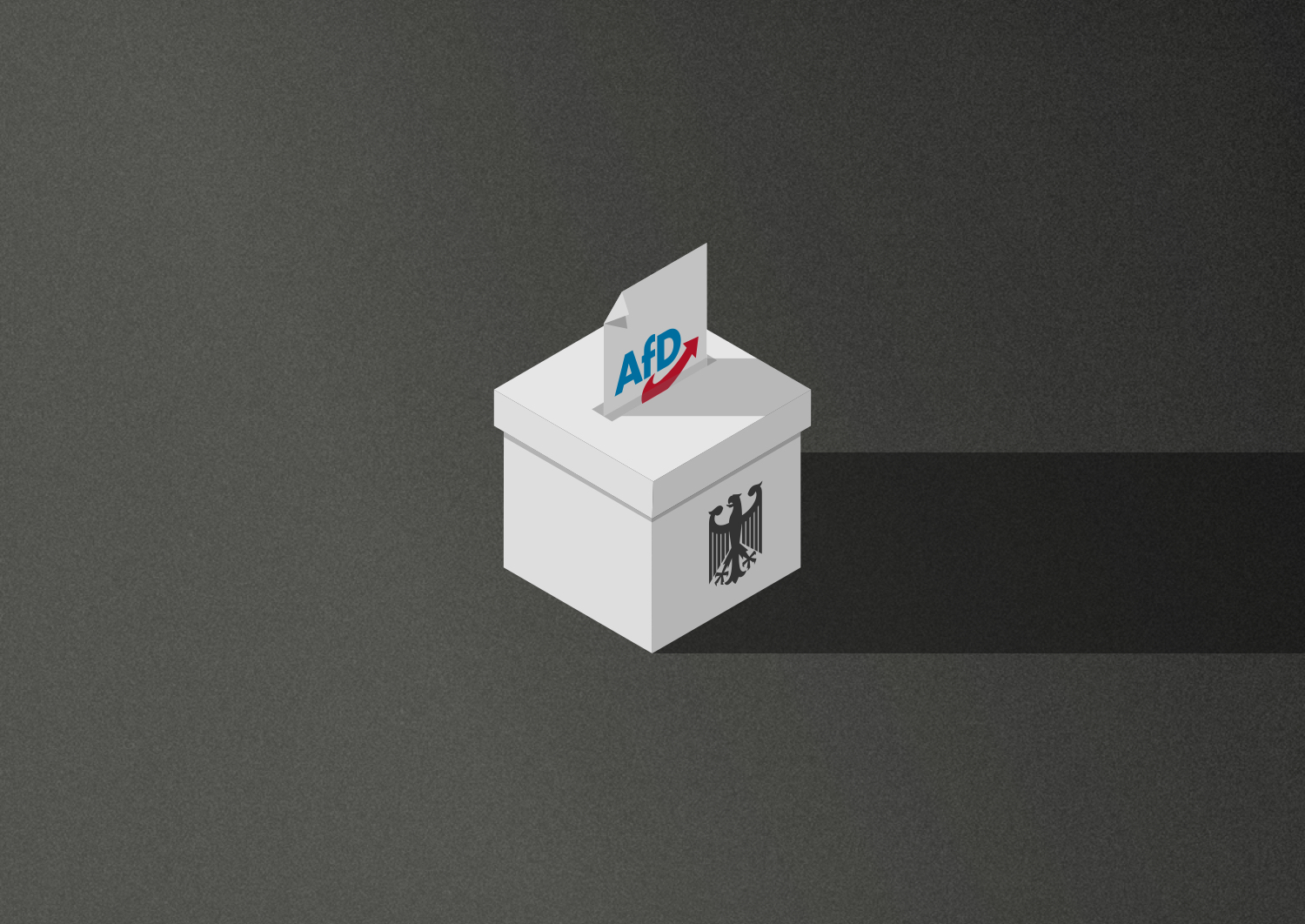
Image Credit: Euro Prospects
By Wout Willemsen, European Politics Correspondent
Edited by Francesco Bernabeu Fornara, Editor-in-Chief and Founder
September 18, 2026

Two weeks ago, the AfD won the Saxony-Anhalt state elections by a landslide. The party, led by the charismatic former perfume salesman Ulrich Siegmund, received 43.8% of the vote – just shy of an absolute majority. It is the AfD’s biggest electoral victory yet, but no absolute majority means forming a government in the state will be a tough task. Despite the AfD winning another election in Mecklenburg-Western Pomerania on Sunday, the AfD will likely not have another chance at claiming a place in a government in the near future.
Saxony-Anhalt
Two weeks ago, much of Europe’s attention was drawn to Saxony-Anhalt, a state that had formerly belonged to East Germany. The Alternative für Deutschland (AfD) – considered to be “extreme-right” according to Germany’s domestic intelligence service – would potentially participate in a state government for the first time in the party’s thirteen-year history. The AfD had previously never been able to do so, since all other parties in Germany have always maintained a so-called “Brandmauer” – literally translated as “firewall” – around the party, ruling out a government coalition with them.
The AfD has, throughout its history, maintained a steadily growing popularity in East Germany. The former border always reappears on election maps showing the party’s vote share. Now, with Chancellor Merz’s approval rating as low as 14 percent, the AfD has shot past Merz’s CDU in the national polls as well, now ranking first nationally.
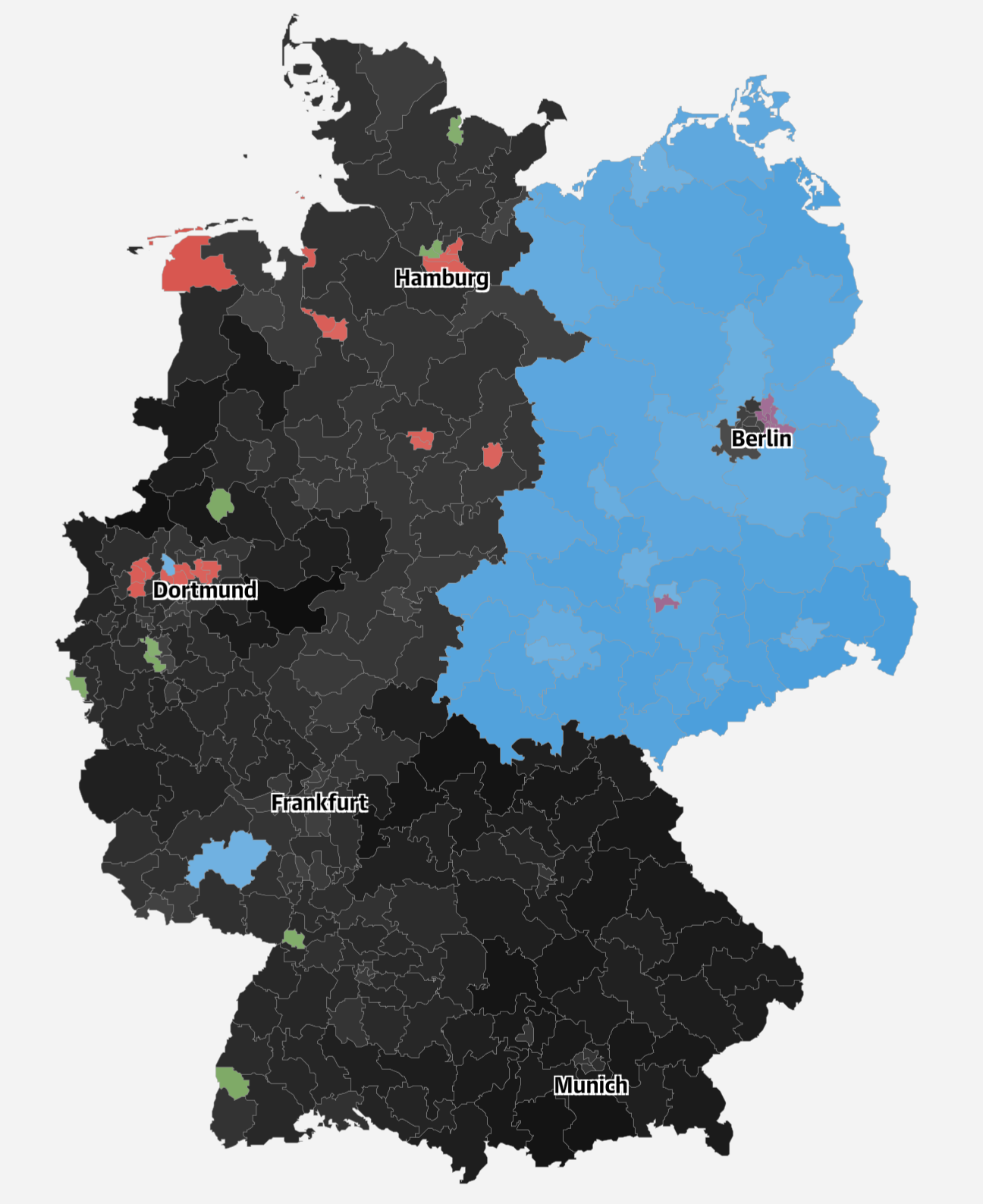
Largest party by constituency in the 2025 German federal elections. The AfD (blue) almost perfectly follows the borders of the former GDR. Source: The Guardian
Saxony-Anhalt is where the AfD is at its most popular, partly due to the efforts of the state party’s charismatic leader Ulrich Siegmund. Siegmund, contrary to some other AfD notables, appears – to his supporters – as friendly and approachable, regularly devoting his time to taking photos with supporters and shooting short clips on his TikTok account with over 19 million followers. He studied business psychology and made his living by selling fragrances to shops to influence consumer behavior.
He has appeared to have applied his sales craft to his political campaign, with poll numbers having suggested he could have even led the AfD to an absolute majority in Saxony-Anhalt – forcibly breaking the firewall. Much of the German and international press reported on the significance of the elections on the 6th of September. The weekly news magazine Der Spiegel‘s cover famously included a mugshot-style photo of Siegmund with the caption: “the most dangerous man in Germany”. A headline in the New York Times read: “German Far-Right Surges, in Threat to Postwar Taboo on Extremists in Power”. An article by Politico was titled “Germany Built a Firewall Against the Far Right. It’s on the Verge of Collapse.”
The AfD did not, however, achieve an absolute majority in Saxony-Anhalt. By just 0.3 percent, the left-conservative Bündnis Sahra Wagenknecht (BSW) party had barely passed the 5 percent threshold needed to get into the state parliament, thereby preventing its percentages from being redistributed towards the AfD. Sahra Wagenknecht, whose party combines left-wing economic policy proposals with socially conservative cultural views, declared shortly before the election: “We must break out of this ‘firewall’ idiocy, otherwise nearly one in two voters will feel betrayed.”
Two weeks after Saxony-Anhalt’s elections, the firewall is seemingly not down quite yet. Talks have started between the AfD and the BSW last week, but not for a government coalition. Instead, the BSW – led by state party leaders Thomas Schulze and Claudia Wittig – has opened the door for “Zusammenarbeit in Sachfragen”, or “cooperation on substantive issues” – a looser cooperation where the AfD forms a minority government in the state, with support from the BSW where both parties agree.
Despite being on opposite sides of the political spectrum, ideological overlap exists, such as on issues concerning Russia and migration. Yet, the ability to effectuate radical policy changes is limited. While a German state has much more autonomy than most regional governments throughout Europe, it is bound by many of the decisions taken on the federal level concerning migration and foreign policy, including ties with Russia and aid to Ukraine.
There seems to be an uneasiness among both parties about cooperation with each other. Signs of this were already apparent at election night, as Siegmund claimed he saw “no suitable coalition partners.” Indeed, there will be no coalition in the traditional sense of the word. Wagenknecht has also publicly distanced herself and her party from the AfD’s more radical positions.
Last week, Wagenknecht asserted that “a segment of the AfD seems to be terrified that, without the firewall, they would have to prove themselves on substantive issues”, accusing them of “torpedoing” talks. A focal point of negotiations rests on disagreement over a planned defense production facility for the Israeli defense contractor Elbit Systems in Saxony-Anhalt, which the BSW is staunchly against. Siegmund, however, has stated that he does not want to categorically scrap the planned defense facility, because “we will naturally need the appropriate tools for the upcoming remigration and deportation offensive.” The following day, Wagenknecht remarked in an interview that the AfD is full of “really weird people” and sharply criticized Siegmund’s claim he needed defense production for remigration.
Whatever the case, the AfD will not be part of a government with a stable majority. The BSW may cooperate on some issues, but may also work alongside other parties against the AfD in Saxony-Anhalt. It is a tough predicament for regional AfD politics. Siegmund cannot carry out his electoral promises as he wishes and will inevitably rely on the BSW for support – the only party that is even considering cooperation.
Mecklenburg-Western Pomerania
On Sunday, the AfD again received the most votes in another state election. Unlike the election in Saxony Anhalt, this latest election in Mecklenburg-Western Pomerania was not a landslide victory. With 38.2% percent of the vote share, the AfD managed to gather just a few percentage points above the SPD’s 35.5%. The election result’s focal point was the fact the CDU received just 4.9%, failing to pass the 5% threshold needed to have representation in the state parliament. This is a significant blow to the unpopular Merz, as his position as Chancellor has come under unprecedented scrutiny.
The AfD – as with all other parties – will now receive more seats in parliament (32 out of 71) than they otherwise would have if the CDU performed only slightly better. The other 39 votes are filled by the SPD with 29 seats, and the Left Party (Die Linke) and the Greens (Die Grüne) both with 5 seats each. The BSW – like the CDU – also narrowly missed the parliament threshold with 4.8% of the state’s vote share.
This means cooperation with both the BSW, who are engaged in cooperation talks with the AfD in Saxony-Anhalt, and the CDU, whose leader Merz had suggested in the past that cooperation with the AfD might be possible locally, is ruled out. As for all other parties, the firewall has withstood, backed by a reluctance to associate themselves or cooperate with the AfD. Beyond policy divergence, the party has been involved in numerous scandals – scandals that have even forced other European political parties on the radical-right to break ties with the AfD – in addition to being regarded by the German intelligence agency as extreme-right.
With the remaining three other parties both aligned along the left of the political spectrum and representing a majority in the Mecklenburg-Western Pomeranian parliament, there are no possibilities for the AfD to govern in Mecklenburg-Western Pomerania.
Next Chance: 2029
With the elections in Saxony-Anhalt and Mecklenburg-Western Pomerania wrapped up, the next state elections in AfD’s eastern strongholds are not until 2029. Ruling out the unlikely possibility of a snap-election, the next federal election will likely not take place before 2029, too. Despite mounting pressure on the unpopular Merz, the CDU and SPD want to continue their government for as long as possible.For them, calling an election with the AfD ranking first nationally would be an incredibly risky endeavour considering the stakes.
Over the next two years, there will only be state elections within the former borders of West Germany. Unlike the country’s eastern states, however, there is no former West German state where the AfD outperforms its peers, in spite of the fact that the party is most popular nationwide. The chances of the AfD participating in government are therefore slim. That is, unless a major established party decides to break the firewall themselves and cooperate with the far-right party. The gap between the AfD and the second-most popular party in other eastern strongholds is also nowhere near as extreme as in Saxony-Anhalt.
Conclusion
For now, the AfD’s only hope for participation in government is in Saxony-Anhalt. Even then, an AfD-led state government hinges on a minority in the state parliament, and the small BSW party has considerable influence over what does and does not pass the legislature. A narrow election win over the SPD in Mecklenburg-Western Pomerania does little to reverse the AfD’s exclusion from government in the state along the Baltic coast.
The next elections where the AfD appears to have a genuine shot at becoming the largest party will not come until 2029. A lot can happen in the meantime, but Saxony-Anhalt remains the only serious dismantling of the firewall for the time being, and it might only be partial.
Whether dissatisfaction with the status quo further fuels the AfD’s steady growth – who are still largely sidelined from decision-making – is pure speculation. It is similarly impossible to predict whether the AfD will ever be too large to ignore for other parties. At least for now, any decision to invite the AfD to government talks remains extremely controversial for any major German party, given its history of scandals and classification as extreme-right.
What remains certain is that absolute majorities will be unattainable for the AfD for the next three years, and the firewall – although weakened – will likely remain standing in all areas of Germany except Saxony-Anhalt in the near future.
Disclaimer: While Euro Prospects encourages open and free discourse, the opinions expressed in this article are those of the author(s) and do not necessarily reflect the official policy or views of Euro Prospects or its editorial board.
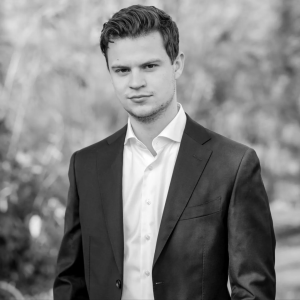
European Politics Correspondent
Willemsen is pursuing a Master’s degree in International Relations in a Historical Perspective at Utrecht University and holds a Bachelor’s in European Studies from The Hague University of Applied Sciences. Raised in The Hague, he focuses on analyzing national politics across European countries, tracking opinion polls, election results, and political developments while contextualizing them within Europe’s broader historical narrative.
Edited by Francesco Bernabeu Fornara | Follow our European journalism