Good Italian, Evil German: Two Fascist Pasts, Two Far-Right Futures
Good Italian, Evil German: Two Fascist Pasts, Two Far-Right Futures
Two far-right parties, but two very different political situations. What does history have to do with it?
Image Credit: Euro Prospects
By Kitty O’Connor Morse, History Correspondent
Edited by Kristóf Hermann, Hungary Correspondent
5 September 2026

Giorgia Meloni, Italy’s Prime Minister, leads the country’s radical far-right government. She utilises language and policies reminiscent of Mussolini’s era, yet maintains a strong position in Italian domestic politics. In Germany, the far-right party Alternative für Deutschland (AfD), is comparatively politically isolated. They are unable to create coalitions and generally not taken seriously by the political establishment and the media. Both draw on the same far-right traditions, but one governs and one is shut out.
This divergence is no coincidence. It comes down to the construction of historical narratives and the ways in which these shape national consciousness and understandings of the past. Both countries have a history marred by fascism, but these pasts were explained by historians in two fundamentally different ways. The myth of the ‘Good Italian’, and its nefarious counterpart, the ‘Evil German’ has shaped postwar understandings of each nation’s fascist past in ways that continue to influence who is permitted to hold power today.
The Making of a Myth
In 1922 Benito Mussolini and his fascist government came to power. In 1933 Adolf Hitler was made Chancellor, and by March the Nazis had consolidated definitive control over the German state apparatus. Both regimes abolished free elections. Both utilised violent paramilitary groups, promoted nationalism, and engaged in brutal expansionist and occupational policies before and during the Second World War.
In the history books, however, one nation comes across significantly better than its fascist counterpart. One nation was a victim of fascism, one was the poster child of fascism. For one nation, fascism was a ‘dark parenthesis’ in its liberal tradition. For the other nation, fascism was an inevitable outcome of centuries of history.
Out of this developed the myth of the ‘Good Italian’ and the ‘Evil German’. Italian historians, elites, and politicians promoted the narrative that fascism was something that the Italian populace ‘survived’, rather than something that they ‘did’. The German invasion of Italy added another layer that Italian historians embraced. They were now also victims of Nazi aggression, a narrative that became all the more compelling with the treatment of Italian civilians and soldiers by the Wehrmacht. What these narratives conveniently left out was the two decades of fascist rule that enjoyed genuine popularity or passive complicity. Germany took a different approach. The postwar historians, philosophers, and political scientists of Germany emphasised the collective responsibility and guilt of the nation. They stressed the need for every individual to come to terms with the role that they played in Nazi atrocities, no matter how big or small.
The Uneven Reckoning
The two myths began to take shape almost immediately after the war. A cornerstone of the ‘Good Italian’ myth arose from the Nuremberg trials, and lack thereof of an Italian equivalent. German criminal accountability was presented for the world to see, cementing an image of Nazi Germany, rather than fascism in general, as the singular architect of wartime atrocity. Italy’s record was also brutal: the use of mustard gas in Ethiopia, civilian massacres in the Balkans and Greece, and the existence of the Larissa concentration camp in Greece. Yet Italian war criminals faced little to no prosecution, at home or abroad. While some individuals were initially arrested, all were eventually released. The Togliatti Amnesty deepened this pattern. It pardoned and reduced sentences for fascists and partisans in the name of national unity which disproportionately benefitted the fascists.
As Germany reeled from the reality of the Third Reich, several strands developed in the historiography. Initially after the war, many wanted to completely forget what had happened during the Nazi period, while others argued that they were merely powerless pawns in a totalitarian system. In the 1950s, history textbooks highlighted the suffering felt by the German populace during the war and assigned guilt to Hitler and a small group of his supporters. However, by the mid-1960s German historians began to take an approach that prioritised collective guilt (Kollektivschuld) and a desire to come to terms with the past (Vergangenheitsbewältigung). These concepts promote the idea of a shared responsibility for the Holocaust and other Nazi crimes amongst the entire population. Only by reckoning with the past would Germany be able to build a future grounded in peace and accountability. From the 1960s, history textbooks explored topics such as German support for the Nazi party, the extermination of the Jews, and the existence of concentration camps – unsavoury but necessary topics to acknowledge and impart on the younger generation. These concepts continue to be taught today for the generations much further removed from Nazism, with mandatory education on the rise of National Socialism cementing awareness for the crimes of their shared past. No similar concepts or acknowledgement exist within Italian historical thought. Instead, the history prioritises narratives of resistance, victimhood, and the decency of the Italian soldier in comparison with his Nazi counterpart.
Ultimately, these diverging narratives have produced two opposing national mythologies. And this accountability, or lack thereof, has political consequences that reverberate to this day.
Power and Exile
Looking at the modern political landscape of Italy and Germany, these mythologies have not remained confined to textbooks but have shaped the degree to which far-right parties are given political legitimacy. Fratelli d’Italia (FdI), is Italy’s ruling party and is currently part of a coalition between Lega, a far-right party, and Forza Italia (FI), which sits on the centre-right. The FdI has been described by political scientists and the media as a far-right, national-conservative party, with extremist roots, and is a successor to the Movimento Sociale Italiano (MSI) – a neo-fascist party established in 1946 by supporters of Mussolini. The FdI utilises the same logo as the MSI, a tri-colour flame, and the FdI’s leader and Italian Prime Minister Giorgia Meloni has invoked the traditionally fascist motto ‘God, family, fatherland’. Despite its overt links to Italy’s fascist past, the FdI enjoys a significant degree of political legitimacy, operating not as a fringe organisation but as the dominant force in Italian domestic politics – proof that within Italy, association with fascism does not pose a meaningful barrier to access to power.
In Germany, the situation is markedly different. In a recent study, 76% of the population explicitly reject far-right beliefs, and the largest far-right party, Alternative für Deutschland, is somewhat of a political pariah hindered by a political firewall (Brandmauer). This is a policy of non-cooperation and political exclusion against the far-right: mainstream parties across the political spectrum refuse to join coalitions with the AfD and motions or candidates proposed by AfD are often blocked by other parties to prevent them from gaining political legitimacy or influence over policy outcomes. A coalition with the AfD would have secured a majority in Germany’s federal elections in 2021 and 2025. This option was never seriously entertained by politicians and media. In Thuringia local elections, the AfD were frozen out despite receiving the most votes in favour of an ideologically disparate coalition of the CDU, BSW, and SPD. Not only do the political establishment isolate the AfD, as a result of being labelled ‘confirmed right-wing extremists’ in 2023, they have also been placed under surveillance by the intelligence apparatus who utilise informants and phone tapping. Their rhetoric is also policed in ways that are not seen in Italy. Like Meloni, an AfD politician, Björn Höcke, has used a slogan associated with Germany’s fascist past. Unlike Meloni who faced no legal consequences for evoking fascist rhetoric, he was fined €13,000 in 2024 and €16,900 in 2024 by a German court for saying ‘Everything for Germany’ (a phrase associated with SA stormtroopers) at two separate rallies.
The Legacy of Responsibility
Why is the far-right received so differently in modern-day Italy and Germany, and how do these persisting historical narratives explain this divide? The fact is that the narrative construction in Italian and German histories provides fundamentally different understandings of guilt, responsibility, and accountability.
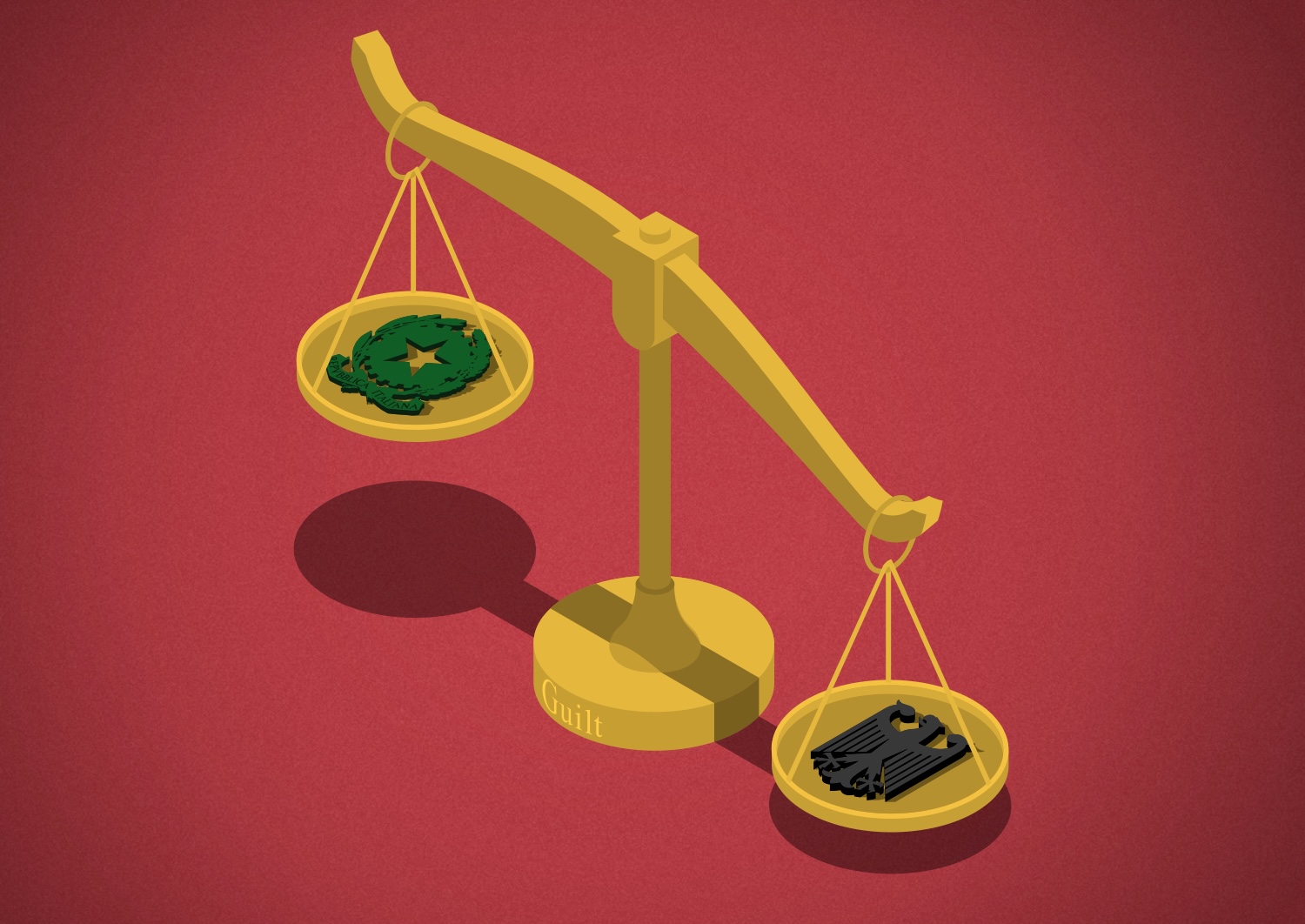
In German historiography, guilt was assigned to both the collective and the individual, whether that be through criminal culpability, political accountability, or moral complicity. This underpinned the idea of collective guilt (Kollektivschuld): that this was a debt owed by the entire population. Despite the fact that there were millions of Germans who were never Nazis or even held anti-Nazi beliefs, the lessons taught in the postwar period demonstrated that passive complicity was not enough – active resistance is needed in order to stop the dangerous slip towards far-right violence. The Italian historiography did the opposite, assigning culpability to Mussolini and a small group of elites – essentially recasting the Italian population as victims of fascism, rather than those driving and legitimising it. The difference in where guilt sits within historical conscience explains the difference in who inherits political legitimacy today. In Germany the blame lies with the individual, meaning any individual, Höcke included, must face accountability for engaging in the ideology and rhetoric of their fascist past. In Italy, however, because the responsibility was assigned to a small and specific group of individuals, Meloni operates outside of that sphere of responsibility and can evoke the language and symbols of Italy’s fascist past with far more freedom.
Crucially, the assignment of guilt has led to varying levels of introspection within each population. In Italy, the avoidance of accountability means there is less self-reflection, less willingness to look inwards and analyse: how did this happen before and how can we prevent this from happening again? The path to fascism and its legitimisation that was facilitated by countless ordinary Italians, becomes blurred and obscured by a historical narrative that makes no effort to understand the role of the individual and their culpability, however big or small this may be. This lack of reckoning allows figures like Meloni to thrive. If one believes fascism was carried out by a small group of unrepresentative individuals almost a century ago, then alarm bells don’t sound when a modern politician echoes their policies or language. The myth insists that the responsibility was something that the wider population, both then and now, could never inherit. The firewall (Brandmauer) strategy represents quite the opposite. The assignment of collective guilt and responsibility in Germany has shaped an instinct, especially amongst the political establishment, that political engagement carries responsibility for what the system produces: one cannot reap the rewards of a system and not hold itself accountable to its failures. Therefore, it is up to every citizen to take an active stand against the far-right, in the hope that they can prevent the mistakes of their predecessors from being made again.
Inheriting Power, Not Guilt
Education leads to introspection, which in turn leads to a deeper understanding of how individuals legitimize dangerous ideologies. The historical narratives, built nearly a century ago, still hold power. As we move further away from the Second World War these myths have become steadily, and stealthily, embedded in each nation’s sense of itself. While Italian historians of the twentieth century have begun to explore their fascist past, they are far from engaging with the wholescale reckoning of the past that occurred in Germany in the postwar period. Until this reckoning happens, the myth of the ‘Good Italian’ and its passive role within fascism will continue to shape what is politically permissible today, allowing the far-right to inherit power without inheriting guilt.
Disclaimer: While Euro Prospects encourages open and free discourse, the opinions expressed in this article are those of the author(s) and do not necessarily reflect the official policy or views of Euro Prospects or its editorial board.

History Correspondent
Kitty is a History MA graduate based in the Netherlands. Originally from the UK, she completed her MA at Leiden Universiteit where she specialised in Politics, Culture, and National Identity. She is primarily interested in the ways in which we can utilise historical narratives to better understand current political and geopolitical situations. Her work explores the legitimisation of regimes through forms of soft power, human rights issues, and the rise of the far right in Europe.
Edited by Kristóf Hermann, Hungary Correspondent | Follow our European journalism