Inside the EU’s New Border System That Answers to No One
Inside the EU’s New Border System That Answers to No One
Airport queues of up to two hours are not a rollout glitch. The EU’s new border system issues have no clear culprit.
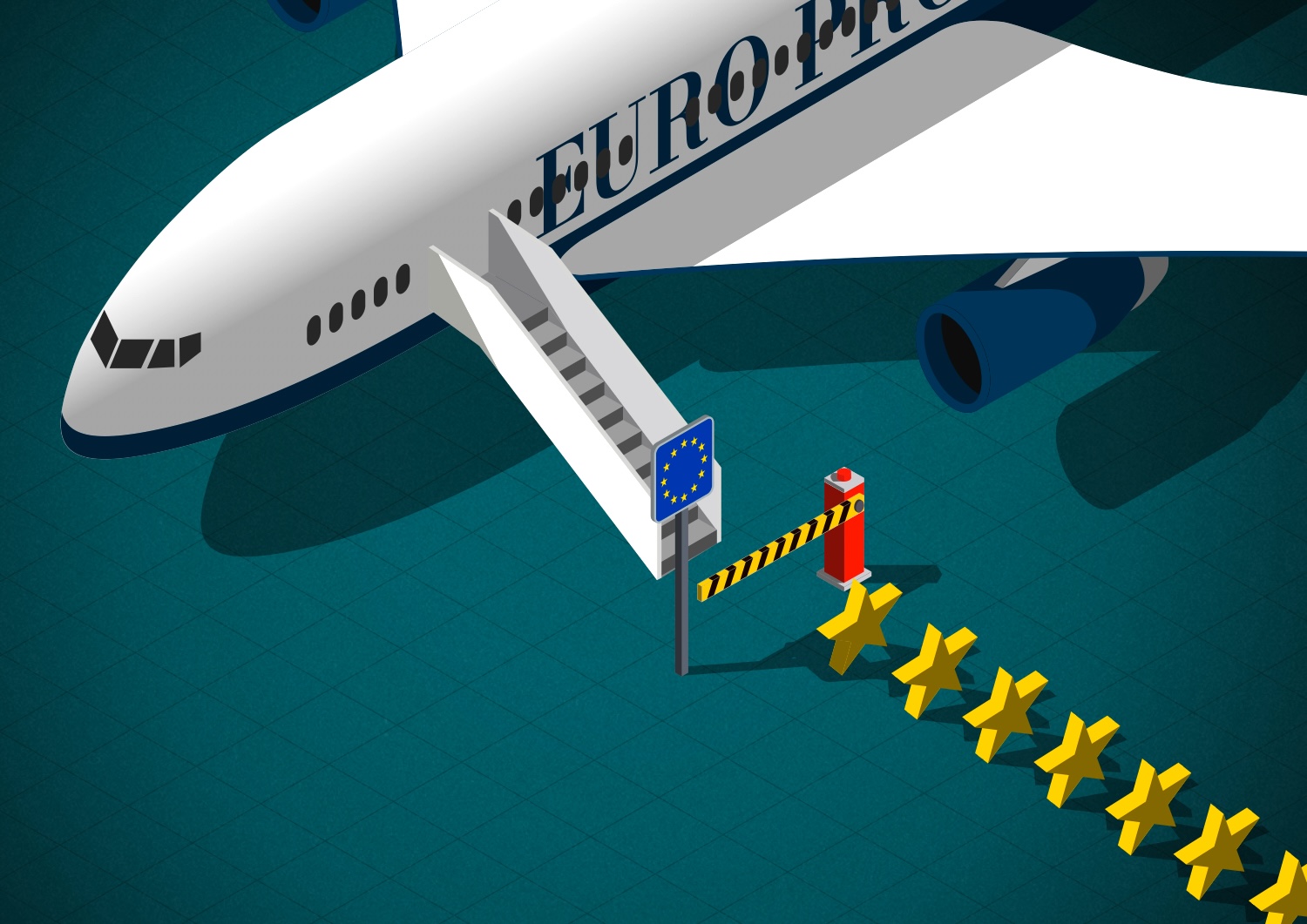
Image Credit: Euro Prospects
By Matheus Maynard, Border Governance Correspondent
Edited by Aurelia Leertouwer, European Politics Correspondent
3 September 2026

Since the EU’s Entry/Exit System (EES) became fully operational on April 10, 2026, travelers across Europe have faced queues of up to two hours at some airports, and passengers have been missing connecting flights. The World Travel and Tourism Council estimates the disruption could put up to 41 million arrivals and $45.4 billion in visitor spending at risk this year alone. But the chaos is not a rollout glitch that better staffing will fix. It is the predictable result of a single EU legal mandate executed through 29 national systems of uneven capacity, each failing in its own way, and each failure now feeding a blame chain to which no single actor can be pinned.
The EES has been in the works since 2016, when the Commission first proposed it to modernize the EU’s entry system for third-country nationals. This integrated and automated registration system replaces the manual stamping of passports and enables the automatic detection of overstays, identity fraud, and other potential security issues by storing a person’s biographic information and biometric data, and by registering their travel data in an integrated database.
After years of delays since its official adoption in 2017, the system was launched on October 12, 2025, with full implementation planned for April 10, 2026. However, since its full implementation was ahead of the summer months, European airports, ports, and border crossing points have experienced long queues, lasting often for many hours.
Four Borders, Four Different Failures
The issues reported at multiple border crossing points with the EES are often unrelated to each other, which indicates substantial, deeper failures across multiple aspects, including operations, system design, and implementation. In Portugal, Lisbon Airport had to suspend the EES entirely for three months during the winter after queues reached past seven hours, reverting to manual stamping and processing of border crossings. The suspension was lifted in March 2026, but Portugal’s main airports still operate on a congestion-pause mechanism that allows for the temporary pause of the EES system for the manual process whenever a queue runs too long.
Another major issue was reported in France, but of a narrower nature: the Parafe e-gates at Paris Charles de Gaulle and Orly airports were malfunctioning under EES rules through the first several months of the rollout. The e-gates are built around facial recognition, to allow automated processing to select non-EU nationalities, such as US and UK citizens. French border police partially reopened the gates to UK and US residency-card holders in late May, and some airports now wave through short-stay UK and US passport holders during surges, but access still varies airport to airport, and full biometric capture at the EES kiosks remains unreliable months after the deadline. A fix that arrives unevenly, airport by airport, without a public account of the criteria, is its own kind of failure.
Crossings at the English Channel into France have also experienced problems, but this one is of a structural nature rather than a technical one. Dover, Eurotunnel and Eurostar’s St Pancras terminal operate under the Le Touquet Treaty’s juxtaposed-controls arrangement, which establishes that French border police run Schengen entry checks on UK soil. Months after the April 10 deadline, operators at all three crossings were still registering passengers manually, because the software link to French systems was not ready. A border architecture built for a different era of cooperation is now the bottleneck for a new one.
Then, there is a fix that nobody uses: Frontex built a voluntary pre-registration app, Travel to Europe, specifically built to relieve pressure at the kiosk. Sweden adopted it the fastest, and Portugal followed suit but only partially. As of this summer, most EU member states have not integrated it at all. Whether this tool is fully functional and can deliver on its promise is hard to predict, as its rollout is minimal so far. Yet, an alternative has been in place, and despite its limitations, most national authorities have largely failed to adopt it.
There have been multiple reports from various airports and border crossing points relating to similar delays: Financial Times and Qsensor data for July found average waits at Frankfurt Airport had doubled to 120 minutes from 60 the year before, with peak waits at Amsterdam-Schiphol Airport rising from 80 to 120 minutes, and at Munich Airport from 31 to 60 minutes. Brussels Airport and Milan-Malpensa Airport have switched off the EES system under the same congestion-paused mechanism used in Portugal.
Airports Council International Europe (ACI Europe) was already warning in December, when only 10 percent of eligible travelers were being registered under the phased rollout, that processing times had increased by up to 70 percent with three-hour peak waits, a floor, not a ceiling, for what followed once full implementation of the EES took place in April. Many major Schengen entry points are running some version of this failure; Portugal, France, the Channel crossings and the Frontex app just happen to show its four distinct mechanisms most clearly.
Passing the Blame Along
Each of these failures and delays has produced its own excuses, and these excuses do not point at each other so much as they point away from everyone. European Commissioner for Home Affairs and Migration Magnus Brunner, in a letter to aviation executives obtained by the Financial Times, attributed the delays to factors described as unrelated to the EES itself, pointing instead to insufficient staffing and inadequate infrastructure at the national level. Brunner emphasizes that the system itself functions well.
National governments have a different interpretation of the same facts. The flexibility clause that Brussels wrote into the EES rules, which allows member states to pause the EES biometric collection when queues become overwhelming, is treated by several governments not as a safety mechanism, but as an admission that the system itself is ineffective. The clause expires in early September, which means that this argument will no longer be able to be held as justification for the situation. However, the EU is now considering extending this mechanism. The agency building the EU’s next border layer is already repeating this pattern. eu-LISA, which manages the EES alongside the forthcoming ETIAS travel authorization system, has privately concluded that a 2026 launch is no longer realistic. Brunner pointed to the same causes for the ETIAS delay that he cited for EES: understaffing and inadequate infrastructure at the national level.
A Structure that Diffuses Responsibility
None of this is a coincidence, and that is precisely the problem. The EES was built as an EU regulation, to be executed uniformly across 29 national administrations that are part of the Schengen Area, on IT infrastructures partly built and maintained by an EU agency. This three-layer structure means every actor’s excuse is individually plausible: the Commission can point to national staffing issues, national governments can point to Brussels’ own flexibility clause and system design flaws, and eu-LISA can point to problems stemming from both. None of these claims can be falsified either, not because no actor here is bound to disclose anything (eu-LISA, for instance, is legally required to publish quarterly and annual EES statistics, covering refusals of entry, revoked or extended stays, and fingerprinting exemptions), but because none of that mandated reporting touches the specific data that would let outsiders check the story: checkpoint-by-checkpoint queue times, member-state staffing levels, or independent infrastructure-readiness assessments.
By eu-LISA’s own account, it “eu-LISA only publishes the statistical data sets mandated by the EU regulations and provided by the Member States”, and queue times and staffing are not among them. There is no EU-wide, checkpoint-by-checkpoint queue-time metric. There is no public accounting of which member states have adequately staffed and have adequate infrastructure to properly roll out these changes. When EU officials describe only 20 of roughly 1,500 border crossing points as genuinely difficult to manage, the number becomes impossible to independently verify. As such, unverifiable numbers are exactly what a structure like this one is designed to produce. This is not a system with an accountability gap; it is a system with an architecture that makes accountability structurally unassignable.
Disclaimer: While Euro Prospects encourages open and free discourse, the opinions expressed in this article are those of the author(s) and do not necessarily reflect the official policy or views of Euro Prospects or its editorial board.

Border Governance Correspondent
Matheus is a Brazilian researcher specializing in Schengen border governance, migration, and European Union politics. He holds a master’s degree from the Erasmus Mundus programme in European Politics, Culture and Society, and studied Journalism and International Relations in the United States. His work focuses on migration policy, border management, European integration, and the political dynamics shaping mobility and security across Europe.
Edited by Aurelia Leertouwer, European Politics Correspondent | Follow our European journalism