Gotta Digitalize’em All: The EU’s League of E-Government
Gotta Digitalize’em All: The EU’s League of E-Government
Brussels has built the rulebook for digital government, but not every member state is playing by the same rules.
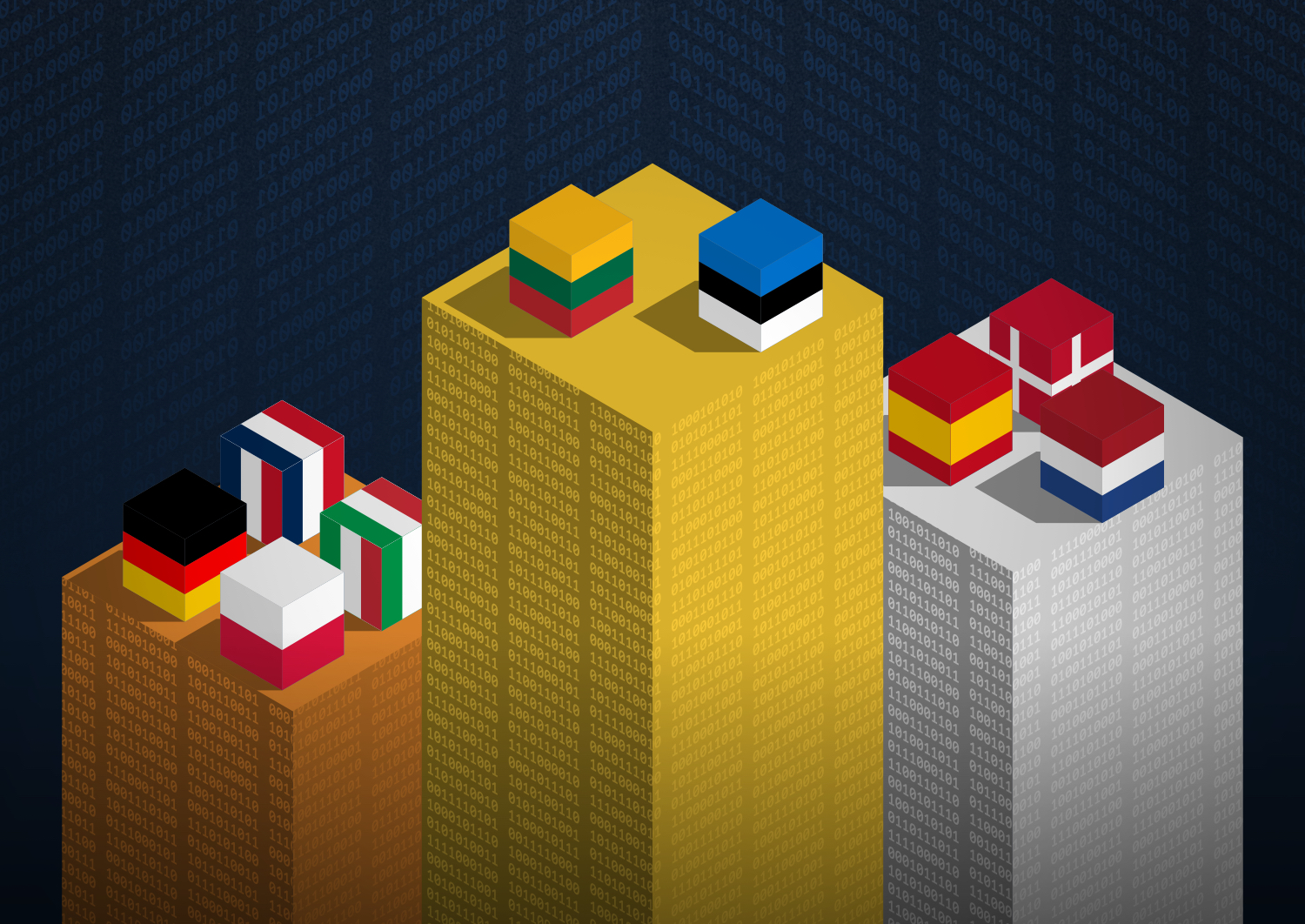
Image Credit: Euro Prospects
By Nuno Dias Pereira, Finance Correspondent
Edited by Ofelia Dournel, EU Affairs Correspondent
22 August 2026

In an ever more digitised world, the European Union aims to create a single market, leveraging its size and power to better serve its citizens.
But, much like the Pokémon world, though every player is limited by the same rulebook, each member state can approach it differently — some obsessed with raw power, others with speed, others with cunning.
Europe’s digital government landscape works much the same way, with each member-state offering its citizens a widely different digital experience.
Welcome to the Pokémon World: Defining E-Government
It’s important to start by clarifying that Digital Government, or e-government, is not merely the IT necessary for the continuation of government. It’s the actual full adoption of information and communication technologies into a government’s strategies, in order to add value to its citizens. Such added value is achieved through the modernisation of existing workflows, replacing paper-based methods with smoother online processes, as citizens and institutions, now digital natives, become more demanding of both the service quality and their level of participation.
However, for how easy e-government is seemingly defined, it contains a whole universe of approaches that governments can decide to employ when launching into such an adventure.
Choosing Your Starter: The E-Government Typology
When faced with the starting point of E-Government, any given government is faced with multiple choices, all limited by the resources at its disposal.
On the one hand, a government may approach it considering the different types of services it may wish to make available:
- Informational services – making information available and consultable by interested users, such as research of government benefits and resources, legislation, among others
- Transactional services – making administrative requirements and workflows fully available through digital channels, such as submission of official forms, payments, etc.
On the other hand, governments may approach considering the different stakeholders:
- Government-to-Citizens (G2C) – for individual needs of a citizen, such as digital government IDs
- Government-to-Business (G2B) – for procurement and company registration, such as business wallets
- Government-to-Government (G2G) – for internal data exchange between agencies, among others, between security agencies
- Government-to-Employee (G2E) – for workforce management, including, for example, salary processing
Similarly to how the strength of a given Pokémon Gym might vary, so does the same apply to how the degree of digitalisation of a given service might vary from institution to institution and, most importantly, between member states, where distinct stages of sophistication are found:
- First level – Web Presence: where static informational websites are provided, in parallel with printed flyers
- Second level – Interactional: two-way communication is made available, through contact forms or databases available for search by the user
- Third level – Transactional: entire processes are performed digitally, including financial transactions and digital delivery of official forms
- Fourth level – Transformational: fully interoperational one-stop-shops, where a single information submission allows for multiple processes to be triggered
Although the advantages of quality e-government might seem obvious, the quantification of the impacts caused by these strategies is necessary when reviewing the impact that these developments could cause in an European Union that aims to be more independent and self-reliable.
These impacts can be quantified: the Greek TAXIS online taxation system has led to € 3.5 million in savings on personal costs; the Portuguese e-procurement programme is expected to save € 250 million euros annually; and, lastly, the French ADELE (2004 – 2007) program whose savings range between € 5 to € 7 billion in savings through increased productivity.
Moreover, these savings are also measurable through their impact on both citizens and companies. Austria’s digital services have led to time savings between 86 and 114 million hours annually, while Estonia’s implementation of an ecosystem paperless has saved the country over 800 years of work through increased efficiency.
All these values show that e-government has the potential to be impactful to the EU’s economy. However, not all countries have been able to achieve the same gains and savings, due to the differences between their digital strategies.
Badge Check: Ranking EU’s Digital Gym Leaders
Fortunately, the EU already has its own method of checking how the different EU member states’ governments are faring in the delivery of quality public services, through the eGovernment Benchmark. In contrast, the OECD has been sharing the Digital government index to benchmark policies on those same services.
It does not come as a surprise that each index considers different dimensions.
On one hand, OECD’s Index considers the following (contemplated within the organization’s Digital Government Policy Framework): digital by design, data-driven public sector, government as a platform, open by default, user-driven and proactiveness. In contrast, the EU’s index relies on: user centricity, transparency, key enablers and cross border services, having recently updated to focus in around 100 essential public services related of nine life events that require interactions with public sector agencies: moving, transport, starting a small claims procedure, family, career, studying, health, starting a business and conducting regular business operations.
Under OECD’s Index 2026 edition, in the overall index result, it’s possible to see how the different countries (including the EU member states) have evolved since 2023:
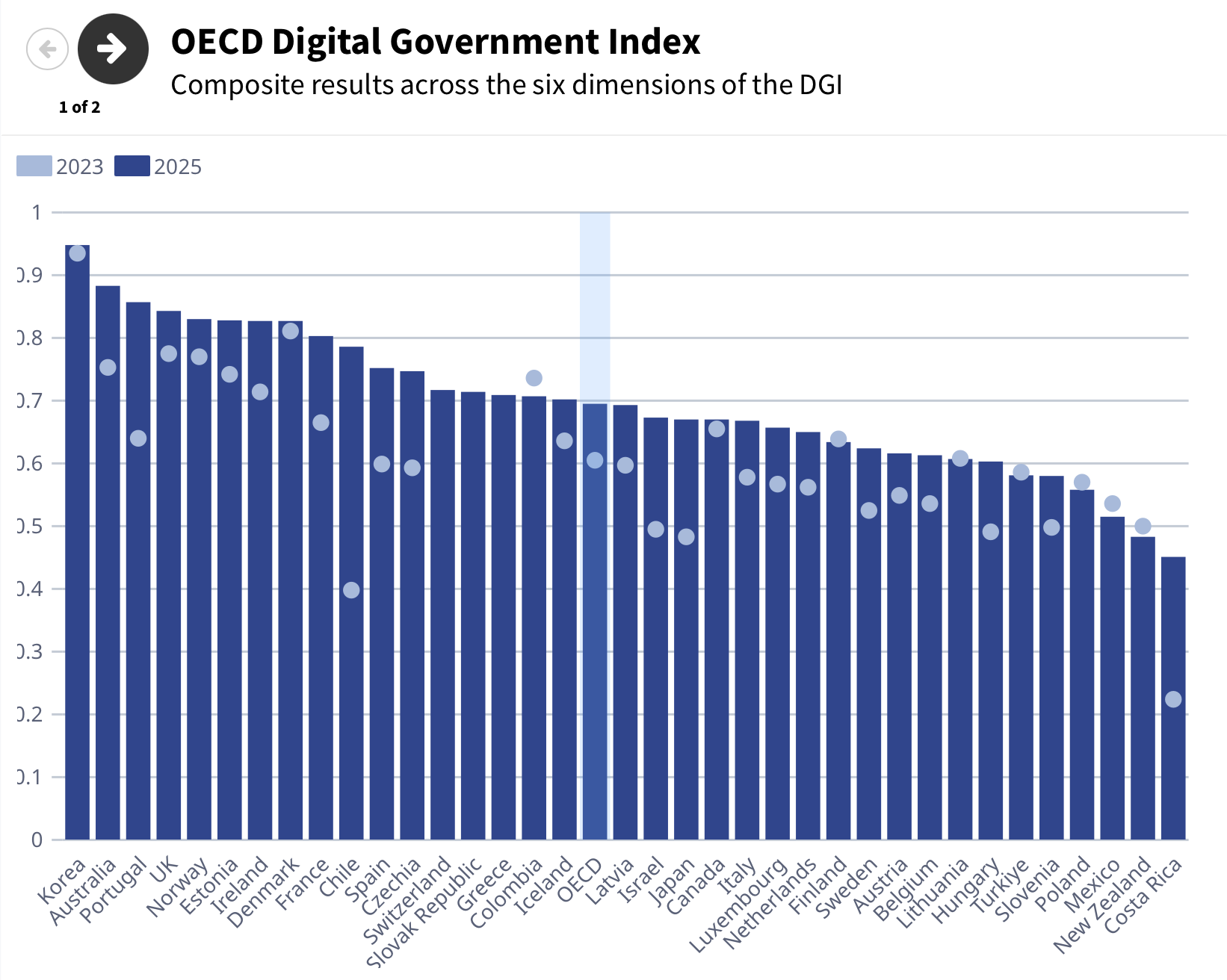
Figure 1: Digital Government Index 2026, overall results by country since 2023. Source: OECD
Needless to say, an overall result does not mean equal success in all the dimensions evaluated by Index, stated as such in the latest report. However, certain countries – including EU member states such as Estonia, France, Portugal and Sweden – were seen as standing out in the integration of all studied components, including monitoring, while other countries might have good formal strategies, but fail in their implementation, accountability or performance tracking. Under the EU’s e-Government 2025 Benchmark, considering the different dimensions, different results are obtained:
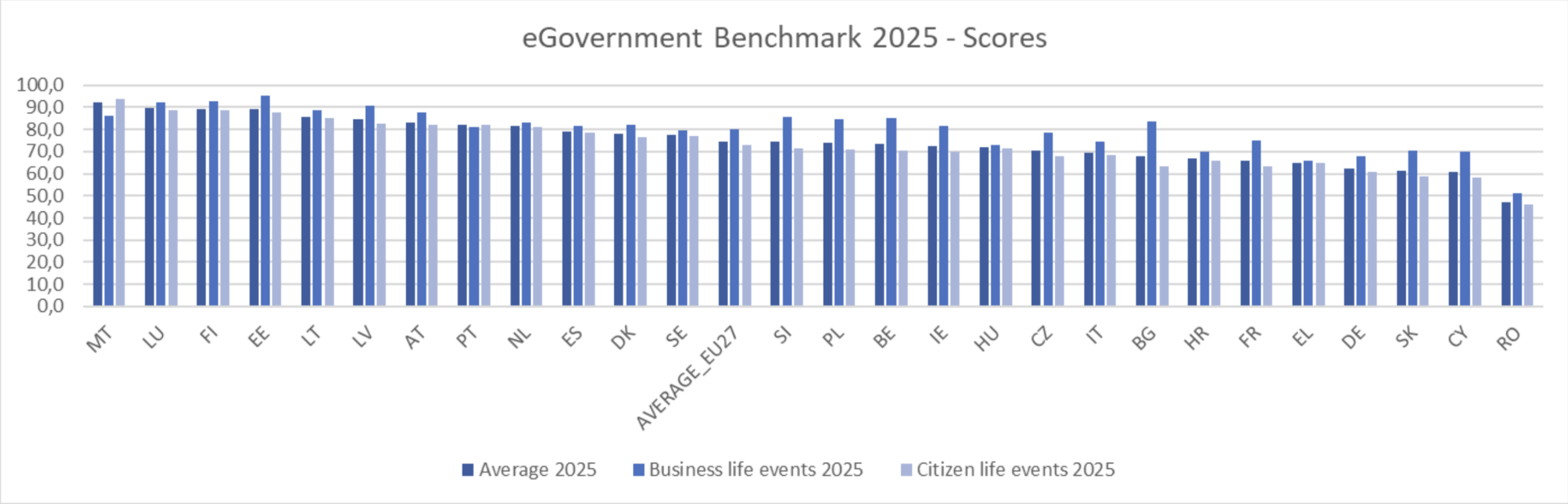
Figure 2: eGovernment Benchmark 2025, results by dimension. Source: European Commission
According to the Benchmark’s 2025 results, the Overall eGovernment Benchmark scores averaged 74.7, though a noticeable gap between the score on business life events (averaging 79.9) and the citizen’s life events (averaging 73.2) is observed, indicating different approaches between how member states address their stakeholders. However, even among countries with the top scores, it’s possible to confirm that the typology of life events that have better scores varies, as is observed by comparing Malta versus Luxembourg. It’s worth noting that the Benchmark further delves into different categories of life events to better study the digitalization of EU governments: Economic, Health, Moving, Justice, Transport, Business Start-Up, Career, Family, Studying. By diving into the type of services that EU member states have specialized in, notable conclusions are reachedcom.
Firstly, and perhaps most concerningly, the Justice category (EU average: 68.7) is the single lowest-scoring category EU-wide. The category covers scenarios such as submission of evidence or appeals, and it’s dragged down by a cluster of countries with very poor scores — Croatia (44.6), Germany (48.3), Poland (49.3), Italy (50.6), and Slovenia (50.0). Even some otherwise high-performing countries score modestly here, such as the Netherlands (third highest overall – 81.7 – but Justice drops to just 59.5), and Denmark (overall of 77.9, but Justice falls to 65.9). Secondly, the Health category, covering scenarios such as the request for electronic records or e-consults, also shows extreme results, with Ireland (48.5) and France (50.3) by far scoring the lowest, which pulls the average down despite top performers such as Malta (97.3) and Luxembourg (92.2). Lastly, regarding the Family category, which includes the request for marriage or divorce licenses, similar clusters are found. Estonia, Malta, and Portugal scored 93–95, but France (46.7) and Romania (35.9) representing significant outliers at the bottom.
Knowing the different types of areas in which EU member states can specialize in, the disparity of results in the data available has allowed for four clusters to become discernable.
Not All Pokémon Are Alike: The EU’s Digital Clusters
At the top, the EU presents its Digital Champions (avg ~88) — Estonia, Finland, Luxembourg, Malta, Latvia, Lithuania. These countries score high across the different categories, without meaningful weak spots. The Baltic-Nordic axis dominates this group, with Malta as the geographic outlier.
On the rise, the Strong but uneven Elite (avg ~80) — Austria, Portugal, Spain, Netherlands, Denmark, Sweden, Ireland. Solid overall performers, but they show a recurring dip in justice and health — sometimes dramatic, as with the Netherlands (overall 81.7, justice 59.5). Business and economic services are mature; citizen-facing services haven’t caught up uniformly.
Representing a more moderate implementation, we find the EU’s Patchy Mid-tier Leaders (avg ~70) — the largest cluster, spanning Belgium, Czechia, Hungary, Poland, Slovenia, Croatia, Italy, Germany, France, Greece, Bulgaria. Business services reach adequate levels but citizen services — particularly justice, family, and health — lag noticeably. France is an interesting internal outlier: weak in health (50.3) and family (46.7) but unusually strong in justice (81.6).
Finally, the EU member states at the seemingly Starter level (avg ~56) — Romania, Slovakia, Cyprus. Structurally low across all categories, including business services. The gap here isn’t category-specific.
The clustering mapped through the data collected by the EU shows that a digital continent, despite existing gaps and similar to the yet unfinished project of the Single Market, can be achieved and has been clearly set as the EU’s goal.
Becoming Champion: The EU’s Vision for a Unified Digital Continent
Awareness of the discrepancies is the motivation for the Digital Decade Policy programme, contributing to the implementation monitoring and cooperation, ensuring that every EU citizen is included in the opportunities and protections that the digital world can bring.
Guided by the goals of a Digital compass, the Digital Decade policy programme 2030 is meant to assist all countries by: setting Key performance indicators (KPIs), describing the expected EU-level trajectories, yearly sharing (at the hands of the commission, which is set to review the targets in 2027) the progress achieved and prompting member states to set their own national roadmaps.
It’s under the 2026’s yearly State of the Digital Decade that one can really understand what advances have been made at EU level, such as the fact that 64% of the 2025 country-specific recommendations have already been addressed.
Nonetheless, significant gaps remain to be addressed, vital in a world fraught with opposing forces that urge for further efforts to be employed. This is exemplified by the weak technological sovereignty, as the EU only accounts for 9% of the global semiconductor market, well below the 2030 target of 20%, or the still lacking digital skills, with ICT specialists representing merely 5% of employment in 2025, half of the 2030 target of 10%.
It’s now clear that the EU has built its own League, drawn up the rules, and handed every member state a Pokédex. The scoreboard shows real progress. However, the question is no longer whether to play — it’s whether, as stronger outside players compete by rules of their own, every trainer will actually show up to fight.
Disclaimer: While Euro Prospects encourages open and free discourse, the opinions expressed in this article are those of the author(s) and do not necessarily reflect the official policy or views of Euro Prospects or its editorial board.
ND
Finance Correspondent
Nuno is portuguese and based in Porto. He has a background in Economics, Management and Financial Markets, as well as in IT. Areas of expertise: Financial Markets, Big Data, Privacy, Portugal, International Politics.
Edited by Ofelia Dournel, EU Affairs Correspondent | Follow our European journalism