8 min read — EU | Economy | Finance | Legislation | Policy
The Fellowship of the Payments: Europe’s Journey Beyond the Two Towers
For decades, Visa and Mastercard have dominated Europe’s payment rails. Efficient — yes. Strategically neutral? Not so much.
The Two Towers of Payments
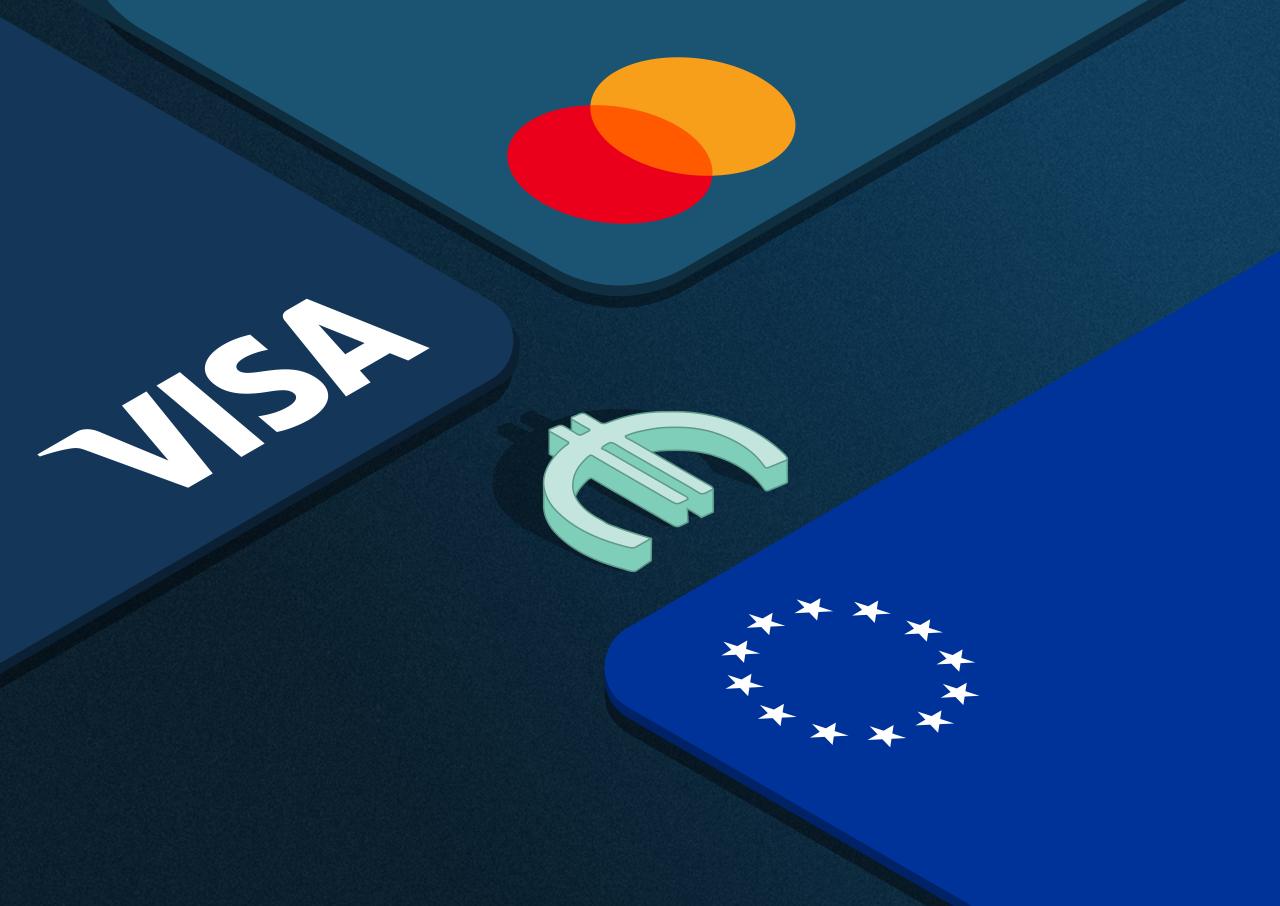
In J.R.R. Tolkien’s Middle-earth, power is concentrated in a single object that two opposing factions aimed to control. In global payments, the power rests on networks that are controlled, in their majority, by two american companies.
For decades, the global card and payment infrastructure has been dominated by Visa and Mastercard. Their rails move trillions across borders, underpin e-commerce, enable point-of-sale transactions, and quietly sustain modern consumption. The European Union is not an exception to such market share conquest, as the two companies had, as of 2022, around 90 % of the international card scheme market.
However, a small group of local EU member state national card schemes have worked to secure a foothold domestically, making an offering specific to their country, representing local payment networks developed and grown to support the payments made within a given geography.
Within the Euro zone, as mapped by the ECB’s 2025 report, these local card schemes include: debit cards only (within Belgium, Denmark, Germany and Malta), debit and prepaid cards (within Italy and Portugal), credit cards only (within Slovenia) and all types of cards (in Bulgaria and France).
Despite their availability, in order to process international payments, national schemes often resort to co-badging, which means their cards end up requiring the a participation of Visa/Mastercard networks, which helps explain why international systems have reached 61% market share of card payments in the Euro zone in 2022, while national systems are only able to conquer 39% (which has been decreasing and becomes smaller if transactions with non-euro merchants are considered).
With American networks commanding the overwhelming majority of cross-border card payments, the strategic question becomes both obvious and unavoidable.
One Network to Rule Them All? Why Payment Dominance Matters
For starters, what is a payment card processor? In essence, it’s the third-party service provider responsible for serving as an intermediary between the banks involved in sending and receiving a payment‚—in exchange for a small fee for providing such service.
When a European consumer taps a card in Lisbon, Paris or Berlin, it’s very likely that the transaction is performed through Visa or Mastercard’s global networks. Their business model thrives on:
- Massive network effects
- Global interoperability
- Deep integration with banks and merchants
- High barriers to entry
Though their scale grants them efficiency, it also creates concentration, as exemplified by Visa’s exclusivity deal with the Olympic Games, where all fans in Milan were forced to use a Visa card for any payment.
In the Shadow of the Two Towers
For years, efficiency beat autonomy, as Visa and Mastercard delivered seamless cross-border payments in what has been shown to be a fragmented European payment landscape.
But in a time where the USA has become an increasingly unreliable commercial partner, dependence on American companies for strategic systems has become a focal point of discussion, with efforts to bring the discussion to the EU level while European regions take the lead on finding alternatives in other sectors. This has led the European Union to now re-examine critical infrastructures, with payments sitting at the heart of economic life of the world’s largest trading bloc.
Payment infrastructure is not merely commercial plumbing; it is a lever of economic statecraft. If the future’s economy is digital, programmable and instant, who controls the data flows matters.
Forging the Fellowship: Public and Private Paths Forward
But what can the future of the European Union’s payment systems look like?
For starters, one certainly can’t disregard the role that the digital euro is bound to have in the current ecosystem.
Aimed at providing an alternative digital payment system for the euro zone, the digital euro is being designed to function as digital cash, creating a public and an (hopefully) universal way to make electronic payments in the euro area.
Integratable with banks and existing payment service providers, users of the digital euro will not require new separate accounts, supported by designated public entities and aiming to be available in multiple ways: through mobile apps or via physical cards, online or offline (through pre-charged logic), for any type of payment (physical, online or peer-to-peer).
However, integratable solutions still require investment from those asked to welcome the system. Current estimates place the digital euro’s integration implementation costs for the euro zone’s banking sector at between € 4 billion and € 5.77 billion—not to mention the user adoption and onboarding efforts that the deployment of this solution will require.
In parallel, to limit the impact to the banking sector, the prospective digital euro’s wallet will have the by-now well-known limit of € 3000, while offering no interest (unlike many commercial bank savings accounts), which makes sense when comparing the digital euro to physical bank notes.
The digital euro may enhance monetary sovereignty. Whether it meaningfully reduces network dependency is a separate question, which leads to the question: has the European banking sector been trying to address the topic?
The answer is a resounding yes, with alliances between existing national payment systems having formed across Europe.
Despite getting off to a rocky start at the beginning of the decade, the European Payments Initiative set itself to kickstart “Wero”. The platform has since emerged as a European mobile payment system aiming to replace the different systems in Germany, France, Belgium, Luxembourg and the Netherlands (only currently available in the first three). Initially launched in Germany in 2024, expanding to France last year, it achieved over 46 million users, with a wide set of payment modalities being expected in the near future, such as QR Code payments.
In contrast, EuroPA – European Payments Alliance – aims to create an interconnected solution between existing payment systems in Italy, Spain and Portugal, within the very near future. Similar to Wero, the goal set by EuroPA is to create an integrated and interoperable payment network that would allow users to use their local apps for cross-border payment interactions, such as the already existing QR code payment methods of Portugal’s MB Way.
At first glance, these separate initiatives might appear to be opposing, competing forces for the same issue of European payment independence. And yet, they’re not!
EPI and EuroPA have signed an agreement memorandum, agreeing to establish, by 2027, EU-wide interoperability, meaning that each country, while keeping their own systems (Germany/France/Belgium with Wero, Norway’s Vipps MobilePay, Italy’s Bancomat, Spain’s Bizum and Portugal’s MB Way). Such concerted effort would allow for coverage of 15 European countries and 382 million citizens that would keep their already existing nationally adopted options.
Furthermore, the digital euro itself is being planned to be integratable with the already existing private payment solutions, reusing existing standards allowing the private sector to continue innovating their services and expanding their coverage. In parallel, common infrastructure would grow, spreading the costs of shared infrastructure, reducing fragmentation and slowly presenting the European alternative to an American duopoly that fragilizes the European Union.
However, one does not simply construct a fully integrated and interoperable European payments infrastructure. The journey forward is marked by competing national priorities, formidable technical hurdles, and the constant danger of fragmentation.
Countries such as Portugal and Spain are used to bank cooperation, with national champions providers of payment processors at no additional shareholder banks, while countries such as Ireland and Greece are less experienced in such projects, limited to compliance related initiatives. Furthermore, the technical constraints of creating interoperable systems can lead to infrastructure overcomplexity or market fragmentation if there is incentive misalignment.
The Road Goes On
The European Union began as a modest experiment in economic cooperation, born in the aftermath of a continent laid bare by war. Over the decades, it has deepened, widened, and endured in the face of adversity.
Today, it anchors the economic rights and freedoms of hundreds of millions of citizens who, despite their differences, have chosen integration over division and cooperation over retreat — even when the path forward has been uncertain.
The ambition to build a truly integrated European payments infrastructure — complemented by an innovative digital euro and embedded across banks and borders — may appear formidable. Yet so once did the creation of the euro itself. So too did the construction of the Single Market. Europe has never advanced because the task was easy; it has advanced because the alternative was stagnation.
The challenge now is no different.
To ensure that the continent’s financial arteries are not dependent on a single external axis of power requires patience, scale, and political will. It requires trust between institutions and alignment between public ambition and private innovation.
The shadow of the Two Towers is long. But shadows persist only where light does not.
If Europe can sustain its resolve, its Fellowship may yet ensure that power in payments is shared — not concentrated — and that the road toward sovereignty, however long, continues ever on.
Disclaimer: While Euro Prospects encourages open and free discourse, the opinions expressed in this article are those of the author(s) and do not necessarily reflect the official policy or views of Euro Prospects or its editorial board.
Write and publish your own article on Euro Prospects
Subscribe to our newsletter – stay informed when we publish articles on pressing European affairs.