10 min read — EU | European Integration | Democracy |
The EU Keeps Insisting It's Not a State. It Keeps Building One Anyway
From a coal and steel pact to an €800 billion defence plan, seven decades of crisis management have quietly assembled something Europe refuses to name.
By Faruk Bašić — Guest author
May 16, 2026 | 19:00
What began in 1951 as a pooling agreement for coal and steel between six war-exhausted countries has, over seven decades, become an economic community, a single market, a common currency, and now reaches for military and diplomatic capacity it did not possess a decade ago. Each step looked, at the time, like a practical response to a practical problem. The cumulative shape looks like something more.
Recent large-scale initiatives make the pattern impossible to ignore. ReArm Europe, rebranded Preparedness 2030, mobilises up to €800 billion for European defence through five interlocking instruments: a national escape clause from the Stability and Growth Pact, a €150 billion loan facility, redirection of cohesion funds, expanded European Investment Bank lending, and the activation of private capital. Stack it alongside what came before: NextGenEU, the European External Action Service, the Anti-Coercion Instrument, the Carbon Border Adjustment Mechanism, the European Defence Fund. A pattern emerges, which is too consistent to be coincidence and too uncoordinated to be design.
Each of these initiatives was framed as exceptional, as a targeted response to a specific crisis. The EU has been building rooms onto a house it insists it does not own.
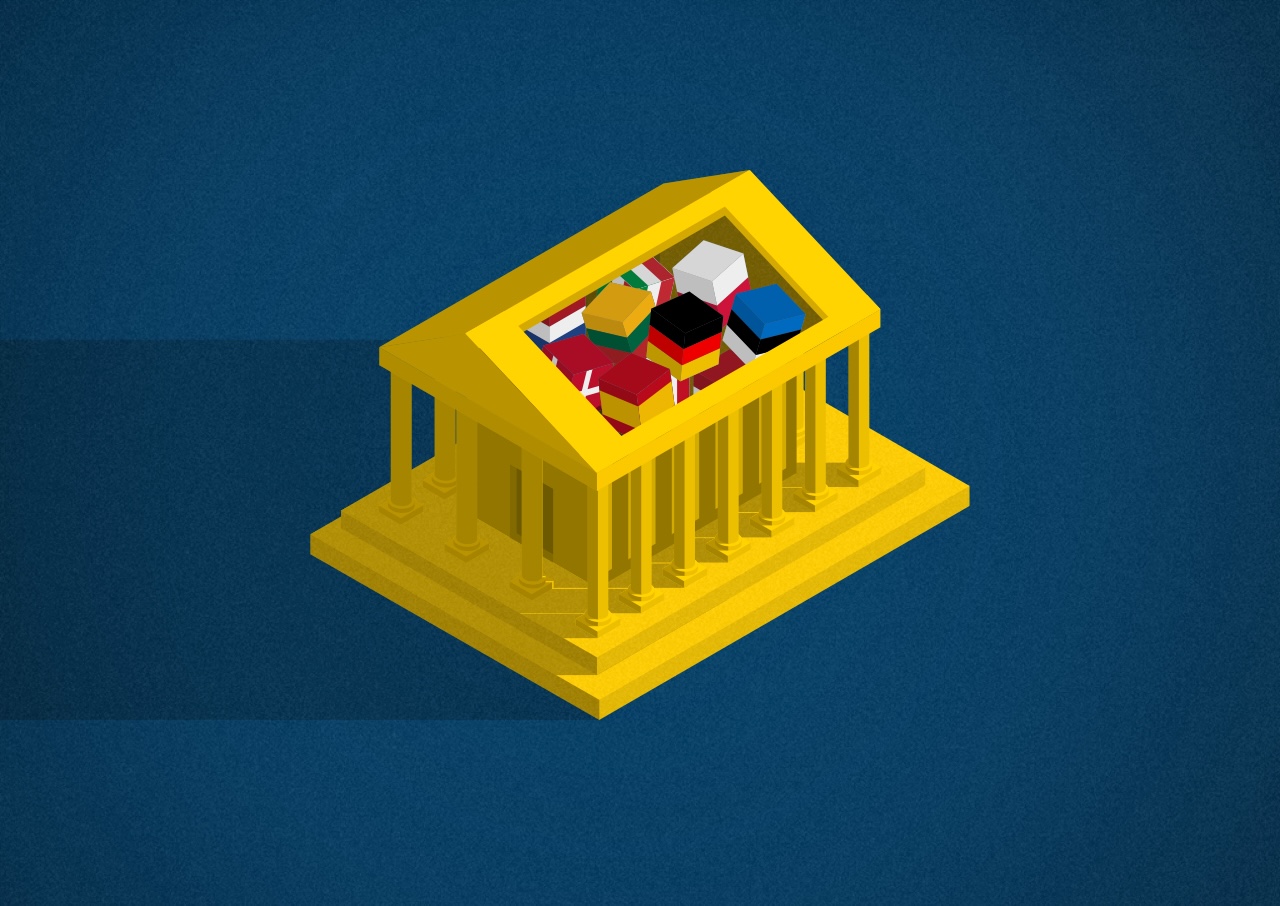
What is driving this accumulation is not political or ideological ambition, nor a deliberate design, but something more impersonal: what this essay calls institutional gravity, the tendency of polities accumulating functional responsibilities under external pressure to develop state-like institutions (by which I mean the fiscal, diplomatic, and coercive capacities historically associated with sovereign statehood), not by design but by the logic of the problems they face. The EU represents an unusually clear case of this dynamic, precisely because it accumulates state-like capacities while constitutionally resisting being called a state, a tension no conventional polity faces in quite the same form. The question worth asking is not whether the EU is becoming more state-like (it is). The question is why, how fast, and what kind of state-like entity it will become.
The mechanism
The needs that eventually produce institutions rarely announce themselves. They build up quietly in the background, visible in policy papers and academic debates long before they crystallize into political will. What crises do is compress the timeline between recognition and action. The COVID-19 pandemic did not invent the idea of European mutualized debt; that blueprint had been drafted and shelved for years. It simply made the political cost of inaction higher than the political cost of finally acting, and NextGenEU reached political agreement within weeks. Russia’s invasion of Ukraine did not create the concept of a European defence apparatus. It made the absence of one feel like an emergency. The institutions follow the needs, always. Crises just speed up the delivery.
What makes the EU’s current trajectory particularly significant is that the geopolitical turn now driving this accumulation is qualitatively different from what came before. Internal market integration could run largely on regulation: harmonised standards, directives, compliance mechanisms. Anu Bradford’s work on the Brussels Effect charts how far this regulatory power already reaches: companies worldwide adopt EU environmental, privacy, and product standards not because their home governments require it, but because access to the single market does. In this sense, the EU’s internal market has long functioned as a latent form of foreign policy, operating through compliance rather than coercion. But it has a ceiling. You cannot regulate your way to military deterrence. You cannot write a directive that secures your supply chains or deters a revisionist neighbour. The geopolitical pressures now bearing down on Europe are forcing the Union to develop capacities that the internal market alone never required, and capacities of that kind tend to look, unmistakably, like a state.
The valley and its shape
Institutional gravity does not pull every political system toward the same destination. Picture a landscape of valleys. A ball dropped anywhere within a given valley rolls toward the floor of that valley, not toward some universal lowest point, but toward the particular bottom shaped by the particular terrain. The starting position of the ball matters far less than the shape of the valley itself. Different valleys produce genuinely different institutional outcomes, such as inclusive democracies, competitive authoritarian systems, captured oligarchies, each with its own floor and its own logic. The EU’s valley is that of the large, post-industrial, market-integrated democracy operating under eroding hegemonic protection. Within that terrain, certain institutional solutions keep recurring across very different political systems: fiscal capacity for crisis response, foreign services that integrate trade and security tools, and defence procurement at scale. The EU is rolling toward those solutions not by grand design, but because the shape of its valley leaves few other floors to land on.
Why now, and the mood underneath the numbers
Five structural drivers explain why this gravity is manifesting with such intensity at this moment: (1) American retrenchment (sensed under Obama’s strategic pivot to Asia, dramatised under Trump’s first term, now structural under his second), (2) China’s emergence as a systemic rival, formalised in the EU’s own 2019 Strategic Outlook, (3) Russian revanchism, from Crimea to the full invasion of Ukraine, (4) the weaponisation of supply chains, exposed brutally by COVID and the energy crisis, (5) and the green transition, which requires industrial policy at a scale that is inherently geopolitical.
Each of these is a need in the institutional sense. Each is generating its own organisational response. But there is a sixth driver underneath all of them, more diffuse and more powerful, and that is a growing European sense of being structurally alone in the world. The EU’s institutional architecture was designed for a liberal international order that would provide its security from the outside. That order is fraying. In After Europe (2017), Ivan Krastev described a continent whose entire post-war political imagination was organised around guarantees (of American protection, of liberal permanence, of historical progress) that were beginning to expire. That expiry has since accelerated from a slow erosion into a crisis of confidence, and it is showing up directly in the institutions the EU is scrambling to build.
What makes this siege effect politically significant, rather than merely atmospheric, is that it is showing up in hard data. The European Parliament’s Autumn 2025 Eurobarometer, conducted across all 27 member states in November 2025, found that 79% of Europeans support a common defence and security policy (the second highest figure recorded since 2004), 83% want the EU to strengthen its economic independence and diversify trade relations, and 66% believe the EU’s protective role against global crises should become more important. Europeans are demanding state-like outputs from the Union at a rate that outpaces any political conversation about state-like inputs. The gravity operates at the level of public sentiment, not Brussels technocracy alone.
The Westphalian counter-pull
The Westphalian order does not surrender quietly. The nation-state remains the primary locus of political identity for most Europeans, and the reasons for that are deep. Unlike the foundational memories that fuse national identities (constitutional moments, revolutions, shared traumas experienced and mourned collectively), the EU has no equivalent founding rupture, no collective political memory of the kind that makes a people feel like a people. Europeans share a history: two world wars, fascism, communism, and the Cold War division of the continent. But different parts of the continent experienced those histories differently, and the gap between shared history and shared political identity is real. It feeds the sovereigntist resistance that remains a stubborn counter-current to the gravity described here. A November 2025 survey by PollingEurope, commissioned by the ECR Party, found that a majority of ECR voters reject fully integrated supranational defence, preferring the strengthening of national armies within a NATO framework. The Westphalian instinct still runs deep.
But notice what even that resistance concedes. It is not that European collective action is wrong, but that its institutional form is contested. The disagreement is over the vehicle more so than the destination. The valley holds.
The problem with building quietly
The more serious concern is not the sovereigntist counter-pull but the habit of construction without declaration. The EU has been accumulating state-like capacities for decades while carefully avoiding the vocabulary that would make those capacities legible to the people they affect. Each new instrument is a technical measure, a crisis response, an exceptional circumstance. The sum of those exceptional circumstances is beginning to look like a political project, but one that has never been submitted to the public as such.
State-like capacity requires state-like accountability. The EU can continue assembling its fiscal, military, and diplomatic toolkit while insisting it is something other than a state, but the gap between what the Union does and what Europeans understand themselves to have authorised will not hold indefinitely. The task is to make the trajectory of the gravity visible and to develop the political vocabulary, the democratic architecture, and the public conversation that allow Europeans to contest the shape of what is being built, before they arrive at the bottom of the valley and find it already furnished.
The direction of travel is not seriously in question. What remains open is the form it takes and the degree to which Europeans have any say in it. Institutional gravity will do its work either way. The question is whether Europe gets there by design or by drift, and whether, when it arrives, it finds something it chose.
Disclaimer: While Euro Prospects encourages open and free discourse, the opinions expressed in this article are those of the author(s) and do not necessarily reflect the official policy or views of Euro Prospects or its editorial board.
Write and publish your own article on Euro Prospects
Subscribe to our newsletter – stay informed when we publish articles on pressing European affairs.