10 min read — Space | Canada | ESA | Geopolitics
What Canada’s ESA Investments Signal for the Future of Transatlantic Space Cooperation
“The Canada-ESA collaboration has proven its value for nearly 50 years…by deepening our commitment, we’re ensuring Canada remains a trusted and forward-looking space partner.”
— Lisa Campbell (President of the Canadian Space Agency) – Nov 2025
By Jake Southerland — International Security Correspondent
Edited/Reviewed by: Francesco Bernabeu Fornara
December 10, 2025 | 12:00
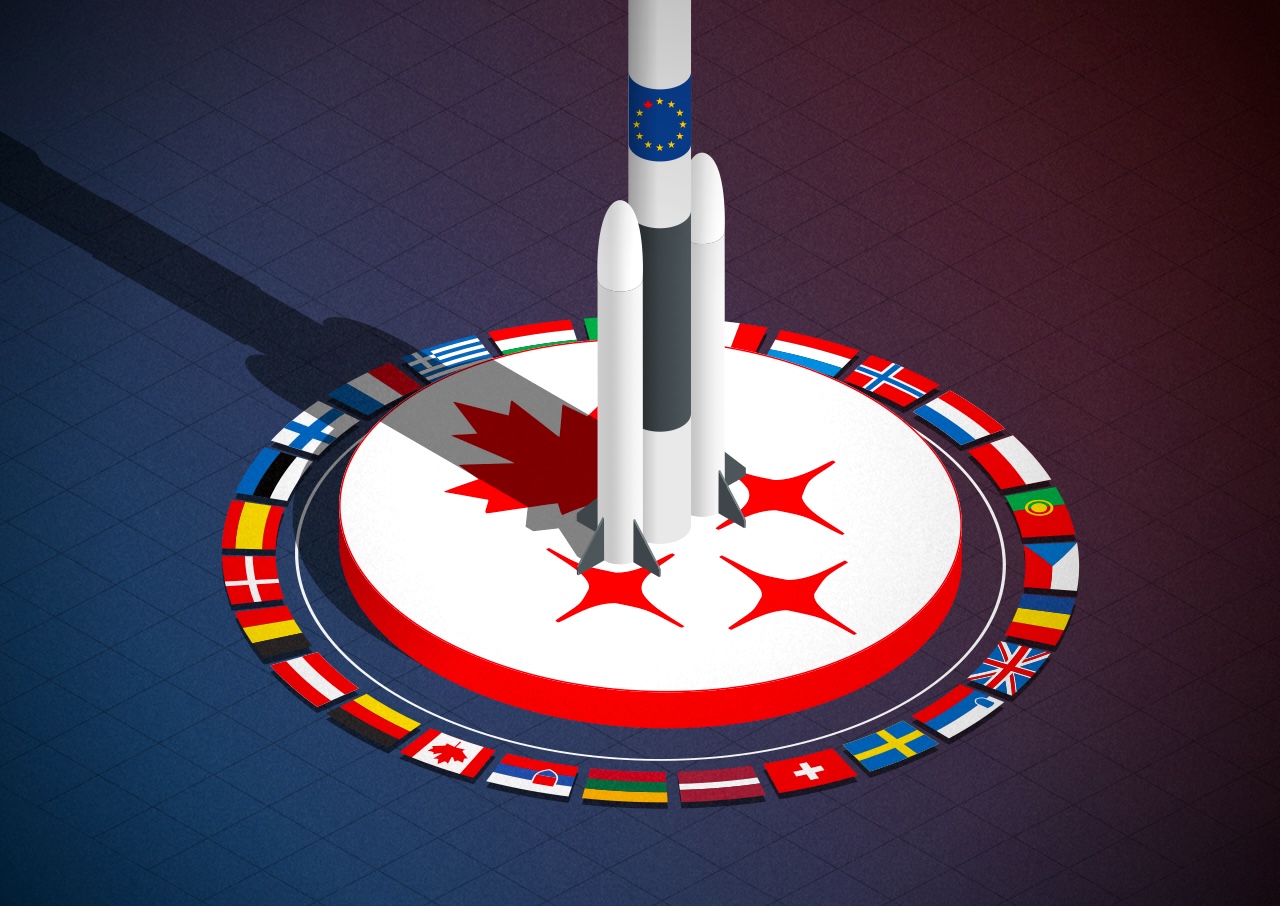
Три (three), 双 (two), one… Liftoff!! For years, the space race has been a battle of innovation between the U.S. and Russia (USSR 1945 – 1991). The People’s Republic of China is the newest addition to this game of astropolitical chess, having rapidly expanded their space program since the turn of the 21st century thanks to significant financial initiatives and strong interest from the government in Beijing. Europe? It’s no secret that the Europeans are rapidly falling behind the U.S., China, and Russia when it comes to space technology and innovation. While EU members like France, Italy, and the Netherlands have heavily invested into their domestic space program and aerospace industry, the European Space Agency (ESA) continues to be almost totally reliant on U.S. space technology. However, with a three to five year long investment, valued at $377.96 million (€325 million), pledged by Canada on November 18th, Europe’s fortune in space may receive a much needed boost.
While collaboration between ESA and the Canadian Space Agency (CSA) is nothing new, it is the geopolitical context that has made the latter’s investment significant. Given the increasing social, economic, and political pressure that Ottawa has been facing from Washington since Trump’s return to the White House, EU-Canada cooperation has accelerated. While the specific details of this deal were hashed out in the ESA’s Ministerial Council in Bremen, the simple existence of the ESA-CSA deal is groundbreaking for Europe’s space aspirations and the future of transatlantic space cooperation. But, how so?
Why Europe Needs Canada’s Help
Europe hasn’t exactly nailed down the whole “launching homegrown rockets” thing. The ESA’s Ariane series still takes off mostly from French Guiana, or occasionally utilizes American launching systems in Port Canaveral, Florida. However, the most recent attempt, in Norway, by German startup Isar Aerospace, ended in an explosion just 40 seconds after launch.
That said, while Brussels hasn’t quite nailed the launching part of the equation, Europe no doubt has significant assets, including players like Airbus, Thales, and Avio leading the charge, putting the ESA well within arm’s reach of a successful homegrown rocket launch. That’s where the Canadians come in. The ESA’s biggest weakness is its size. With 26 members, division and disagreements are only natural — whether it’s splitting funding, geopolitical turf wars, industrial quotas, or how the sharing of contracts. Canada doesn’t have that problem. It has one system, one budget, and one decision maker. The CSA, the government in Ottawa, and a handful of ministries control the entirety of Canada’s space strategy. You don’t have Berlin fighting Paris over tech contracts or London squaring off with Rome over rocket technology. Without a reliable, independent partner like Canada, these bureaucratic battles will continue to hinder European innovation for years.
That being said, Europe and Canada still have a lot of catching up to do. This year alone, Elon Musk’s Space X has launched 154 rockets — that’s not accounting for other U.S. space companies like Blue Origin and United Launch Alliance. What’s more, the Americans have a huge advantage when it comes to the reusability of its rockets, thanks in large part to innovation from both SpaceX and Blue Origin. That is not to say, however, that Europe does not have the foundations for a reusable rocket, nor that the Canadians cannot bring their own expertise. Canadian companies, such as MDA, represent the pinnacle that Ottawa has to offer in satellite systems, robotics, and Earth observation technologies. GHGSat manufactures the high-resolution remote sensing tools that few European startups can match and lastly, Canadian startups like Mission Control Space Services have made significant strides in the development of lunar rovers and other land-based planetary exploration tools. Beyond technology, Canada brings influence and credibility beyond the continent that may enable the ESA to negotiate international contracts with other non-US/EU startups—thereby strengthening the ESA’s position globally.
Indeed, combining European advances in rocket technology with the Canadian aerospace industry has the potential of creating significant benefits for both parties. Canadian companies will receive more exposure to the European market and vice versa for the ESA and its private sector partners. But, one thing needs to be considered by Ottawa and Brussels: the reaction from Washington.
The Geopolitical Standoff: U.S. vs ESA/Canada
Since his return to the White House, President Trump has moved quickly to reassert American power in space. His administration’s FY2026 plans include major boosts to several NASA programs, from the Artemis Accords, to efforts to build the International Space Station’s replacement. Efforts to restore NASA’s core mission of exploration. The strategy is clear: stay ahead of China, whose space program has expanded and innovated at an unprecedented pace that even Washington could not anticipate.
Put Canada and the ESA in the equation and things become sticky for both parties. Several EU member states and Canada are signatories to the US-led Artemis Accords, which establishes clear principles for the civil governance and exploration of space. Simultaneously, space is now considered a new domain of war by NATO, and in practical terms, the alliance, which includes Canada and the most EU members, are still heavily reliant on U.S. aerospace technology — from launch vehicles, crewed systems, and Anti-Satelite (ASAT) weapons systems still mostly run of American hardware. Even with growing European ambitions and Canadian funding, the practical reality is that the U.S. remains the gatekeeper for critical space infrastructure, making Canada’s role in Europe a subtle balancing act. This dual-tract strategy isn’t just about lunar exploration, but it means that Europe will gain access to a broader industrial base and new markets. Beijing and Moscow are watching closely and any lull in European space capabilities will create opportunities for Russia and China to assert influence.
The Big Picture
As you probably already figured out, Canada’s support is helpful but it won’t be the magic fix for Europe’s structural problems. Unless addressed, the ESA’s internal struggles will continue to risk Europe falling even greater behind the U.S., China, and Russia in this modern-day space race. By stepping in, Canada gives the ESA not only exposure to new technological innovation, but also an alternative partner if Washington ever hesitates in the future. Any slowdown in U.S. innovation could give ample opportunities for China to pull ahead and for Russia to reassert their relevance in today’s space race. Canadian involvement could allow the ESA to trail advanced robotics, artificial intelligence (AI), and satellite systems without Brussels’ sluggish bureaucracy slowing it down.
But the stakes go beyond aerospace technology. Europe and the ESA are at risk of losing the little influence they have in setting international standards for space operations, from lunar exploration to satellite regulation. If Europe stalls, it is not just behind in rockets and satellites. It risks ceding leadership in shaping the rules of the road for the next generation of space activities. Canada’s investment sends a signal that Europe can still assert itself as a significant player in the modern space race, but only if it utilizes this momentum to streamline decision-making, fund consistent vessel launches, and strengthen industrial competitiveness in the continent’s aerospace sector. At the same time, this collaboration is a subtle counterbalance in the Western space ecosystem, proving the Europeans an additional partner in case America hesitates. However, with Canada’s help, Europe is being granted an opportunity to experiment, take risks, and accelerate projects in ways it could not do alone. In a nutshell, Canada’s support is both a lifeline and a challenge. It’s a nudge to the ESA to simplify its decision-making processes, continue to collaborate with foreign partners, and support homegrown innovation or risk irrelevance in a space race that is moving at light-speed.
Conclusion
If Europe stalls, it is not just China they risk falling behind; Russia could reassert its presence once sanctions and resource constraints ease following an anticipated peace deal in Ukraine. This is especially the case as President Trump has put the easing of Russian sanctions and Moscow’s reentrance into the G7 on the table for peace negotiation in the ongoing Russo-Ukrainian war. Canada’s move shows both the value of partnership and the urgency for Europe to get its act together. While NASA and the U.S. private sector will always have a leg up in the Western space bubble, this ESA-Canada collaboration could spark new innovations and bring capabilities into the mix, adding variety and resilience to the broader Western space exploration landscape. Canada’s investment is not a safety net. It is a wake-up call for Europe to innovate or risk irrelevance in humanity’s future in the final frontier.
Disclaimer: While Euro Prospects encourages open and free discourse, the opinions expressed in this article are those of the author(s) and do not necessarily reflect the official policy or views of Euro Prospects or its editorial board.
Write and publish your own article on Euro Prospects
Subscribe to our newsletter – stay informed when we publish articles on pressing European affairs.