12 min read — Geopolitics | Populism | Illiberalism | Security
The Populist Quagmire: The European Far-Right in the Age of Strategic Autonomy
Amidst the rise of the populist far-right in Europe, the EU must look beyond its differences and be unequivocal in its “strategic autonomy”.
By Rikou Blayer — Guest Author
Edited/Reviewed by: Francesco Bernabeu Fornara
March 25, 2026 | 14:30
If one were to choose an overarching concept to describe the EU’s future, it would likely be strategic autonomy. According to the European Parliament in 2022, strategic autonomy entails the “capacity of the EU to act autonomously—in strategically important policy areas.” Since then, international geopolitical trends have nothing but further highlighted its relevance and deep-seated challenges. With the global economic slowdown and the international rise of populism marking a definitive split from the international liberal order, the EU faces a situation in which it can no longer reliably and heavily depend on its historical foreign partners for its interests and security.
The infamous current state of Europe’s transatlantic alliance is but the newest example highlighting the importance of strategic autonomy. The United States, one of if not the closest ally of the EU, since 2016, has shown a striking divergence from the long-held European assumption that Washington will always come to its defence. Made explicit throughout both Trump terms, the once-immutable US security guarantees of NATO have now become conditional, at best. Now, only by meeting US demands on increased military spending can Europe hope that the US follows through with its collective security commitments.
The most recent episode of this widening rift was seen earlier this year, with the Trump administration’s unequivocal demand for Greenland’s annexation, a sovereign territory of the Kingdom of Denmark. The current U.S. administration’s coercive actions—including tariff threats against European states over Greenland—have underscored the EU’s need to reassess its alliances. Were all else to remain the same, the collapse of the transatlantic relationship as the backbone of European security would spell catastrophe for the EU. This rings further true when considering the Union’s extensive dependence on the US in other policy areas, such as for energy security, following the EU’s transition away from Russian energy after its full-scale invasion of Ukraine.
Strategic Autonomy’s Rationale
The rationale behind the EU’s strategic autonomy is clear.
Absolute military dependence on the United States for continental security is no longer a reliable option. Without American military capabilities and its defence industries which sustain it, the EU is not ready to ward off foreign military aggression against its members (not least given the EU’s lack of a permanent unified army, nor the fact that Europe’s arms industries simply do not match in capabilities to its American counterpart). These are no minor worries: faced with the dubiousness of US backing, what is Europe’s action-plan today once Union territory is attacked?
Secondly, trade reliability is fading. Following the corona-virus pandemic which damaged global confidence in international supply-chains, the EU’s economic vulnerabilities are clear, exacerbated by episodes of economic coercion from our dependency on Russia’s energy and China’s critical rare earth minerals. Europe’s capabilities to manoeuvre in the theatre of global politics, at least in the realm of economy and trade, has often been constrained, reflecting a significant need in changing continent-wide trade policy.
Public Support and State Backing
Strategic autonomy, when brought to the European people, has clear majority support. A majority of Europeans support an expanded security policy in the continent and 81% support a larger common EU defence policy. Additionally, most Europeans still have faith in NATO as a security guarantor, with 66% having a positive view of the organization by the end of last year. But while strategic autonomy has been supported throughout the Union, the meaning of the concept has been heavily contested. What strategic autonomy grows to mean in finer detail will determine the crucial next steps for the continent.
At the state-level, what strategic autonomy entails practically vis-à-vis NATO and the United States has been divided. Strategic autonomy has often been criticized as unrealistic, given Europe’s long-term reliance on the US for its security. From the perspective of smaller member states, moving away from the United States and towards a larger EU security policy may lead to the dominance of larger member states, such as France and Germany.
Differences regarding what strategic autonomy means are also based on national security considerations. Countries closest to Russia in eastern Europe unsurprisingly advocate for the maintenance of a US-backed security apparatus, given its evidently more robust military defence capabilities.
The Populist Far-Right Factor
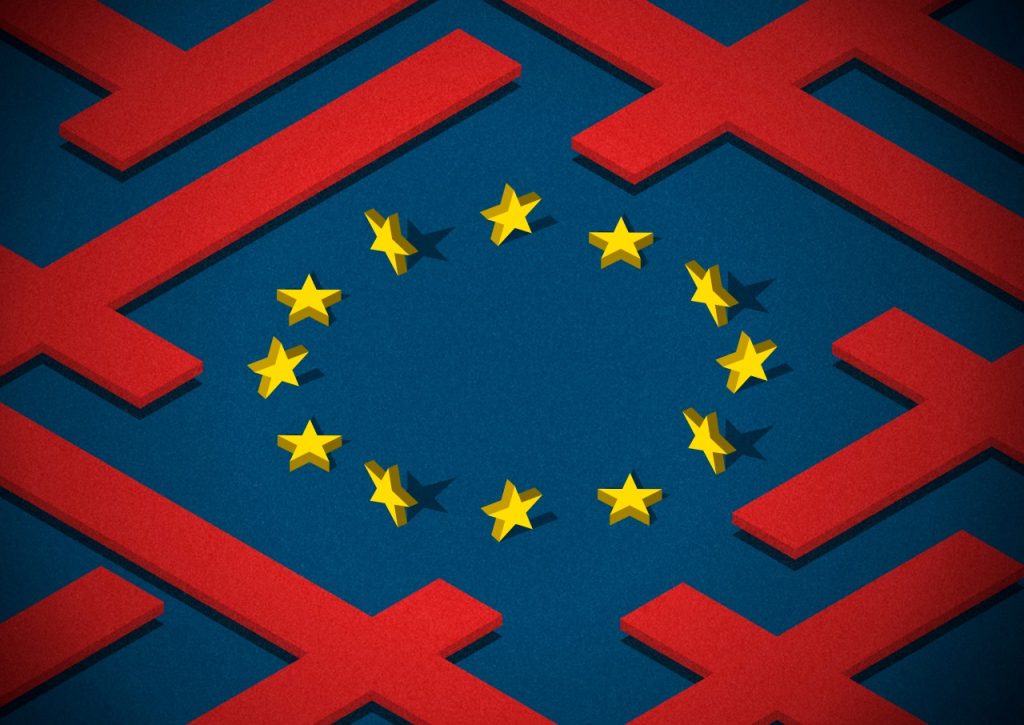
While such differences are steeped in historical grounds, the debate regarding strategic autonomy will now have to take into account an increasingly influential factor: the populist far-right. Once considered part of the political fringe, recent national and EU parliamentary elections have proven that they are a significant political force capable of influence. In the present, whilst still being a minority in EU politics (not enough to pose a blocking minority in the EU council within non-unanimous voting), that does not mean their rise should be dismissed. Given their historically hostile tone to the EU, paying attention to their agenda is crucial, especially to their positions which run counter to the current objectives of strategic autonomy. A future EU in which at the most executive level consists of politicians that have a history of rejecting its foundational principles (such as collaboration and transparency) could drastically alter the meaning and success of strategic autonomy.
The far-right, however, is no monolith. Among right-wing European Parliament political groups, divergences on ideological positions and in political influence are plain to see. Some are in government (such as Italy’s FdI), while others are in opposition (such as the AfD in the German Bundestag). They also often differ in regards to other relevant policy areas: on Russia (some being staunchly anti-Russia, while others oppose EU Russian sanctions), the EU’s role in national politics (with some being eurosceptic or stringently anti-EU) and economic policy (ranging from economic nationalism to deregulation).
Furthermore, amidst their rise in Europe, their connection to the American far-right and various (ex)members of the Trump administration is worth also noting. Ideologically, the similarity between both camps is evident: from stringently anti-immigrant rhetoric and the advocacy for national sovereignty, to their criticism of liberalism and its various manifestations. One can refer to the actions of influential (ex)members of the Trump administration such as Elon Musk, Steve Bannon and current Vice President J.D Vance, which have gone out of their way to support parties of the European far-right. Most notably, their support and links to parties such as the AfD and Fidez act as a clear starting point to understand the connection between the two camps.
At the same time, the increasing emphasis on continental defence by European leaders such as France’s Macron coupled with the simultaneous rise of the populist far-right in European national elections should not be treated as separate trends. With the far right advocating for stronger national sovereignty in their country’s relationship to the EU, the danger of the far-right seeping into strategic autonomy policy is significant.
Were the European populist far-right to be successful at the national executive level, their influence would soon ripple into the future of the EU’s Common Security and Defense Policy (CSDP), replacing military collaboration in favour of sovereignty entrenchment. Safe to say, this would undoubtedly hamper the development of the Union’s defence capacities as a unified foreign actor, limiting its capability to pool sovereignty and move on from the current predicament of intense dependence on other international actors. Continued success of the far-right within such executive-dominated policy areas at the EU level would also likely lead to the corrosion of better oversight demands in many parts of the CSDP, further fragmenting Europe’s already-lagging defence policy. Such a misalignment at the EU level, especially in areas of defence, would prove cumbersome to decision-making, while the need for strategic autonomy grows more pressing.
While Europe’s current defence capabilities look grim, the Greenland episode has become a defining flashpoint for the Union and the far-right. It is clear that the Trump administration’s episode with the Danish territory has revamped the sense of EU-wide solidarity, with many European leaders responding negatively to the White House’s position. Indeed, a fundamental contradiction has emerged within Europe’s far right: one where its prior alignment around national sovereignty is increasingly at odds with Donald Trump’s willingness to threaten that very principle. It has also led to concerted efforts by MEPs demanding a stronger action by the Union, such as in stalling its trade agreements with the United States or even by considering launching economic action against the historical ally.
Amidst pressure for condemnation, leaders of the far-right have more often than not, begun condemning or outright rejecting the Trump administration’s position on Greenland. Indeed, transatlantic ideological alignment among populist circles seems too costly. While the far-right shares similarities with the Trump administration’s theoretical positions on immigration and national sovereignty, the future prospect that the administration’s links to its European populist footholds has become strained since the Greenland row. Regardless, the situation reflects the danger of adopting such ideas. If the EU entrenches itself in a policy which solely prioritises national sovereignty, it will be left in a global geopolitical theatre in which its dependencies will be further exploited by both allies and adversaries.
The EU must toe the line between its pursuit of “strategic autonomy” and the preservation of its safeguard mechanisms, which are crucial to upholding its democratic liberal values and geopolitical position. For example, it should maintain rule-of-law conditionality and parliamentary oversight to prevent executive overreach. A situation in which a member state bypasses collective decision-making and acts unilaterally in security matters is harmful not only to the Union’s security interests but also to the democratic principles that underpin it. When considering what autonomy means in practical terms at the continental level, both the procedure of unanimity in matters of national security and diverging interpretations of the concept continue to hamper progress. Nevertheless, the EU must initiate a continent-wide effort to strengthen existing institutions responsible for its security policy. For instance, it should further develop the capacities and cooperation frameworks of PESCO (Permanent Structured Cooperation) and the European Defence Fund. Simultaneously, it must ensure that robust safeguards are embedded within these institutions to prevent their co-optation by narrow, sovereignty-driven far-right security agendas.
While the pragmatic necessity for strategic autonomy, especially in defence, is not ideal, materially cost-efficient dependence on outside actors is no longer a viable future for an aspiring geopolitical actor. In aspiring towards this agenda, it must pay attention to the increasing tide of the populist far-right whose rhetoric on national sovereignty hampers the geopolitical mobility of the Union, while simultaneously undermining its core principles of transparency and the rule of law.
Disclaimer: While Euro Prospects encourages open and free discourse, the opinions expressed in this article are those of the author(s) and do not necessarily reflect the official policy or views of Euro Prospects or its editorial board.
Write and publish your own article on Euro Prospects
Subscribe to our newsletter – stay informed when we publish articles on pressing European affairs.