14 min read — China | Governance | Global Europe | Democracy
Left in the Dark: When Looking Towards China, Europe Needs a Clear-Eyed View
Despite China’s remarkable political and economic transformation, the narrative of a ‘Communist success story’ merits far more nuance. As China’s international influence grows, Europeans must learn to better understand the Chinese model—a task for which Europe’s own past with collectivism and authoritarian can offer valuable insight.
By Luca Boccardo — Guest author
February 17, 2026 | 10:00
China is frequently hailed as the world’s leading ‘Communist success story’. Yet, its rapid economic transformation, strong centralised government and the significant influence of both State and private enterprise should prompt Europeans to reconsider what truly defines the Chinese political model. By analysing China’s approach to social class management, state control, nationalism, and human rights, the article underscores the risks and dilemmas these pose for Europe—from unfair competition and strategic dependency to threats against democratic values and civil liberties. What Europe needs is a clear-eyed, unified perspective that prioritizes transparency, human rights, and strategic autonomy in the face of China’s growing global influence.
Historical parallels: Europe’s own lessons
Looking back at Mao’s vision for China and the country’s trajectory since then reveals how Chinese ‘communism’ is far more complex than what the Chinese Communist Party’s name suggests. The adoption of communism in China, as in early Soviet Russia, was motivated by its appeal to the masses, particularly the poor and disenfranchised—a phenomenon not unfamiliar to Europe’s own 20th century upheavals. The utopian promise of equality resonated in societies marked by injustice, just as it did in parts of Europe.
However, for European observers, it is crucial to recognize the risks inherent in the persistent idealization of the Chinese model—particularly among Western European left-wing intellectuals. This tendency to romanticize China’s proclaimed socialist ideals often obscures the reality that the system in practice resembles autocratic corporatism more than genuine socialism. Much like in interwar Europe, where segments of the intelligentsia idealized the Soviet Union and ignored its authoritarian realities, today’s admiration for China’s rhetoric may enable the Chinese regime to mask its ambitions and the autocratic and corporatist nature of its government.
Collectivism and Authoritarianism: European experience and modern risks
Europe has a long history with collectivist ideologies, spanning from Bolshevism to fascism. Collectivism subordinates the individual to the collective—whether a social class, nation or State. Europe has seen how this has led to the suppression of individual liberty under both communist and fascist regimes under the banner of ‘the greater good’.
Today, China’s system, with its blend of state control and private enterprise, mirrors the corporatist models once seen in Europe, where private initiative was tolerated but strictly subordinated to the State’s interests. For Europe, this is not just a historical curiosity: it is a contemporary risk, as China’s economic and political influence increasingly shapes global norms, undermining European standards on transparency, corporate governance and the rule of law—a process not least supported as the US steps back from a leading role in global governance.
Political structure: The authoritarian echo and European values
China’s one-party system, with its suppression of dissent and centralisation of power, is reminiscent of Europe’s own authoritarian past. European democracies, forged in the aftermath of fascism and communism, have enshrined pluralism and checks on power as core values. The Chinese model, forged in the aftermath of its own socio-economic crises and so-called ‘century of humiliation’ by foreign powers, stands in stark contrast. For Europeans who have learnt to value a liberal system that upholds individual rights over collectivism, the Chinese model serves as a warning of how easily the promise of equality can morph into the reality of state dominance.
Moreover, China’s growing global assertiveness has begun to challenge European unity and values. Chinese pressure on European states—whether through economic retaliation or diplomatic leverage—has tested the EU’s ability to present a united front on issues such as human rights, freedom of expression, and sovereignty.
Economic model: Dependencies, risks and European industry
China’s economic reforms since the late 1970s have produced remarkable growth and a plummet in poverty, but at the cost of abandoning orthodox communism. Instead, the country has adopted State corporativism, echoing economic policies similar to fascist Europe, where the State dictated priorities and private property is subordinated to State’s interests.
For European policymakers, businesses and consumers, this model presents both opportunity and risk. European industries—from automotive to pharmaceuticals to green technologies—are deeply integrated with and dependent on Chinese supply chains. This dependency exposes Europe to strategic vulnerabilities, such as disruptions in critical raw materials, intellectual property theft and forced technology transfers. The EU’s recent efforts to ‘de-risk’ supply chains and scrutinise foreign investments reflect a growing awareness that China’s model can threaten Europe’s economic sovereignty and resilience.
Social structure: Managing classes and social cohesion in Europe
Europe’s own experiments with corporativism sought to manage, rather than eliminate, social classes. In China, Maoist ideology and current practice both echo this approach. The State organises and controls socio-economic groups to preserve social cohesion, ensuring their loyalty to the national project.
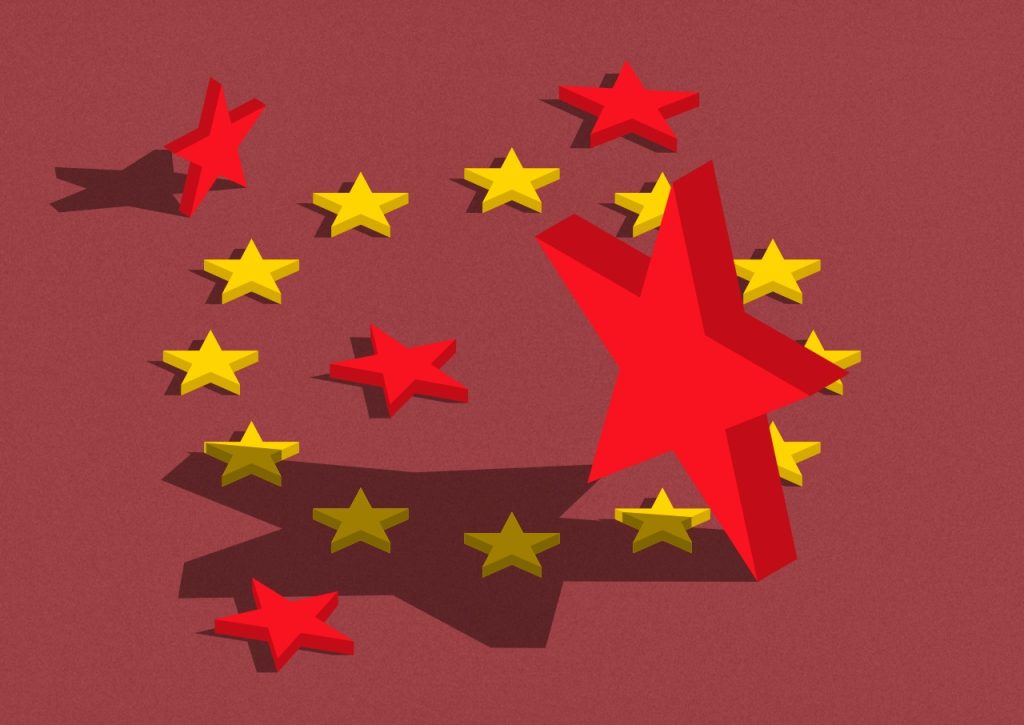
The symbolism of the Chinese flag itself—where the four smaller stars represent the proletariat, peasants, petty bourgeoisie, and national bourgeoisie—underscores the regime’s approach to social class: not their abolition, but their management under state direction.
For Europe, where class divisions have historically fuelled both conflict and reform, China’s approach serves as a reminder of the risks inherent in institutionalizing class structures rather than promoting genuine social mobility.
Europe is no utopia of social cohesion, but China’s model is a cautionary example of the dangers in sacrificing aspirations of social mobility for state-imposed stability. As European societies address their own socio-economic inequalities, the temptation of adopting ‘managed’ solutions—at the expense of individual freedoms—remains.
Social control and civil liberties: A (should be) European concern
China’s extensive surveillance, censorship and restriction on civil liberties are familiar to Europeans who remember the totalitarian regimes of the 20th century. The suppression of free expression, the control of education and media, and the rewriting of history are tactics that Europe has struggled to overcome and must remain vigilant against.
Moreover, China’s use of digital technologies for surveillance and social control is increasingly exported through partnerships with European cities and governments, raising concerns about privacy, data protection and the future of open societies in Europe. These concerns are not unique to China; as recent analyses have shown, European law enforcement’s own adoption of AI-driven predictive policies and the evolving legal landscape post-Brexit present similar challenges. The controversy surrounding Huawei’s role in European 5G networks illustrates the dilemma: how should Europe balance economic opportunities with national security and data privacy? Recent Western experiences with the expansion of state surveillance after 9/11 further underscore the importance of upholding civil liberties in the face of new technological threats.
Finally, China’s efforts to rewrite history—such as reframing the narrative of WWII or glorifying the CCP’s role while downplaying uncomfortable truths—reflect a broader strategy not necessarily specific to China of using the past to legitimize present authority. Europe, with its own history of confronting and, at times, revising its past, knows well the dangers of allowing political interests to dictate historical memory. The integrity of liberal democratic societies depends on a truthful reckoning with history—a lesson Europe cannot afford to ignore as it engages with China.
Nationalism and imperialism: Europe’s cautionary tale
While the CCP continues to use Marxist language, its embrace of nationalism and imperial ambition bears a closer resemblance to Europe’s fascist past than to communist internationalism. The focus on national rejuvenation, historical grievance and territorial claims is reminiscent of the narratives that once led Europe to its 20th century calamities. The increased presence of Chinese military power in Asia along with its assertive stance on territorial dispute also have implications for European security interests and global stability.
China’s Belt and Road Initiative, with its vast investments across Africa, Latin America, and even parts of Eastern Europe, has been described as a new form of economic imperialism or neo-colonialism. For Europe, this expansion poses direct challenges: it complicates EU–Africa relations, raises competition for resources, and creates dependencies that can undermine European influence and strategic autonomy in neighbouring regions. This competition is made even more challenging—and arguably unfair—because European business and governments are bound by strict human rights, labour standards and environmental protection, whereas Chinese investment often proceed without such constraints, giving China a structural advantage in many markets. Not least is this true in adherence to World Trade Organisation law, where China has frequently been accused of violating strict constraints on state-owned enterprises and intellectual property protection.
The law as an instrument of power
Europe’s commitment to the rule of law and independent judiciary stands in sharp contrast to China’s system, where the legal system serves the interest of the ruling party. Historical experience teaches Europeans that when the law becomes an instrument of political power, justice and freedom are at risk, as was the case in Europe’s autocratic past.
Human rights and Europe’s moral responsibility
Europe’s postwar identity is built on the defence of human rights and opposition to state repression. China’s treatment of ethnic minorities, such as the Uyghurs and Tibetans as well as its crackdown on dissent and civil society, clashes with Europe’s liberal values.
European institutions and civil society face mounting pressure to respond. Steps need to be taken on targeting sanctions against Chinese officials and companies impacted in human rights violations, restrictions on imports linked to forced labour and tighter controls on sensitive technology exports. Enhanced screening of Chinese investments in strategic sectors—as is already starting to be done—and coordinated diplomatic action at international forums would further reinforce Europe’s commitment to its own principles.
The credibility of Europe’s human rights advocacy is at stake if it fails to uphold these measures in its relationship with China.
The future of the European model
China’s authoritarian state corporativism presents a test for the European project. If China’s blend of state control and economic growth continues to gain traction, it could undermine the appeal of an ever-weakening support for liberal democracy, especially in Europe’s neighbourhood. It is essential for Europe to reinforce its own values, invest in strategic industries and present a viable alternative to authoritarian regimes as it gradually takes on the mantle from the US.
A European call for vigilance
China’s system is the result of a complex historical evolution, blending Marxist-Leninist theory, Maoist practice and pragmatic reforms—all enveloped under a collectivist foundation in contrast to Europe’s more individual-centred systems. But while it retains some features of its communist origins, its political structure, economic model and social management display striking similarities to autocratic regimes familiar to European history.
For Europe, the lesson should be clear. The nature of China’s regime is not just a theoretical question for historians or political scientists—it is a pressing, practical concern for Europe’s economic security, political independence and core values. Europeans must move beyond outdated perception and confront nuanced reality. China’s complex system of values and political structures demands a clear-eyed, unified and principled approach. While China’s system has lifted millions out of poverty and built an economic superpower, doing so has not been without sacrifices—something Europeans must be aware of when looking at Europe’s own model. The lessons of European history are unequivocal: where the promise of utopia is used to justify repression, it is freedom—and Europe’s own future—that is left in the dark.
Disclaimer: While Euro Prospects encourages open and free discourse, the opinions expressed in this article are those of the author(s) and do not necessarily reflect the official policy or views of Euro Prospects or its editorial board.
Write and publish your own article on Euro Prospects
Subscribe to our newsletter – stay informed when we publish articles on pressing European affairs.