8 min read — United States | Elections | Global Europe
From City Hall to the Continent: The Mamdani Effect and Europe's New Left
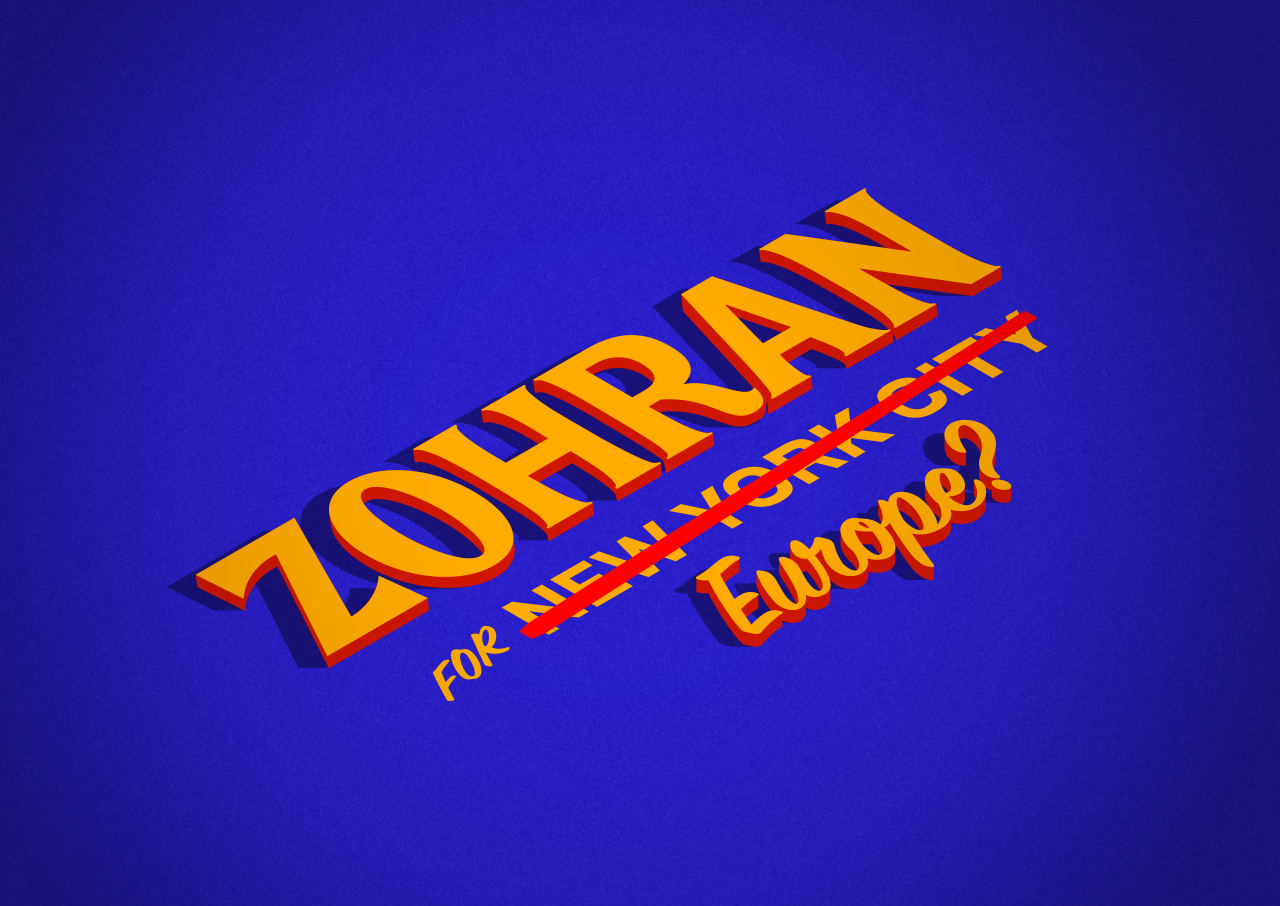
An unlikely mayoral victory in New York City is rippling across the Atlantic, as Europe’s left looks to Zohran Mamdani’s grassroots surge for clues on how to confront rising inequality and the far right.
By Paul Caron — United States Correspondent
Reviewed by: Kristóf Hermann and Francesco Bernabeu Fornara
December 29, 2025 | 19:30
How did an unknown 34-year-old Muslim democratic socialist, Zohran Mamdani, win the mayoralty of America’s largest city? That question has drawn some of Europe’s most prominent left-wing parties to the city that never sleeps, eager to understand his unlikely rise. Party strategists from France, Germany, and Britain have crossed the Atlantic to see whether what some are calling the “Mamdani Effect” might be replicated in their own national elections.
Who is Zohran Mamdani, and how does his win affect Europe?
A City Caught in a Moment
The mayoral race had New York City in a trance this past fall. As a Brooklyn resident, it became nearly impossible to walk a single block without encountering Mamdani’s charismatic smile, splashed across blue-and-yellow campaign signs in apartment windows and on street corners. The race followed me everywhere. Into dinners, bars, and museum rooftops, with each conversation circling back to Mamdani’s sudden rise and what his candidacy might signal for the city’s future.
Some supporters spoke with unfiltered enthusiasm, wearing “Hot Girls for Zohran” shirts, saying he represented a new hope for New York’s long-standing problems. Others were far more skeptical, voicing fears about the city’s future should he become mayor. My social media feeds were flooded with viral street interviews racking up millions of views, late-night speeches delivered over DJ booths in Bushwick clubs, and my apartment door filled with flyers from tireless canvassers.
Mamdani’s rise was meteoric, capturing attention far beyond New York City. Members of Congress and even the President publicly weighed in on the race. Fellow self-described democratic socialist heavyweights, including Bronx Congresswoman Alexandria Ocasio-Cortez and Senator Bernie Sanders, rallied behind Mamdani at events across the city.
Yet Mamdani also became a rare point of consensus among political opponents: fear. Republicans and Democrats alike attacked his Muslim identity during a period of heightened Islamophobia, his relative youth and limited executive experience, and his identification as a democratic socialist. The President repeatedly questioned Mamdani’s citizenship and even threatened deportation through ICE. Others took his proposals out of context, falsely tying him to foreign governments he never cited as models. The familiar American scare tactic of branding him a “communist”, a label Mamdani has never identified himself as, was deployed frequently. Billionaire grocery magnate John Catsimatidis, for example, warned that Mamdani’s policies would “drag us down a path toward the bread lines of the old Soviet Union.”
Despite these attacks, Mamdani’s campaign became one of the most successful grassroots political efforts in the city’s history. Though heavily outspent, raising roughly $17 million to Andrew Cuomo’s $55 million, Mamdani surged from relative obscurity to defeat the former New York State governor by more than 200,000 votes. I still remember hearing the roar from inside crowded bars from my Brooklyn residence that engulfed the city shortly after his win. Their roar has reverberated not only in Brooklyn but also increasingly around the world, particularly in Western Europe.
The European Left Flocks to the Big Apple:
Almost immediately, Mamdani’s win became a subject of intense study for European left-wing parties seeking to reconnect with voters after the rise of the far right in recent years. They sought not merely to observe from afar, but to actively engage, crossing the Atlantic to understand the machinery and message behind the victory.
- In France, Manon Aubry, co-chair of The Left in the European Parliament, canvassed alongside Mamdani’s volunteers in the campaign’s final days. She championed his push for “radical change” as a model. Similarly, France Unbowed MP Claire Lejeune called the victory a “beacon of hope,” with her party sending delegations to New York to study the campaign’s methods.
- In Germany, the anti-capitalist party Die Linke dispatched officials to meet with Mamdani’s strategist. Liza Pflaum, from the office of Die Linke’s co-chair, noted, “He offers a concrete vision of how people’s lives can actually be improved… people have begun to feel hope again.” This sentiment is being translated into local strategy; Heidi Reichinnek, a party co-leader, stated their upcoming campaigns will mirror Mamdani’s focus on “rent freeze, free and fast buses, free childcare.” Berlin mayoral candidate Elif Eralp explicitly cites Mamdani as an inspiration for her platform.
- In Britain, Green Party leader Zack Polanski highlighted the victory’s global resonance, stating it matters because it’s “about improving people’s lives and recognizing the inequality that lies at the heart of New York, and frankly, much of the world.”
The transatlantic appeal is clear. As Jan van Aken of Die Linke put it, “The problems people in New York face are very similar to those we hear about at people’s doorsteps here in Germany.” Together, these reactions help explain why Mamdani’s victory has resonated so strongly across Europe. His campaign relied less on abstract ideology and more on a populist, material message rooted in everyday economic pressures. From New York to Berlin, left-wing movements are now actively engaging with Mamdani’s message, adapting it to their own message at home.
A New Hope
Can European leftists replicate Zohran Mamdani’s success at home? In some places, elements of his campaign style and political message already appear to be taking root. In the Netherlands, for example, many observers have drawn comparisons between Mamdani and incoming Prime Minister Rob Jetten. Like Mamdani, Jetten represents a generational shift: he became both the youngest and the first openly gay prime minister in Dutch history. Both are Millennials who defeated more established political figures, aided in part by viral social media moments particularly on TikTok that propelled them into the national spotlight.
Substantively, the parallels extend beyond style. Like Mamdani, Jetten ran on affordability, centering his campaign on the housing crisis and cost-of-living pressures without resorting to the racist and inflammatory anti-immigrant rhetoric that has become common in right wing political circles across Europe and the US. While Jetten’s policy platform remains more centrist than Mamdani’s, stopping short of proposals like free public buses or rent freezes, the similarities in their meteoric rise, charisma, and appeal to younger voters are difficult to ignore.
Elsewhere across Europe, left-wing parties appear to be gaining momentum, particularly in 2025, amid growing pushback against far-right movements.
In Ireland, independent left-wing politician Catherine Connolly won the October 2025 presidential election by a landslide, securing over 63% of the vote. Her victory was widely interpreted as a rebuke to the incumbent center-right coalition and served to energize a previously fragmented left-wing opposition.
Norway offered a different but equally notable signal. In September 2025, the center-left Labour Party, led by Jonas Gahr Støre, won a second term in government, with a path toward forming a narrow majority coalition. The victory demonstrated that social democratic parties can still prevail electorally despite the simultaneous rise of right-wing populism across the continent. Germany has also seen renewed energy on the left, possibly as a response to the far-right AfD in the nation. Die Linke staged a comeback in the February 2025 elections, recovering ground after a period of internal division and declining support.
Taken together, these few examples of many prove how Mamdani’s victory was not an isolated anomaly, but part of a broader shift taking shape across Europe. While local contexts differ, the underlying frustrations, rising costs, and housing insecurity are strikingly similar. For European leftists, Mamdani’s win has become less a blueprint than a proof that bold, youth-driven campaigns centered on material concerns can still break through, even in crowded and right-wing political landscapes. It is one day my hope that I will see the same iconic blue and yellow street sign in an apartment window on my next trip to Europe.
Disclaimer: While Euro Prospects encourages open and free discourse, the opinions expressed in this article are those of the author(s) and do not necessarily reflect the official policy or views of Euro Prospects or its editorial board.
Write and publish your own article on Euro Prospects
Subscribe to our newsletter – stay informed when we publish articles on pressing European affairs.